
What actually is ‘The Dakar’?
Put simply, it is the toughest rally raid on the planet – and completing it earns the respect of anyone who understands motorsport. Very few people make it to the finish, so those who do belong to off-road racing’s elite: the Delta Force/SAS of the discipline. A genuine travelling circus of endurance competitors, it spans numerous classes, from cars and classics to motorcycles and trucks, all trying to cover an unforgiving route in the fastest possible time.
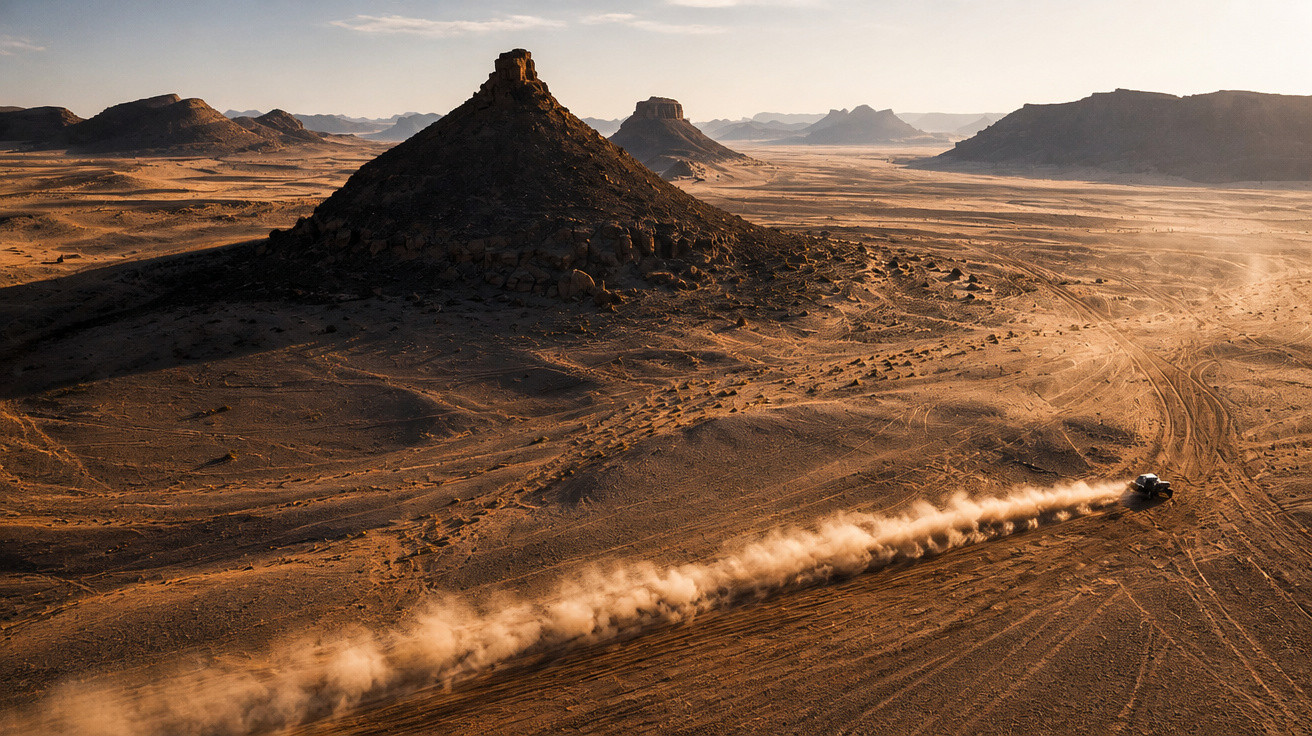
That sounds straightforward, until you consider that the ‘course’ covers thousands of kilometres of vehicle-destroying terrain: dunes, dangerous rocks, horrific off-road sections, mud, unexpected canyons and dirt. Individual stages can stretch beyond 500 miles (800 km) in a single day. This is not an event for the faint-hearted, or for anyone with flimsy dampers. Alongside the Baja 1000, it is probably the best-known enduro event in existence. Originally named Le Rallye Paris-Dakar, it began in 1978 as a journey from Paris to Dakar, Senegal, exactly as its title implied. It has since relocated, and now takes place in Saudi Arabia, but its famous name remains.
There’s a hometown hero in the running in ’26 – in a new category
You might assume an event like the Dakar would be natural territory for a brand such as Defender. Yet 2026 marks Defender’s first official entry, and it appears to be approaching the challenge with considerable intent. Its weapon is the most extreme Defender 110 on Earth: the Defender Dakar D7X-R.
It will race in the updated ‘Stock’ category, intended for vehicles closely based on production models, using standard engines, gearboxes, drivelines, bodywork and chassis. In other words, it is a class designed to prove the capability of a car you could genuinely drive along a high street. Defender’s starting point is admittedly the already wild 4.4-litre V8 Defender OCTA, but aside from a vast fuel tank, upgraded suspension and safety equipment, it is remarkably close to the vehicle available to buyers.
The prospect has even persuaded ‘Mr.Dakar’ Stephane Peterhansel to return to Dakar competition, which probably says everything required.
So how does it stack up in 2026?
The 48th edition of the Dakar follows a colossal 8,000km loop. Scrutineering takes place on 1st and 2nd January in Yanbu, a Red Sea city north of Jeddah. The opening ceremony and ‘prologue’ are scheduled for the 3rd, while the rally begins in earnest on the 4th.
The route passes through Alula, Hail, Riyadh, Wadi-Ad-Dawasir, Bisha and Al Henakiyah before returning to Yanbu, with every location presenting a new form of misery for the competitors. Weather is another complication. Anyone expecting uninterrupted sunshine and sand is mistaken: rain, mud, sandstorms and a range of near-natural-disaster-style surprises can all feature. Nights can be properly cold, while daytime temperatures can reach 45-degrees Celsius.
A rest day is held in Riyadh on the 10th, before the final podium ceremony on 17th January. Everything between those dates is where the suffering takes place.
What about the other runners and riders?
For 2026, 325 vehicles are entered across a huge variety of wheel counts and wheelbases. Categories include Challenger class, for purpose-built lightweight buggies; SSV, for production side-by-sides; T1 Ultimate, for tube-chassied beasts with minimal design restrictions; quads; trucks; Stock, covering factory-derived cars such as the Defender Dakar D7X-R; Dakar Classic, for older machines meeting a specific 1980s and ‘90s cut-off, where endurance matters more than outright pace; and Mission 1000, for carbon-neutral and emerging technology.
There are also around 118 motorcycles, which always appear to be the least sensible possible way to tackle the Dakar. Their riders are, quite plainly, mad.
What makes it so hard?
The Dakar’s defining quality is its total lack of mercy. It involves thousands of kilometres and more than 80+hours of competitive driving, on top of travelling between stages on public roads, where competitors must still obey ordinary traffic laws. Settling down after 12hours at race speed through the desert is no easy task, and adrenaline is a quiet killer. Stage 6 alone covers 925km, including 336km timed against the clock – effectively a conventional rally in its own right.
The real mental breakers, however, are the two-day marathon stages, 4 and 9. External help is forbidden, leaving crews to repair and maintain their own vehicle throughout a 48-hour racing period. At 4pm, they stop at a prescribed ‘bivouac refuge’, receiving the modest luxury of a mattress, sleeping bag, tent and food ration for dinner and breakfast – and nothing more. Racing resumes at 7am, although sleep is unlikely if something needs repairing. And something will need repairing. One of Dakar’s greatest threats is not the landscape; it is fatigue.
Saying that – it’s easier for the crews to rest in 2026
That is not to suggest the ’26 Dakar will be any less traumatic than previous editions, but the event has been arranged with slightly greater consideration for genuine rest. Now in its seventh year in Saudi Arabia, the organisers have simplified the operation somewhat, because the logistics of an 8,000km rally are, understandably, complicated.
The port city of Yanbu serves as both start and finish, while six bivouacs sit in the open desert and another is located in Riyadh, where the rest day offers a brief pause. There are also four ‘loop’ stages. These still allow competitors to batter themselves against the terrain, but mean teams and support crews do not have to relocate every single day, reducing the strain on transport operations.
Is it really that bad?
A new 2026 arrangement introduces ‘Mid-Stage Service’ points, specifically intended to help more entrants reach the finish, because Dakar’s attrition rate is brutally high. Last year, just 175 vehicles completed the event from a starting field of 335.
Dakar’s particular problem – and appeal – lies in its combination of extreme distances and terrain, relentless physical and mental punishment, technical and navigational tests, and the constant risk of mechanical failure. There is also the certainty that sand will find its way into places where sand does not naturally belong. Add the heavy emphasis on self-reliance and the marathon stages, and the result is a recipe for quiet tears and mild PTSD.
How do they work out who’s winning?
GPS, substantial amounts of mathematics and, quite possibly, more than a few stopwatches. The Dakar runs one stage each day, including at least one on- or off-road ‘special’ stage, and unfolds over a couple of weeks rather than the usual two or three days of a less punishing rally. The overall running order is determined by times recorded on special stages, minus any sporting penalties – such as being caught speeding on road sections.
Navigators are not merely passengers, either. They use a GPS beacon and roadbook, but the route is handed out only shortly before each stage begins, keeping it secret until the last possible moment. Waypoints must then be checked off to ensure nobody takes an opportunistic shortcut. Nor can crews simply follow the tracks ahead: a) they may not be heading in the correct direction, or b) they may lead into a ravine. On top of the person whose tracks you were following.
2026 has new rules
This year, some starts are genuinely split to prevent competitors from following motorcycle tracks. Organisers believe the use of slightly different – but equally dangerous – routes will reduce risky overtaking, increase the cars’ ‘daylight driving’ time, as bikes would often start first, and favour the strongest navigators in the car and buggy categories.
Competitors also cannot deliberately ease off on one day to secure a later start and a clearer route the following day. The split starts are arranged as two consecutive pairs, meaning time gained on day one is surrendered on day two.
Is it a one-off?
It is certainly distinctive, but the Dakar also opens the year-long World Rally Raid Championship (W2RC), in which Defender is competing as well. Since 2022, the series has brought together the finest off-road rally raid competitors as they travel around the world chasing points and finding new ways to break themselves and their machines against different anvils of terrain.
Because the Dakar is so lengthy and demanding, it counts for double points in the championship, making a strong result especially valuable.
Who would you bet on?
Once a driver has become very, very good at rallying, competing in the Dakar can feel almost inevitable, as it represents the peak of the format. The entry list has included plenty of familiar names: Didier Auriol, Colin McRae, Jacky Ickx, Carlos Sainz (the OG), Ari Vätanen, Nasser Al-Attiyah, Juha Kankkunen and Sebastien Loeb.
One man is an undeniable legend, though, and he is driving for Defender in its first official Dakar campaign: Stephane Peterhansel, better known as ‘Mr.Dakar’. Or, more accurately, ‘Monsieur Dakar’. He has won the event 14 times – six times on motorcycles during the ‘90s and eight times in cars, most recently in ’21 aboard a Mini JCW buggy.
This year, he races the new Defender Dakar D7X-R in the ‘Stock’ class, so it is essentially a Defender OCTA with Dakar-specific modifications. It will not be the outright fastest vehicle in the field, but it is as close as anyone can get to contesting the Dakar in a car they can actually buy. That feels like a moral victory before the rally even starts. And if anyone can make it work, Peterhansel can.
Defender OCTA | Master of Extreme Performance, Everywhere

Comments
No comments yet. Be the first to comment!
Leave a Comment