
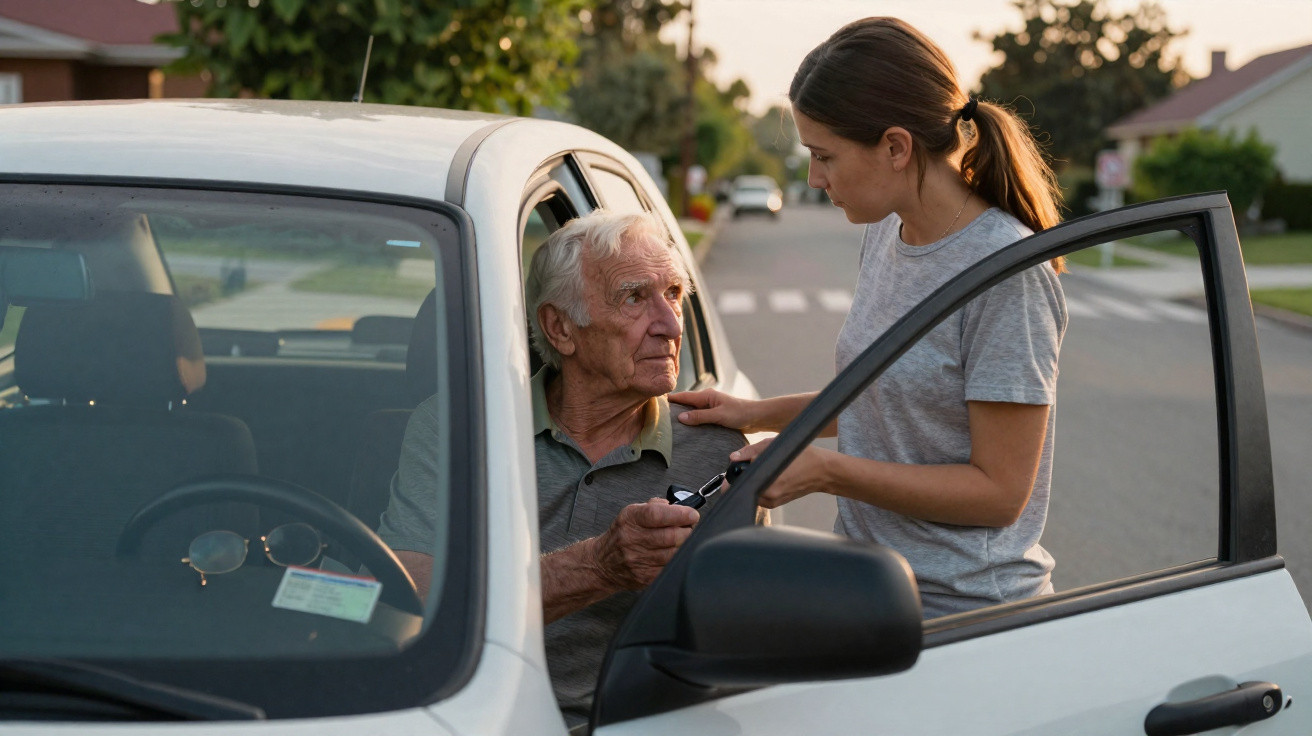
The ageing Peugeot stalled as the lights turned green. From the back of the queue came a burst of sharp, impatient horns. At the wheel, a man in his late seventies bent towards the dashboard, peering at it while one unsteady hand fumbled for the gear lever and the other gripped the steering wheel too tightly. His anxiety seemed almost visible through the windscreen. By the time he pulled away, hesitantly and with a jolt, the lights had already changed to amber and he caught only the final seconds of the phase.
Watching from the pavement, we felt both concern and annoyance.
Somewhere between those reactions lies an uncomfortable question.
When driving stops being freedom and becomes a risk
There is an odd point at which you realise that your own parents are now the “elderly drivers” you once grumbled about.
The indicator left flashing for kilometres. A delayed response at a roundabout. Small marks from parking mishaps that they cannot recall.
Their licence remains valid on paper. Behind the wheel, though, they can suddenly appear vulnerable.
For countless families, this is where the argument starts: are they still safe to drive, or are we simply hoping that nothing goes wrong?
Nobody is ever truly ready for that discussion.
Consider Mary, an 82-year-old from a small town near Manchester. For her entire life, she drove the same familiar journey: home, the supermarket, the GP, church. She knew every pothole along the way. Then, on one winter evening, she misjudged a crossing and struck a cyclist. It happened at low speed and nobody died, but it still changed everything.
She had passed her most recent medical examination. Officially, her eyesight met the standard. She was travelling below the speed limit. But once her children viewed the dashcam footage, they understood what had happened. The space Mary believed she had seen between the car and the bicycle was never there.
For the family, it was no longer an abstract concern.
Growing older is not like a switch being flicked; the changes arrive gradually. Reaction times lengthen, night vision weakens and dealing with several tasks at once becomes tiring. A distraction that a 40-year-old might dismiss can cause a 78-year-old to panic.
Traffic today is also quicker and more complicated than the roads on which many older people first learned to drive. Lane markings are more crowded, signs are more numerous and fellow motorists can be more aggressive.
That creates a difficult paradox: older drivers generally cover fewer miles and take fewer chances, yet when collisions occur, the consequences are more likely to be serious for both them and others. The evidence is not straightforward, but the concern is clear.
Age limits or skill checks: what actually keeps roads safe?
The most blunt solution appears straightforward: licences would automatically expire at a particular age.
There would be no further tests, no continuing arguments and no uncomfortable family disputes. At 75, 80 or whichever age legislators chose, you would surrender your licence, full stop.
In safety terms, it may look tidy. In political terms, it is explosive.
A driving licence is not merely a plastic card. It represents independence, dignity and the ability to choose when to go out and when to return home. Removing it overnight does more than reduce risk; it shrinks the boundaries of someone’s life.
A number of countries already use tougher measures. In Japan, drivers over 75 who commit certain offences must undergo cognitive testing. In Denmark, older motorists must renew their licences regularly with a medical certificate. Several Canadian provinces require older drivers to take road tests after particular incidents.
When such arrangements are effective, they are usually focused rather than indiscriminate: not every 80-year-old is labelled “unfit”, but anyone beyond a certain point receives more frequent assessments. The focus is less on age than on capability.
Most experts tend to favour the same approach: routine, objective assessments rather than a fixed automatic cut-off.
In truth, few people want to say, “You’re too old to drive now.” Families avoid raising it. Doctors may feel it falls outside their role. Authorities are wary of appearing discriminatory. As a result, the choice is often left to the person least able to judge it objectively: the ageing driver.
A more sensible system would share that responsibility. It could include regular eyesight checks, cognitive screening and brief practical drives on real roads, all conducted respectfully.
Not as a penalty, but as a check on reality.
After all, a 68-year-old with excellent eyesight and quick reflexes may be much safer than a distracted 45-year-old staring at their phone.
How to discuss driving licences with ageing parents
Before debating legislation or age thresholds, it is important to start with day-to-day life.
If an older relative’s driving concerns you, begin with modest, candid observations. Recommend avoiding driving at night or on busy dual carriageways. Offer to take care of long motorway journeys. Occasionally sit in the passenger seat, not to monitor them, but to provide a calm perspective.
You could gently ask, “Do you still feel comfortable on this route?” Then pause and listen.
Many older people already sense the pressure. Allowing them room to acknowledge it may work better than confronting them with a final judgement.
The worst approach is to make the discussion feel like a prosecution. Statements such as “You’re dangerous” or “You’re going to kill someone” produce shame and defensiveness. The licence then becomes a symbol in a battle, rather than an issue of safety.
Instead, concentrate on specific problems: missed signs, confusing junctions or near-misses they have described. Connect the conversation to practical answers, not only to limitations.
Sharing a car with relatives, taxi vouchers, community transport and online shopping for heavy groceries can each remove a reason to stay behind the wheel at all costs.
You are not removing freedom; you are reshaping it.
At times, an outside opinion has greater influence than family conflict.
“Losing my licence felt like losing my last bit of authority,” a retired teacher told me. “But when the doctor explained I might not stop in time if a child ran out, I knew I couldn’t live with that risk on my conscience.”
- Bring up the issue early, before an accident makes it unavoidable.
- Ask a GP or optician to speak openly about whether they are fit to drive.
- Propose a voluntary driving assessment with an instructor.
- Begin with restrictions, such as no night driving or motorway driving, rather than an outright ban.
- Look into transport options together, so they feel included rather than pushed aside.
Beyond driving licences: what sort of roads should we share?
Remove the bureaucracy and a more personal issue comes into view.
This is not solely about older drivers; it concerns how society responds to ageing. Are we willing to adapt our towns and cities, public transport and expectations so that losing a licence does not feel like losing one’s place in the world?
Some places are already trying different approaches: flexible on-demand shuttles, lower-cost ride-hailing vouchers for older people and safer crossings with longer green-light phases. Small changes like these can shift the feeling from “I have to drive” to “I can cope without it.”
The question of an age cut-off conceals a deeper difficulty.
All of us are moving, gradually, towards that vulnerable moment at the traffic lights, where freedom and danger occupy the same seat.
| Key point | Detail | Value for the reader |
|---|---|---|
| Ongoing fitness checks are better than rigid age limits | Regular eyesight, cognitive and practical driving assessments focus on ability rather than dates of birth | Provides a fairer, safer approach than automatic licence withdrawal |
| Start the family discussion early | Raise worries before accidents occur, using clear examples and practical alternatives | Makes the move away from driving less harsh and more cooperative |
| Mobility options alter the entire debate | Improved public transport, community journeys and digital services reduce reliance on cars | Helps older people retain independence even without a licence |
FAQ:
- Question 1 At what age should we begin reassessing driving licences for older people? Many experts recommend starting at about 70, with checks becoming more frequent over time. The precise age matters less than a consistent system based on ability.
- Question 2 Is withdrawing licences on the grounds of age discriminatory? Blanket restrictions based solely on age are widely regarded as discriminatory. Systems based on medical and practical assessments are much easier to justify ethically and legally.
- Question 3 Which signs suggest an older driver may no longer be safe? Repeated minor collisions, becoming lost on well-known routes, a new fear of driving at night, confusion at junctions or relatives feeling unsafe as passengers are significant warning signs.
- Question 4 Can older drivers improve their skills rather than surrendering their licence? Yes. Refresher sessions, practice on unfamiliar routes and honest medical checks can extend the years in which they drive safely. The essential factor is being receptive to feedback and restrictions.
- Question 5 What happens if a parent refuses to stop driving despite obvious risks? This is among the most difficult situations. You may involve their doctor, suggest an official assessment, change insurance arrangements or, in extreme circumstances, notify local authorities. The aim is not punishment, but preventing a tragedy.





Comments
No comments yet. Be the first to comment!
Leave a Comment