
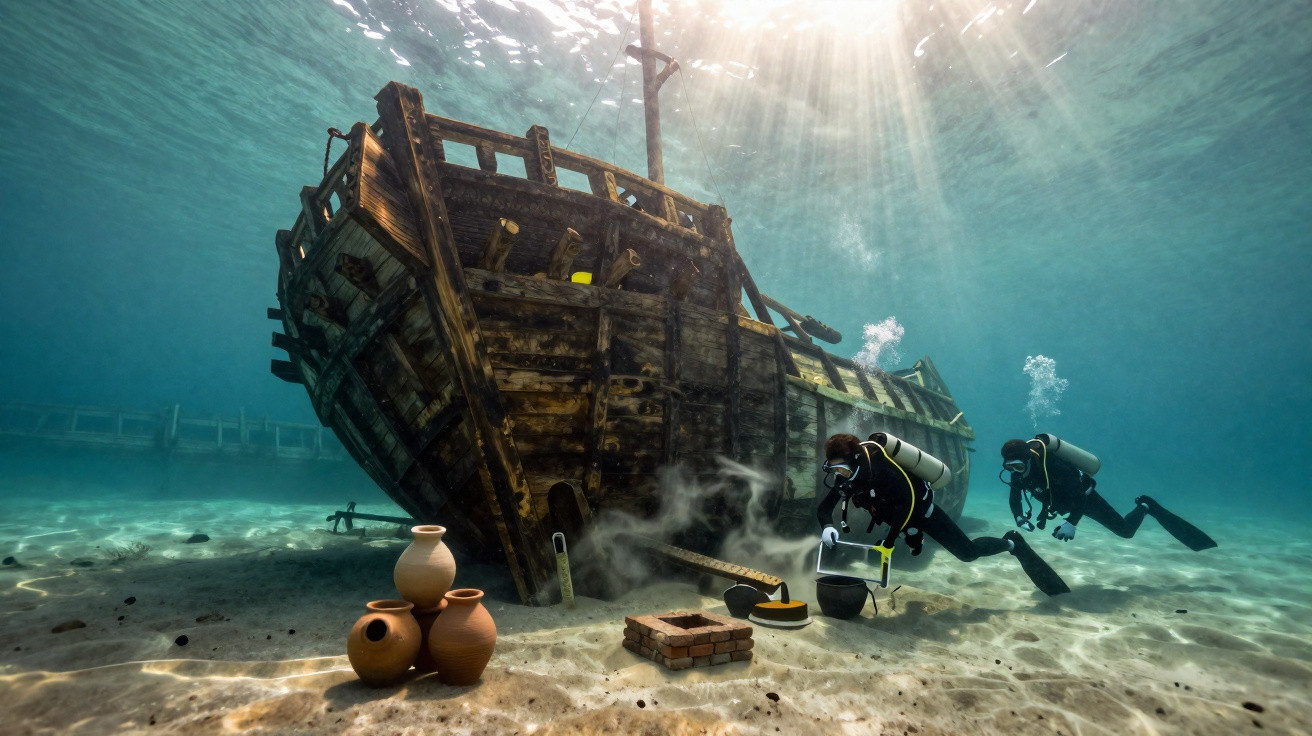
Divers working near Copenhagen have revealed a medieval cargo ship measuring roughly 28 metres long. It is now the biggest known vessel of its type.
Discovered during harbour surveys for Lynetteholm in Denmark’s Sound, or Øresund, the 600-year-old wreck is called Svælget 2. It retains unusual sections of its upper structure.
Underwater archaeological work
Marine archaeologists from Denmark’s Viking Ship Museum took part in the Lynetteholm seabed investigations in the Sound, operating from a research vessel.
Otto Uldum, a maritime archaeologist responsible for underwater excavations and research into ship outfitting, led the project.
His work involves recording medieval shipbuilding techniques from preserved timbers and connecting this evidence with the practical realities of sailing.
Using suction equipment, divers removed sand without damaging the wood fibres, enabling the team to chart the cargo ship’s hull where it lay.
Svælget 2 and bulk trade
This type of vessel is known to historians as a cog: a wide cargo ship constructed to transport bulk freight.
Shipbuilders typically used one mast carrying a square sail, while the flat-bottomed hull allowed the vessel to rest in shallow harbours.
With a width of around 9 metres, the wreck’s hold was built to carry approximately 300 metric tonnes of cargo.
Its combination of capacity and stability enabled regular transport of ordinary materials, rather than only luxury items, over lengthy routes.
Rare surviving rigging
Lying at a depth of about 13 metres, the wreck was beyond the reach of storm waves that commonly destroy wooden hulls.
A dense covering of sand and silt reduced oxygen around the planks, slowing the microbes that would usually consume waterlogged timber.
The preserved rigging - the ropes and fittings used to control sails - includes uncommon blocks and tensioning components intended for major voyages.
“It is extraordinary to have so many parts of the rigging,” said Uldum.
Tree rings reveal timber origins
By using dendrochronology to compare tree rings with regional sequences, researchers dated the oak timbers to about 1410.
A tree produces one growth ring each year, and comparisons between ring sequences can establish when a plank was felled.
The analysis found that the planks originated in Pomerania, now part of Poland, whereas timber for the internal frames grew in the Netherlands.
These origins point to an organised supply chain, as builders needed to obtain substantial oak timbers from widely separated areas before construction could begin.
Trade networks behind the scale
Operating a cargo ship of this size depended on reliable purchasers, credit arrangements and port facilities capable of loading and unloading bulk goods.
By the early 15th century, the Hanseatic League connected merchant towns and maintained the movement of goods through important Baltic ports.
By applying shared trading rules across cities, the network made cargo sales more dependable for investors.
“Svælget 2 is a tangible example of how trade developed during the Middle Ages,” said Uldum.
Evidence of everyday life aboard
Cargo is usually lost after a vessel sinks, and no trade goods from Svælget 2 have survived so far.
Leather and wood can endure when kept wet and sealed, since drying allows oxygen to accelerate deterioration.
Archaeologists working on Svælget 2 recovered shoes, a wooden comb and painted ceramic bowls that had once been used around mealtimes.
Even without cargo or the names of the crew, these discoveries give the story a human dimension.
A stern castle emerges
Timbers at the wreck’s rear define a stern castle, an elevated deckhouse that provided shelter for crew members at the back of the ship.
Since most wrecks retain only their lower sections, upper features such as this generally disappear when waves tear them away.
Uldum said stern castles had previously been known mainly through artwork, while this wreck provides about 20 times more wood for examination.
The additional material allows researchers to assess how the structure bore weight and kept out spray, rather than relying on interpretations of illustrations.
Preparing food at sea
Close to the centre of the wreck, archaeologists found a brick galley, a compact cooking space incorporated into the ship.
The galley contained around 200 bricks and 15 tiles, with the masonry preventing heat from scorching the surrounding planks.
Bronze and ceramic cooking vessels were found beside the hearth, indicating that crew members could prepare hot meals while at sea.
“It speaks of remarkable comfort and organization on board,” said Uldum, pointing to evidence of planned cooking and onboard discipline.
After the excavation
Once a hull has been recorded, teams commonly create a digital archive before lifting any part of it, as underwater timber can disintegrate.
Researchers used photogrammetry - the creation of 3D models from numerous overlapping photographs - to measure the timbers without repeatedly handling them.
This documentation helps conservators prepare supports because, when waterlogged timber dries, its cells can collapse and distort as they shrink.
For Svælget 2, secure storage and detailed analysis will matter as much as excavation, because many of the answers are contained in small details.
A ship linking different worlds
Svælget 2 brings together hull design, intact rigging and everyday objects with the commercial systems that funded large-scale medieval shipping.
Future research will rely on preserving the timber and publishing complete measurements, since one wreck cannot stand for every port.
Information from a press release by the Viking Ship Museum.
Photograph courtesy of the Viking Ship Museum.






Comments
No comments yet. Be the first to comment!
Leave a Comment