
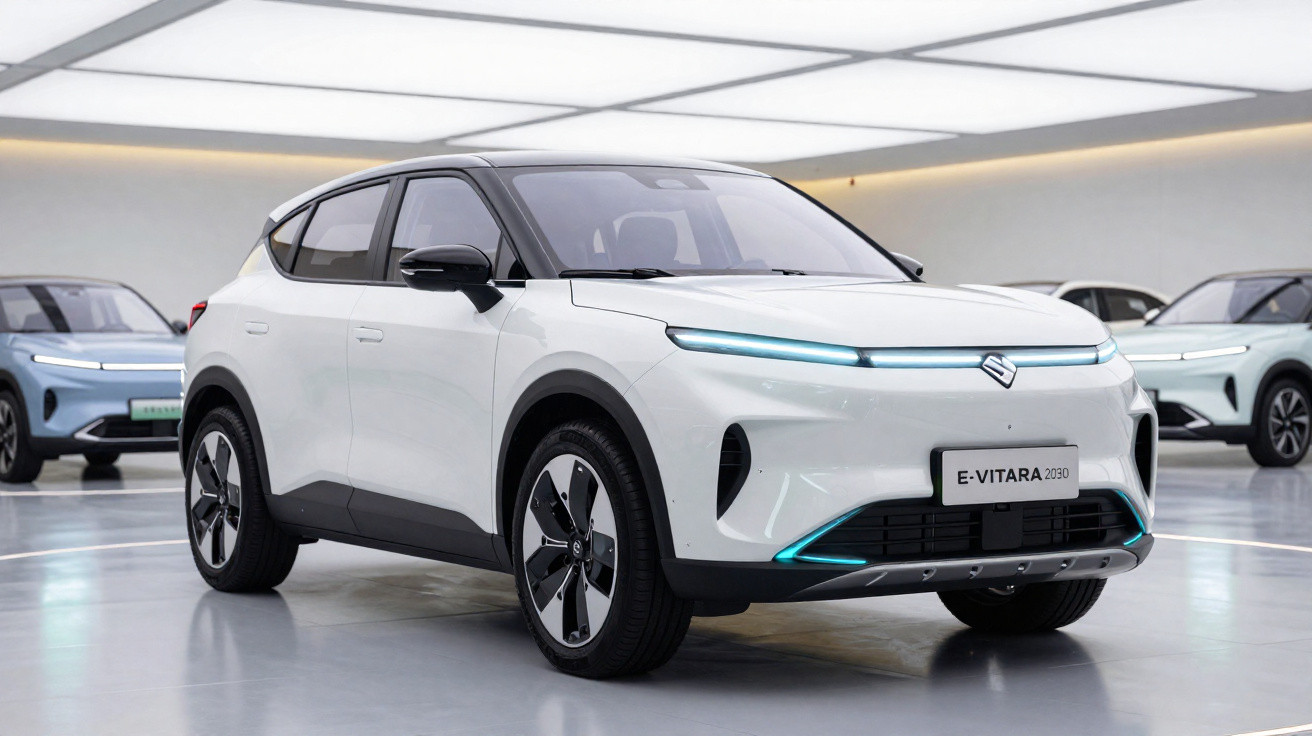
Suzuki was certainly not among the first manufacturers to jump on the “electric car bandwagon”. By the time it did, many of its rivals already offered several models powered solely by electrons.
That wait is now over with the e Vitara, Suzuki’s first-ever fully electric car and the first member of a family set to expand over the coming years.
Do not expect an avalanche of EVs, however. Suzuki is retaining a cautious strategy and has even scaled back its own targets: while its 2023 plan called for five electric models in Europe by 2030, the latest roadmap specifies four. Its other electrified vehicles, from mild hybrids to plug-in hybrids, are still far from being phased out.
The e Vitara has opened the door
The e Vitara has already arrived in Portugal, facing the challenging task of establishing Suzuki in one of the market’s most fiercely contested sectors: compact electric SUVs.
Pricing is not its strongest opening move. The range starts at just over €36,000, putting it above several competitors.
In return, it comes with a reasonably broad line-up. Battery options include 49 kWh and 61 kWh units, outputs range from 106 kW (144 hp) to 135 kW (184 hp), and WLTP range reaches up to 426 km.
It also offers something uncommon among rival models: all-wheel-drive versions, made possible by a second electric motor on the rear axle. This does not turn the e Vitara into an electric Jimny, but it gives it off-road ability that few competitors can match. Read, or revisit, our first drive of the Japanese EV:
The next model will be much smaller
Suzuki’s second electric car will take an entirely different approach. Previewed by the Vision e-Sky, it will be a city car measuring around 3.4 m long.
The production version is expected in spring 2027, signalling Suzuki’s return to the European city-car market after the Ignis was discontinued in early 2025.
Technical details of the final model remain unknown. The concept claims a range of more than 270 km and retains the distinctly Japanese proportions of a kei car, with a tall, highly compact body.
Price is also expected to be one of its main selling points. David Kateley, Suzuki’s UK chief, has indicated a figure below £20,000 in that market, placing it directly against cars such as the Renault Twingo, the forthcoming Dacia Spring and Volkswagen ID. 1, which will be built in Palmela.
And there is still another to come
The next step is expected to arrive in 2029. Very little is known about Suzuki’s third EV, although all signs point to a B-segment SUV positioned between the small city car and the e Vitara.
One possibility appears to have been ruled out: it will not be an electric Swift. David Kateley has already confirmed that the brand’s best-known model will remain separate from this push, with Suzuki expected to continue relying on its hybrid powertrains and keeping the Swift outside this electric offensive.
There will still be one piece missing. The current plan includes four fully electric models in Europe by 2030, but Suzuki has yet to reveal the final one.


Comments
No comments yet. Be the first to comment!
Leave a Comment