
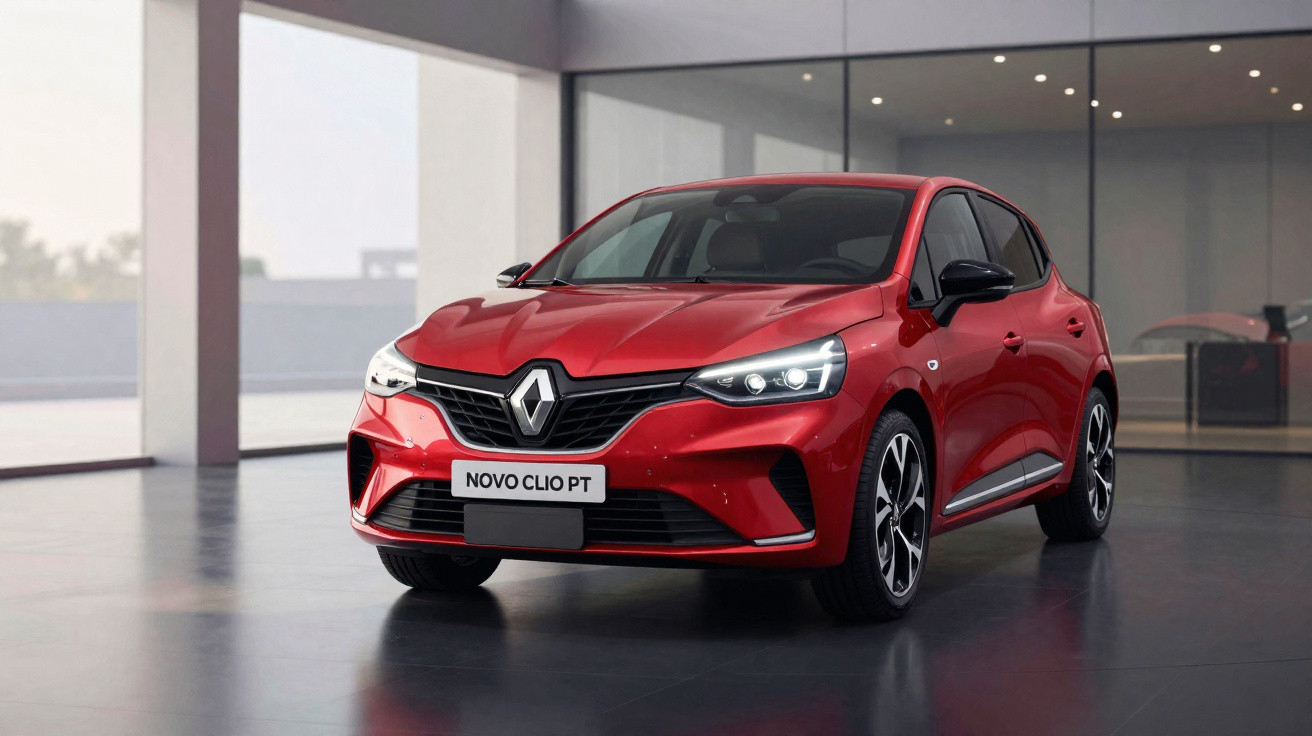
The new Renault Clio carries a formidable legacy: it has been Portugal’s best-selling car for the past 30 years.
You know the saying, “don’t change a winning team”? The French clearly do not, as they have redesigned the sixth-generation Renault Clio from top to bottom.
Virtually nothing remains from the previous Renault Clio generation (2020–2025). Its appearance has been completely transformed, the technology has taken a substantial step forward, and the bodywork has grown too.
In this video, I cover each of those changes. This first drive took place between Lisbon and Cascais, where the French brand presented the sixth-generation Clio to more than a hundred journalists from across Europe.
I can already reveal that it is not all good news. Portugal’s vehicle taxation will make life difficult for the Clio hybrid version:
A different exterior and a roomier cabin
As I mentioned in the video, the new Renault Clio has increased in every dimension. More importantly, though, its styling has changed dramatically. Some may argue that it has perhaps changed too much.
The rounded shapes that once defined its bodywork have been replaced by an aggression never previously seen on the new Renault Clio. Slim headlights, a prominent grille and a split rear light signature: it has a little of everything.
Fortunately, the interior also brings more of everything: more technology, more equipment and more room. While the exterior’s final result may be open to debate, there is no disputing that the new Renault Clio represents a clear advance over its predecessor inside.
The starting point was already strong - we had the chance to drive the previous generation very recently. However, the introduction of a Google-based infotainment system and extra work on cabin sound insulation have greatly improved the user experience in this new generation.
Better on the road
The steering is more direct and the handling has improved as well. The faster the pace, the more noticeable that progress becomes. Believe me, with 160 hp available to the “right foot”, it is very easy to travel quickly…
Unfortunately, at this presentation I was only able to test the new Renault Clio in E-Tech Hybrid form. It is the most powerful and the most economical version, but it has an obstacle ahead: Portuguese vehicle taxation. As I explain throughout the video, the country’s vehicle tax (ISV) heavily penalises this powertrain.
This Instagram Reel summarises the tax dilemma Portuguese buyers will face. It is a dilemma with a cost of more than €4,000.
Putting performance aside, let us turn to what matters most in a car in this segment: comfort. As noted above, cabin sound insulation has improved.
As for the comfort provided by the suspension, I honestly think the new Clio is very much on a par with the generation that has just ended its run. The remarkable part is that its dynamics have improved without harming a quality so appreciated in French cars.
You can tell that the Clio was born, educated and trained in the French school. That matters when it comes to the “school” of Portuguese roads…
How much does the new Renault Clio cost?
For Portugal, the initial range comprises three choices. At the entry point is the TCe 115 engine, available with either a manual gearbox or an EDC automatic. Next comes the 160 hp E-Tech Full Hybrid system. Another version will arrive in the middle of this year, perhaps the most interesting of them all: the LPG-fuelled ECO-G 120 EDC.
Prices start at €21,990. Here are the prices for every version of the new Renault Clio:
In equipment terms, the new Clio generation has been streamlined into three trim levels - evolution, techno and esprit Alpine - all of which, Renault promises, come with a very generous specification.
Even the entry-level version includes features such as adaptive cruise control, an electric parking brake with auto-hold function, a driver fatigue alert system, a 10.1-inch central display with Apple CarPlay and Android Auto, and rear parking sensors.



Comments
No comments yet. Be the first to comment!
Leave a Comment