
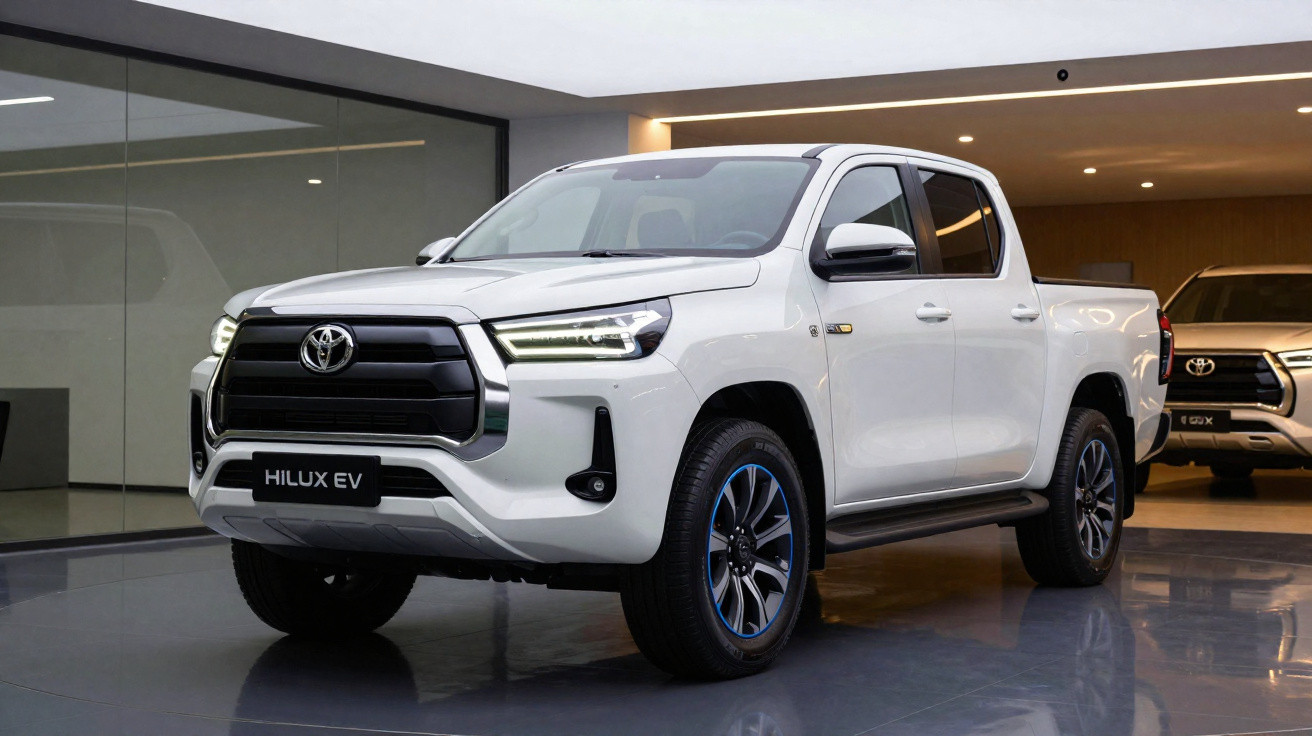
The Toyota Hilux is a little like the Portuguese: wherever you are in the world, you are bound to come across one. After the Corolla, it is the Japanese manufacturer’s second best-selling model in history. It is a genuine institution among pick-ups.
Perhaps that explains why Toyota took 10 years - yes, a full decade! - to introduce this new generation. Was it overly cautious? Possibly. Yet, from a technology perspective, this is the biggest leap in Hilux history. It is evident on the outside, in the cabin and, above all, in the details that are not immediately visible.
“Hilux does not follow fashions and it cannot fail,” Makoto Inoue, one of the people responsible for developing this ninth-generation model, told me at the vehicle’s presentation. Expectations are understandably high, although the competition is becoming increasingly fierce too.
New Toyota Hilux now 100% electric
There is no cause for concern. Diesel versions of the Toyota Hilux will remain available - more on those shortly. However, the headline news is unquestionably the arrival of a fully electric version. It is a first in almost 60 years of the model’s history.
It uses two electric motors, with one mounted on each axle, supplied by a 59.2 kWh battery that provides around 240 km of range (WLTP).
Combined output stands at 145 kW (197 hp). More significant, however, is the torque: the front motor produces 205 Nm, while the rear unit delivers 269 Nm. This is enough to provide permanent four-wheel drive and a towing capacity of up to 1600 kg.
When it comes to ground clearance, the Hilux BEV matches its combustion-engined siblings. Its range is a different matter. With 240 km available, this Hilux BEV will only suit highly specific jobs that do not involve covering substantial daily distances.
We have already driven it, and will shortly publish that test both on the Razão Automóvel website and on its YouTube channel. The drive took place at a test centre on the outskirts of Paris, away from prying eyes.
Land Cruiser-inspired interior and modern technology
Inside, the new Toyota Hilux makes an undeniable step up in quality. Its dashboard takes direct inspiration from the Land Cruiser, featuring straight lines, a new 12.3" central display, digital instruments and physical controls for the main functions - a deliberately practical decision.
There is very little missing from the cabin of this new Hilux, which is also better insulated and more comfortable. At the model presentation, we had the opportunity to try both the current generation and this new one and… the 10-year gap is noticeable.
But has all this added refinement compromised its working ability? According to Makoto Inoue, who led the development of this new generation, “that was never a possibility. We know very well what the Hilux’s role is in the global market”.
The new Hilux also introduces electric power steering (EPS), over-the-air updates, driver monitoring, safe exit assist and a new Toyota Safety Sense system featuring fatigue detection and automatic emergency braking.
Diesel engine remains part of the Toyota Hilux range
The BEV version may capture the headlines, but sales will continue to be led by the conventional diesel-engined Toyota Hilux. In the manufacturer’s words, “Diesel remains the most rational choice for heavy-duty work and long distances”, and every indication suggests it will be the best-selling version in Europe.
The 2.8 Turbo Diesel engine with 48 V mild-hybrid technology remains in the line-up, delivering 204 hp and a towing capacity of 3500 kg. There was never much chance of it being otherwise.
Toyota has also confirmed the arrival of a hydrogen-powered Hilux Fuel Cell, scheduled for launch in 2028. The prototype, which is already undergoing testing in the United Kingdom, shares its technology with the Toyota Mirai and represents another part of the brand’s energy diversification strategy.
The familiar workhorse, brought up to date
More than 21 million Toyota Hilux units have been sold since 1968. The new generation will be built in six countries and sold in over 180 markets - including Portugal - with its arrival expected during the first half of 2026.
As for pricing, we will need to wait a few more months to find out what to expect. However, the differences compared with the current generation are not expected to be substantial. After all, at its core, the new Toyota Hilux remains the same dependable workhorse it has always been. Fortunately, it is now more comfortable…
Comments
No comments yet. Be the first to comment!
Leave a Comment