
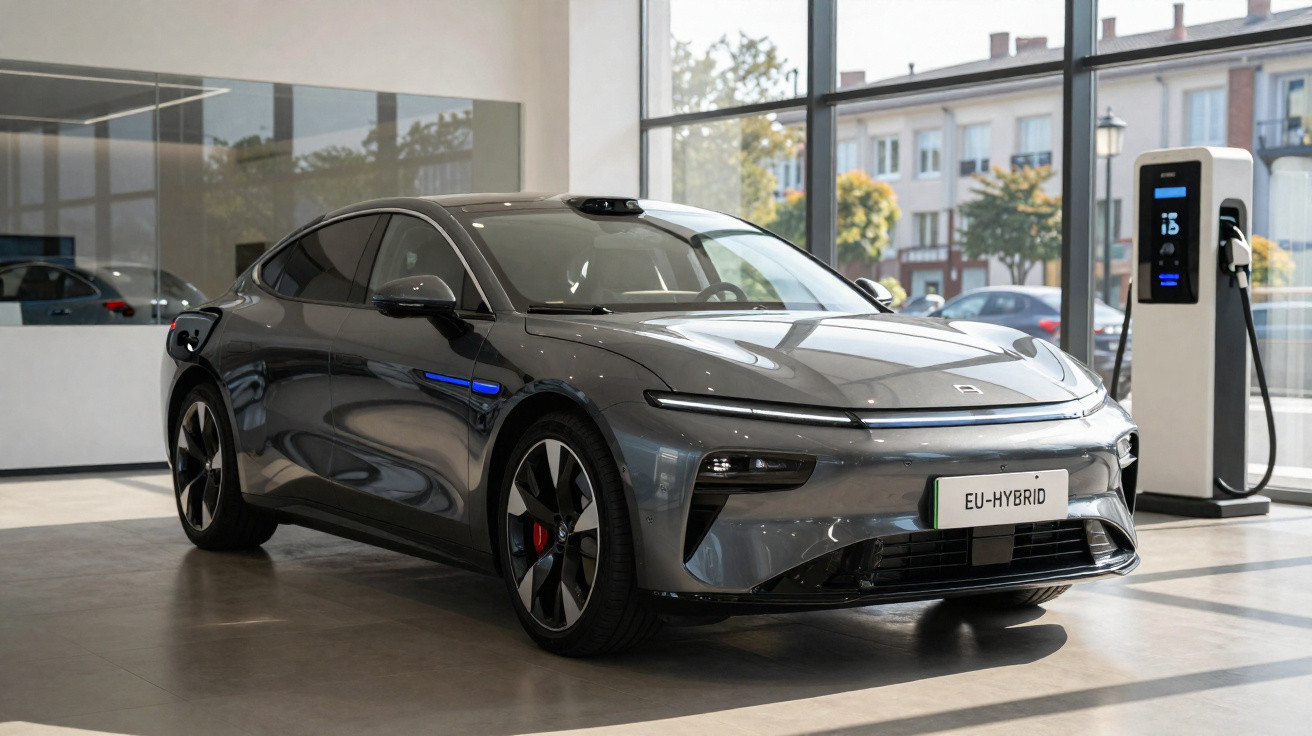
More and more manufacturers are promoting new electric cars with an integrated petrol generator – yet Brussels simply classifies them as hybrids.
A new type of vehicle has been appearing in European showrooms for several months: cars that look much like pure electric vehicles but also carry an internal-combustion engine intended to serve as an emergency generator. Marketing departments present them as the ideal answer to range anxiety. The EU, however, places them matter-of-factly in the same category as conventional plug-in hybrids – with noticeable implications for incentives, taxation and access to low-emission zones.
What lies behind range-extender cars
The engineering concept initially sounds appealing. In everyday use, the car runs solely on electricity. Once the battery is depleted, a small combustion engine starts up, drives a generator and recharges the battery. Under the concept, the wheels are powered exclusively by the electric motor.
Chinese brands in particular, including Leapmotor, are pushing this approach aggressively in Europe. They promise an “electric car plus a safety net”: drivers gain the benefits of an EV without worrying that the motorway charging point they need may be out of service.
The industry markets these vehicles as electric cars with a lifeline – the EU classifies them as ordinary plug-in hybrids.
In brochures, this can appear to offer the best of both worlds. In reality, however, two perspectives collide: that of the marketing teams and that of European regulators.
Why the EU legally regards them only as hybrids
For type approval purposes, Brussels does not differentiate between a plug-in hybrid (PHEV) and a car with a so-called range extender. Both are assigned to the same vehicle category, identified by the unwieldy abbreviation “OVC-HEV”, meaning an externally chargeable hybrid electric vehicle.
In effect, the EU is saying that it does not matter whether the combustion engine drives the wheels directly or “only” operates as a generator: for tax, emissions standards and CO₂ fleet targets, the vehicle counts as a hybrid. There is simply no separate classification for range extenders.
The key issue is that many buyers believe they are purchasing an almost fully fledged electric vehicle. Legally and for tax purposes, however, they are driving a hybrid. That can prove costly in several ways.
Specific consequences for buyers in Europe
Depending on the country, governments link incentives for “genuine” electric cars to clearly defined requirements. Typical criteria include:
- Minimum range in electric-only operation
- Maximum CO₂ emissions in the test cycle
- Maximum weight or price caps for purchase incentives
- Classification within local low-emission-zone or city-congestion-charge categories
Because range-extender cars are legally PHEVs, they are subject to exactly the rules intended for conventional plug-in hybrids. If a vehicle fails to meet the often strict thresholds, the incentive is withdrawn or reduced substantially.
Someone driving what they consider an electric car may ultimately face the same restrictions as the owner of an ordinary plug-in hybrid.
This is becoming increasingly important in major cities with low-emission zones or congestion-charge schemes. Some metropolitan areas plan to exclude conventional PHEVs from sensitive areas after a certain point, or at least treat them less favourably than battery-electric vehicles. Depending on how local authorities interpret the EU classification, a range extender may be caught by these rules without the buyer expecting it.
Technology: how does it differ from a plug-in hybrid?
There are genuine technical distinctions. A typical plug-in hybrid combines a combustion engine and an electric motor, with both able to power the wheels. Its battery is relatively small, usually 10 to 25 kWh. In everyday driving, that generally provides around 40 to 60 kilometres of electric-only range.
Range-extender cars, by contrast, use a more powerful electric drivetrain and a larger battery. Battery capacities commonly range from 20 to 40 kWh or more. Their electric-only range in the standard test cycle can therefore reach 80 to 100 kilometres, and sometimes more.
Ideally, the combustion engine functions solely as a generator. It recharges the battery or supplies electricity indirectly to the electric motor, but does not drive the wheels itself. Many engineers regard this as a clean electric drivetrain with a power station on board.
For the EU, the operating role of the combustion engine ultimately makes little difference. What matters is that a fossil-fuel engine is still present, burns fuel and can therefore produce emissions.
Promise versus legal reality
The difficulty lies in the detail: brochure and website terms such as “extended electric range” or “almost like an electric car” are highly appealing. The legal lens used by authorities does not recognise such shades of meaning.
Without a clearly defined threshold for battery size or minimum range, “range extender” remains a marketing term with no distinct legal basis. The advertising slogan may be compelling, but the type approval remains firmly hybrid.
Who may still benefit from these models
Despite this mismatch, these vehicles have a place. Anyone who drives fewer than 60 to 80 kilometres each day, can charge at home or at work, and makes longer journeys only occasionally can travel almost entirely on electricity in daily life.
In that situation, the range extender genuinely works as an emergency system: it starts only on holiday trips or when charging has been forgotten. Actual petrol consumption remains low, while local CO₂ emissions fall significantly.
In everyday use, a sensibly operated range extender can drive almost like an electric car – as long as the user charges it consistently.
It becomes problematic when drivers charge the vehicle infrequently and effectively keep the combustion engine running almost permanently. The supposed electric pioneer then turns into a heavy hybrid with correspondingly high consumption.
What buyers should check now
Anyone considering such a car should examine several points carefully before signing the purchase agreement:
- Clarity about the official EU category: If the specification sheet or vehicle registration document states “hybrid” or refers to the hybrid class, PHEV rules will generally apply.
- Checking incentive conditions in the buyer's own country: Many countries publish separate lists of models eligible for the full or reduced grant. These show whether the range extender is actually treated like an electric car.
- Real electric range: The official WLTP range offers guidance. Anyone travelling 70 kilometres daily should look for an official electric range clearly above 70 kilometres.
- Charging options: Without regular access to charging, the concept loses its purpose and running costs rise.
Buyers who ask directly about these points during test drives and sales discussions can avoid unpleasant surprises when reviewing a tax assessment or low-emission-zone rules.
Why manufacturers are still promoting the concept
For carmakers, range-extender models are a strategic tool. They can build comparatively affordable platforms with electric drivetrains without yet having to depend on comprehensive rapid-charging infrastructure. The combustion engine compensates for gaps in the charging network.
These vehicles also appear more favourable than pure combustion-engine cars in fleet calculations. Official consumption in the standard test cycle is often substantially lower – provided the test cycle assumes a high proportion of electric driving.
European manufacturers have so far been hesitant to commit fully to this technology. Chinese brands are exploiting the gap to position themselves with a “more practical” form of electric car and offer aggressively priced models.
Terms worth knowing
The debate is full of abbreviations. A brief overview makes the classifications easier to understand:
| Abbreviation | Meaning | Key feature |
|---|---|---|
| BEV | Battery electric vehicle | No combustion engine; runs exclusively on electricity from the battery. |
| PHEV | Plug-in hybrid | Combustion engine and electric motor; both can drive the wheels. |
| EREV / Range Extender | Electric car with range extender | The electric motor powers the wheels, while the combustion engine supplies electricity as a generator. |
Legally, BEVs count as pure electric vehicles, while PHEVs and range-extender cars fall into the hybrid category. That is the decisive distinction for tax, insurance and access rights.
How buyers can protect themselves from disappointment
Consumers can take a few simple steps to establish whether marketing promises suit their circumstances. The most important factor is a realistic view of their own driving patterns. Anyone who carefully calculates their everyday needs will quickly see whether a pure electric car, a range extender or an efficient combustion-engine car makes more sense.
It is also sensible to check the specification sheet for the amount of fuel the car uses when the battery is “empty”. This figure indicates how efficiently the combustion-engine generator really operates. On long journeys in particular, this is where the meaningful differences become clear.
Ultimately, the value of these vehicles depends heavily on how consistently their owners charge them and how transparently manufacturers communicate their legal classification. Those who do not rely solely on advertising slogans, but keep the EU classification in view, can benefit from the technology without misjudging the position on incentives and low-emission zones.



Comments
No comments yet. Be the first to comment!
Leave a Comment