
Introduction.
Two European combat aircraft, two contrasting approaches to air warfare, and one difficult question for smaller air forces seeking to prepare for the future.
With war once again on European soil and defence spending rising, selecting between France’s Dassault Rafale and Sweden’s Saab Gripen E is no longer simply a comparison of performance. The decision signals how a nation expects to fight, invest and work with partners over the coming thirty years.
Two fighters, two concepts of air warfare
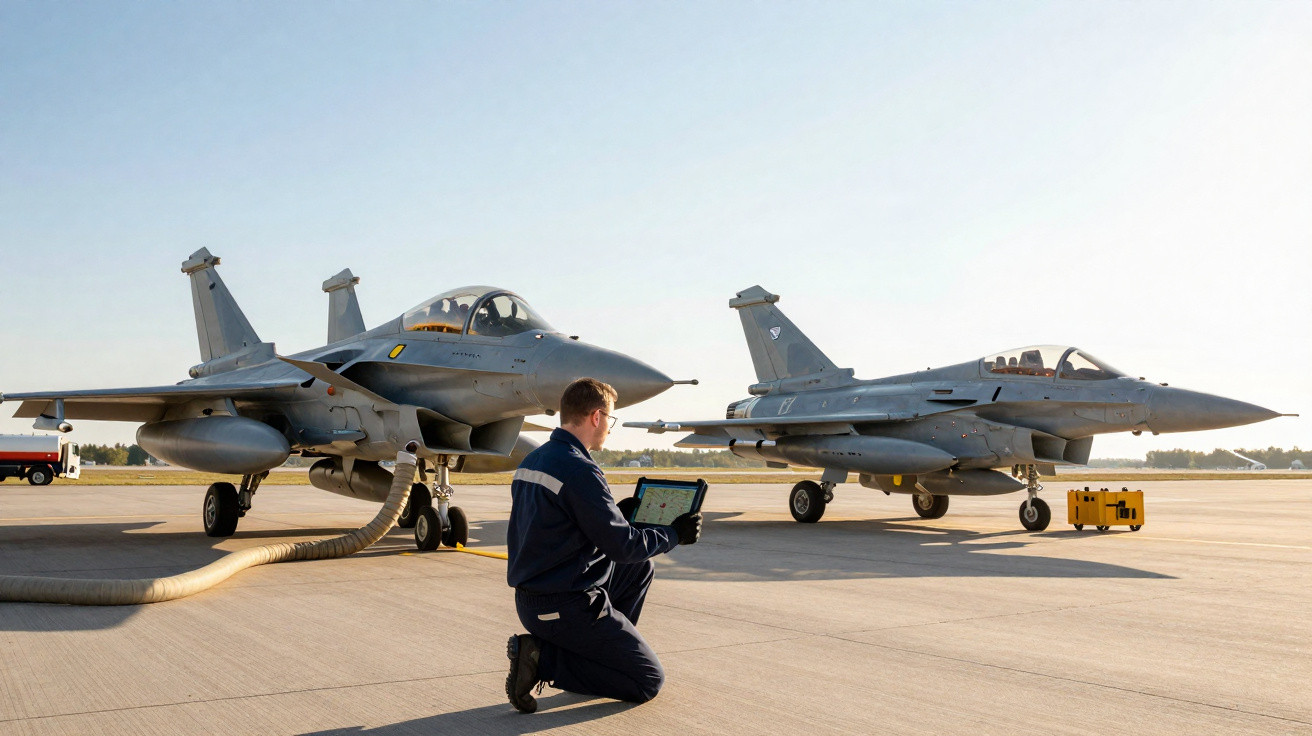
The Rafale was created as a national all-purpose aircraft. France required one platform capable of tasks ranging from air-to-air combat and deep-strike missions to nuclear deterrence. This requirement informed every element of its design, including its high-powered two-engine configuration and the integration between its sensors.
Saab, meanwhile, developed the Gripen E as a “smart fighter” for states that prioritise resilience and affordability over outright power. Its approach reflects decades of Swedish preparation for conflict with a larger neighbour, while air bases faced a persistent risk of missile attack.
The Rafale bets on concentrated power and strategic autonomy; the Gripen E bets on dispersion, survival and tight budgets.
Rafale: the omnirôle heavyweight
French officials refer to the Rafale as “omnirole”, rather than merely multirole. The distinction is important: a single aircraft can move between assignments during one sortie, conducting air defence over friendly territory before carrying out a precision strike minutes later, or following a maritime patrol with close air support.
Its nuclear-strike mission is its most politically sensitive responsibility. Rafale can carry the ASMPA-R cruise missile, which travels at approximately Mach 2 and has a range exceeding 500 km. In late 2025, the French Navy’s Rafale Marine received this capability, placing the aircraft firmly at the centre of France’s nuclear deterrent.
This nuclear mission requires France to retain complete command of the whole system - including software, weapons and electronic warfare - and adds to the Rafale’s appeal for countries that regard strategic independence as almost as important as pure performance.
Gripen E: designed to disperse and endure
The Gripen E has its origins in Sweden’s Cold War BAS-90 doctrine. Its principle was straightforward but uncompromising: expect air bases to be attacked early, train pilots to use short road sections with minimal support, and continue relocating.
That principle remains central to the modern Gripen E. It can operate from a 500-metre stretch of road, then be refuelled and rearmed by a six-person team in roughly ten minutes before returning to the air. This makes the aircraft difficult to neutralise during a high-intensity war.
The Gripen E sacrifices some payload and endurance to gain a rare ability: serious combat power from improvised, scattered locations.
The concept is particularly attractive to smaller NATO air forces close to Russia’s borders, as well as countries with limited airfield facilities that nevertheless require credible air defence.
Purchase prices and the actual cost of flying
The initial price is only one aspect of the equation, although it is often the first consideration for parliaments. A basic Rafale airframe is typically priced between €70 million and €100 million. Export agreements become substantially more expensive once weapons, training, spares and support are included.
| Programme | Aircraft | Approx. package value |
|---|---|---|
| India (naval Rafale Marine) | 26 | €6.5 billion (about €250m per jet fully equipped) |
| United Arab Emirates | 80 | €14 billion (around €175m per jet fully equipped) |
Gripen E is intended to offer a lower entry cost. Its airframe is commonly estimated at between €60 million and €70 million. A recent Colombian package covering 17 aircraft was valued at €3.1 billion, or around €182 million per fighter after weapons and support were included.
Saab places particular emphasis on operating expenditure. The company advertises a flight-hour cost of €4,000 to €8,000, approximately half the frequently cited €16,000 cost per Rafale flight hour.
- Rafale: a greater acquisition cost and higher operating expenditure, offset by a larger payload and longer-range missions.
- Gripen E: lower running costs, making it suitable for air forces that must fly frequently without exhausting their budgets.
For Latin American and South-East Asian air forces facing restricted budgets and long-term currency uncertainty, the chance to spend less for every hour an aircraft flies may matter as much as the performance data presented in a polished brochure.
Payload, range and electronic warfare
Rafale: greater loads, longer missions
In straightforward payload and endurance figures, Rafale has the advantage. It can carry up to approximately 9.5 tonnes of weapons and fuel on 14 hardpoints beneath the wings and fuselage. Equipped with three external fuel tanks, it has a combat radius of around 1,300 to 1,700 km and can remain on station for more than three hours on patrol duties.
These margins provide commanders with greater flexibility. A single Rafale can take air-to-air missiles, precision-guided bombs and targeting pods on the same sortie. This lowers the number of aircraft required for a complex mission, which is a significant benefit for a nation seeking to project power well beyond its own borders.
Gripen E: lighter, but digitally ambitious
As a lighter, single-engined fighter, Gripen E has a more limited maximum payload. It can carry approximately 5 tonnes of weapons and stores across ten hardpoints, while its quoted combat radius generally ranges from 800 to 1,500 km according to configuration. In similar circumstances, endurance is typically about one hour and a quarter.
Saab seeks to compensate through sensor fusion and electronic warfare. Its ES-05 Raven radar provides broad 200° azimuth coverage through a mechanically swivelling array, creating a wide surveillance sector. The Swedish MFS-EWS suite brings together active jamming and passive sensors in a 360° protective bubble intended to confuse hostile radars and incoming missiles.
Gripen E’s concept hinges on seeing first, sharing faster, and emitting less, rather than relying on brute force payloads.
The aircraft also uses the Skyward-G infrared search and track (IRST) system, which detects aircraft passively through their heat signatures. This is valuable against targets attempting to reduce their radar visibility.
Rafale’s developing avionics
Rafale’s sensor suite is also highly capable. Its RBE2 AESA (active electronically scanned array) radar can search up to about 70° away from the nose and is often credited with a range of around 150 km against fighter-sized targets. Meanwhile, the SPECTRA electronic-warfare system monitors all 360° around the aircraft and can locate threats with considerable precision.
More recent F4-standard improvements include a helmet-mounted display, enhanced tactical data links, GaN-based antennas, SATCOM connectivity and AI-assisted features in the TALIOS targeting pod. These enhancements are intended to ensure Rafale remains relevant into the 2040s, despite increasingly stealthy threats.
Export paths: major volumes versus focused campaigns
Rafale currently has stronger export momentum. In 2025, it completed 26 deliveries in one year, 15 of them to overseas customers, and accumulated an order backlog of approximately 220 aircraft, with roughly 175 earmarked for export.
Its customer base now includes Egypt, Qatar, Greece, India, the UAE, Indonesia and Serbia. A letter of intent with Ukraine even refers to a potential order in the hundreds, although any agreement will depend on funding and developments in the war.
Rafale has turned from a slow-selling national project into one of Europe’s strongest export stories in combat aviation.
Saab is following a more limited route. Sweden took delivery of its first Gripen E in late 2025. Brazil, the programme’s principal overseas partner, has started introducing the aircraft but has so far received only a portion of its 36 jets, amid changing defence priorities in Brasília.
Contracts with Colombia and interest expressed by nations including Thailand are keeping production active. Sweden has allocated new public funding to sustain manufacturing and development, while Saab is approaching Canada and other potential customers with offers involving local assembly and industrial participation.
Sovereignty versus collective efficiency
Rafale frequently appeals to countries seeking the greatest possible control over their defence policy. A French purchase generally provides access to a complete system of missiles, pods and training, alongside the option of national customisation for buyers with sufficient political influence and financial resources to seek it.
For such states, the increased expense is presented as the cost of sovereignty: domestic employment, technology transfer, fewer US export limitations and reassurance that Paris can operate independently if alliances become uncertain.
Gripen E generally appeals to countries placing interoperability and spending discipline at the heart of defence planning. Close compatibility with NATO data links, logistics designed for swift road-based operations, and reduced fuel and maintenance costs suit air forces that expect to operate beside larger allies rather than replace them.
How a medium-sized air force could choose
Consider a European country under defence-budget pressure and situated near a tense frontier. Its planners must decide whether to acquire fewer Rafales or more Gripen Es at broadly comparable overall programme costs.
Choosing Rafale would provide a smaller yet more powerful fleet, capable of deep strikes and carrying substantial loads during coalition operations. Choosing Gripen E would allow more aircraft to be purchased and distributed across rural road networks, making them more difficult to destroy in an initial missile salvo.
Either option can be reasonable. In practice, the deciding issues are often political considerations, industrial offsets and the degree to which the country expects its air force to operate independently in a worst-case scenario.
Key terms shaping the debate
Several technical ideas are central to this comparison:
- Combat radius: the distance an aircraft can travel from its base, complete a mission and return without refuelling. A longer radius supports deep strikes and patrols at greater distances.
- Electronic warfare: the full range of methods used to detect, jam or deceive enemy missiles and radars. For modern combat aircraft, this can be as important as speed or manoeuvrability.
- Dispersed operations: operating from numerous smaller locations instead of a limited number of major air bases, making enemy targeting more difficult and allowing aircraft to continue flying after early attacks.
As drone swarms, long-range missiles and cyber-attacks become more widespread, these factors are moving from technical details to core planning concerns. Whether air forces favour Rafale’s model of concentrated, high-end capability or Gripen E’s approach of agile, distributed resilience will determine how Europe fights - and pays - for air power for decades ahead.

Comments
No comments yet. Be the first to comment!
Leave a Comment