
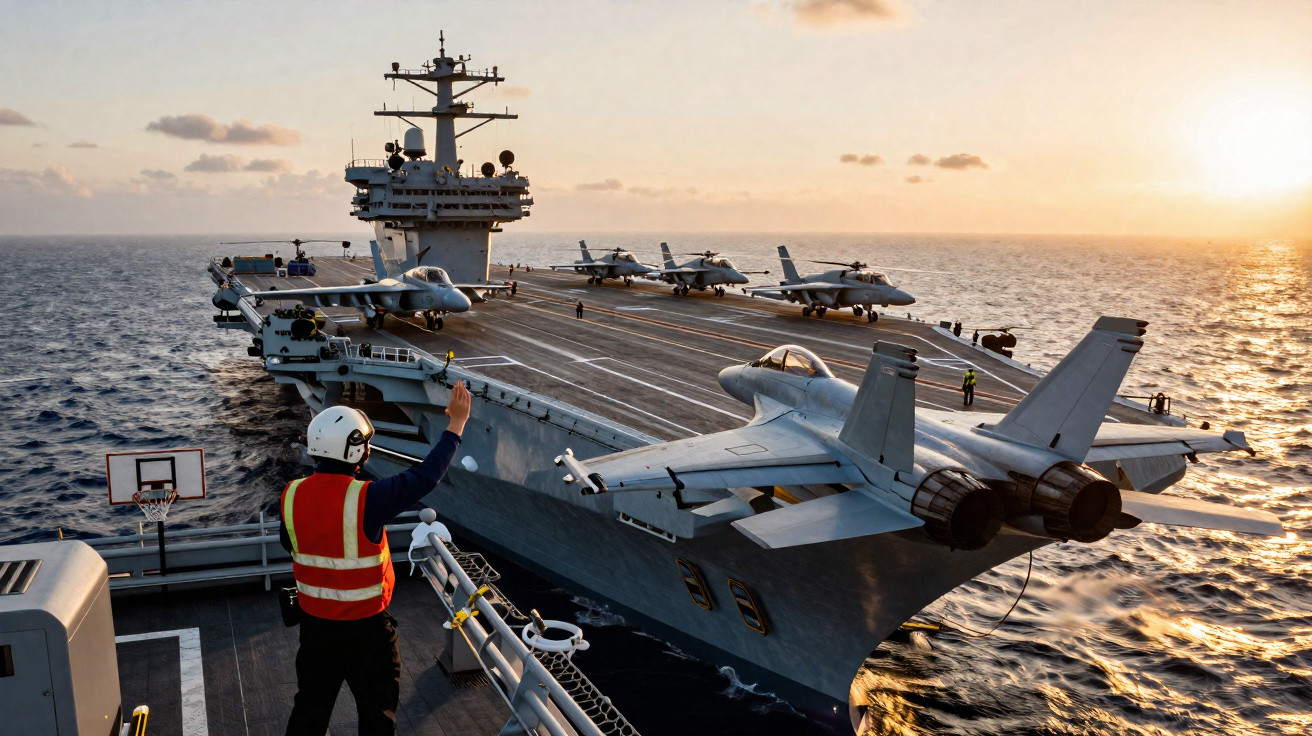
Far out at sea, a steel giant cuts through the waves like a building in motion.
While many ships follow predictable commercial routes, one vessel stands out not only for its size but also for what it represents: military power, technological capability and political influence projected thousands of kilometres away.
A giant that takes an entire city to sea
The world’s largest aircraft carrier is the USS Gerald R. Ford, designated CVN-78 by the United States Navy. Measuring 337 metres in length and displacing around 100,000 tonnes, it would exceed the Eiffel Tower in height if laid horizontally and dominates any seascape it passes through.
It entered service in 2017, following more than a decade of construction, testing and refinements. Its estimated cost is about US$13 billion, a figure that helps illustrate the scale of technology concentrated on board.
Able to accommodate roughly 4,500 people, the USS Gerald R. Ford operates as a small floating city, with everything needed to function for weeks away from any port.
On board are service personnel from dozens of specialisms, including pilots, mechanics, air traffic controllers, marines, cooks, doctors, IT technicians and engineers. Every day is a logistical puzzle on an industrial scale.
What exactly does an aircraft carrier do?
In the traditional definition, an aircraft carrier is a large warship with a deck that serves as a runway for fighter aircraft and other types of aircraft. In practical terms, it is a mobile air base that can be deployed close to conflict zones or strategic regions within days.
The concept is not new. The first attempts to launch aircraft from ships date back to the early 20th century. In 1910, an aeroplane successfully took off from an American ship, paving the way for a revolution in naval warfare. Since then, the idea has been refined into enormous structures such as the Ford class.
Its main benefit lies in flexibility. Rather than relying on fixed bases in foreign territories, a country operating aircraft carriers can launch fighter jets, helicopters and drones from the sea, adjusting its position as the geopolitical situation changes.
A mobile air base travelling at 55 km/h
The USS Gerald R. Ford can reach around 30 knots, or roughly 55 km/h. That may seem slow for a car, but it is considerable for a 100,000-tonne block of steel. This performance is made possible by a nuclear propulsion system, which provides extensive endurance without frequent refuelling.
As a result, the ship can remain operational for long periods, repositioning in response to crises, military exercises or deterrence operations in sensitive regions such as the South China Sea or the Middle East.
Mobility combined with air power makes an aircraft carrier an instrument of political and military pressure, even without firing a single shot.
337 metres of runway, 90 aircraft on board
The Gerald R. Ford’s flight deck works like a compact yet highly efficient airport. According to public data, it can operate close to 90 aircraft, including fighter jets, helicopters and drones.
- Attack and air-superiority fighter jets
- Search-and-rescue helicopters
- Airborne early-warning aircraft
- Surveillance and support drones
One distinguishing feature of the Ford class is its use of electromagnetic catapults, replacing the older steam systems. These catapults launch aircraft more precisely, require less maintenance and enable a more intensive pace of flight operations.
Comparison with the French Charles de Gaulle
To grasp the scale of the Gerald R. Ford, it is useful to consider one of Europe’s best-known aircraft carriers: France’s Charles de Gaulle. It can accommodate around 1,900 people and operate approximately 40 aircraft, including Rafale Marine fighters, E-2C Hawkeye aircraft and helicopters.
| Ship | Country | People on board | Aircraft | Approximate displacement |
|---|---|---|---|---|
| USS Gerald R. Ford (CVN-78) | United States | ~4,500 | ~90 | ~100,000 t |
| Charles de Gaulle | France | ~1,900 | ~40 | ~42,000 t |
The difference is immediately apparent: the American aircraft carrier has more than twice as many people on board and aircraft. This translates into greater capacity for attack, surveillance and logistical support.
Inside the floating “city”: daily life and challenges
Living aboard a ship such as the Gerald R. Ford means sharing confined spaces, working in shifts and coping with the constant noise of engines, catapults and night landings. Thousands of meals are served each day, tonnes of supplies must be managed, and a complex network of electrical, electronic and communications systems has to be maintained.
The vessel includes medical facilities, gyms, industrial kitchens, maintenance workshops, command centres, briefing rooms and even recreation areas. Every element must work like clockwork, as any failure could compromise an air operation or a delicate manoeuvre.
A simple coordination error between the flight deck, control tower and pilot can lead to a serious accident within seconds.
This level of danger explains the intensive training undertaken by crews, who repeat procedures relentlessly so they can respond to fires, collisions, equipment failures or enemy attacks.
Why size matters so much in military strategy
The larger the aircraft carrier, the more aircraft it can carry and the greater its ability to sustain prolonged operations. This applies both to combat action and presence missions, such as patrols in disputed waters or exercises with allied countries.
From a political perspective, the mere arrival of the world’s largest aircraft carrier at a foreign port sends a clear message: its operator has resources, global reach and the willingness to defend its interests.
Risks, vulnerabilities and debate
Despite its imposing presence, a vessel of this size also raises questions. Construction and maintenance costs are extremely high, while concentrating so much power on one platform makes it a priority target in the event of conflict.
The proliferation of long-range anti-ship missiles, modern submarines and attack drones has fuelled a debate: to what extent is it still worthwhile investing in supercarriers? Some analysts favour more distributed fleets, with smaller vessels that are harder to strike. Others argue that, with adequate layered defences – escorts, anti-missile systems and electronic warfare – these giants still make sense.
Terms that help explain this colossus
A few concepts help place this type of vessel in context:
- Displacement: simply put, this is the ship’s “weight”, measured by the water it displaces. In the case of the Gerald R. Ford, it is around 100,000 tonnes.
- Knot: a maritime unit of speed. One knot is equivalent to approximately 1.852 km/h. When 30 knots are mentioned, this means roughly 55 km/h.
- Carrier strike group: the group of ships that escort and protect the aircraft carrier, including destroyers, frigates, submarines and logistical support vessels.
A simple exercise helps to visualise the scale involved: imagine a district in a medium-sized town, with around 4,500 residents, a school, hospital, mechanic’s workshop, restaurant, bakery and a small airport. Now fit all of this into a 337-metre structure surrounded by water, with aircraft landing and taking off one after another, day and night, under strict military rules.
That is the kind of setting the USS Gerald R. Ford takes to sea. It is this combination of engineering, logistics and air power that makes the world’s largest aircraft carrier one of the most visible symbols of United States naval strength today.
Comments
No comments yet. Be the first to comment!
Leave a Comment