
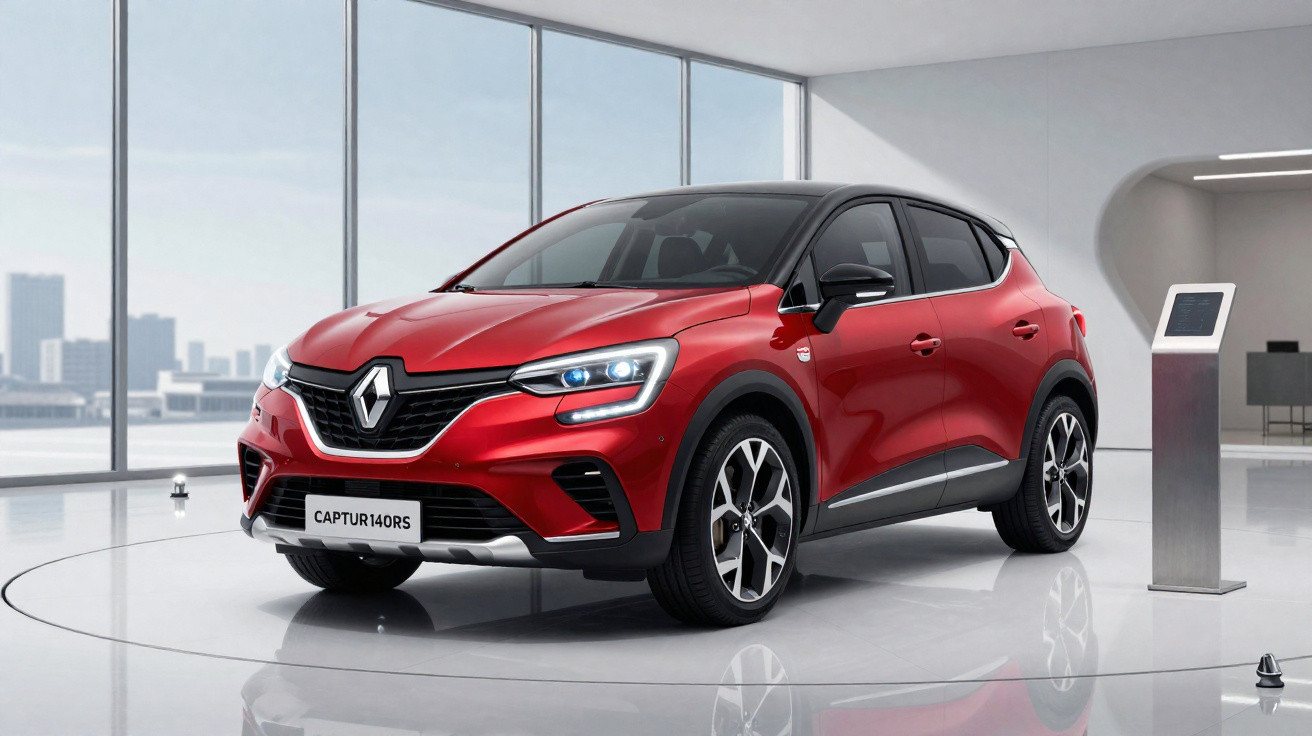
For buyers choosing the sportier-looking Renault Captur R.S. Line, there is no shortage of engine options in the French crossover range: it is available as a plug-in hybrid, a hybrid and with three petrol-only engines - the sole omission is a diesel Captur R.S. Line.
At the top of the petrol-only line-up sits the TCe 160 engine paired with the EDC gearbox, priced from €30,950. However, for €400 less, buyers can choose the model tested here: the Captur R.S. Line TCe 140 EDC, which has 20 hp fewer.
Does it make sense to select it and save that amount? We put it to the test to find out, with our verdict below.
It gets the looks right
If the aim of the R.S. Line trim was to give the Captur a sportier appearance, then it has succeeded in my view, even though there is no way to tell which engine is fitted from the outside.
Its bumper “blade”, honeycomb grille, 18” alloy wheels and rear diffuser-like element give the Captur R.S. Line a convincingly distinctive look compared with the rest of the range.
Inside, the highlights include comfortable seats with a more sporting design, plus carbon-fibre-effect trim that hints at motorsport inspiration. The remaining materials also deserve praise for their generally pleasant feel.
When it comes to passenger space, the Captur remains one of the B-segment models best suited to a young family. A child seat can be fitted on the second row without difficulty, unlike in its latest market rival, the Toyota Yaris Cross.
The boot is also a strong point and offers plenty of flexibility. Thanks to the rear bench that slides through 16 cm, capacity ranges from 404 l to 536 l.
Are 140 hp enough?
Given that the R.S. Line trim can even be specified with a 90 hp engine, this may seem a rather unnecessary question. Yet, as an extra €400 brings 20 hp more, it is still worth asking.
It has no real sporting ambitions, but the Renault Captur R.S. Line combines a highly capable, almost engaging driving experience with comfort that remains among the segment’s benchmarks - and does the French marque’s reputation in this area proud.
Fitted with 18” wheels and tyres with a sportier compound, the Captur corners confidently and, above all, securely. It allows the driver to make the most of a chassis that feels as though it could handle a few extra horses - perhaps a version to take on the Puma ST?
Speaking of “horses”, the 140 hp and 260 Nm produced by the four-cylinder engine in the Captur R.S. Line tested here always proved sufficient. They deliver more than acceptable pace for a B-segment SUV/crossover and, crucially, make overtaking possible without having to make too many calculations.
As for the seven-speed EDC gearbox, it deserves praise. It was quick enough and, more importantly, smooth around town and in the unwelcome stop-start traffic where the Captur is likely to spend a considerable part of its life.
Finally, the French SUV was not especially thirsty. After several hundred kilometres, when I returned it to Renault Portugal’s premises, the trip computer showed a more than respectable average of 5.8 l/100 km.
That figure was achieved without making any special effort to drive economically, during use that included long motorway and main-road journeys as well as excessive hours “lost” in traffic queues.
Is the Renault Captur R.S. Line TCe 140 EDC right for you?
Whichever version is chosen - and we have tested almost all of them, from the LPG bifuel variant to the plug-in hybrid - the Renault Captur consistently ranks among the segment’s most appealing options.
Spacious and versatile, this French model combines comfort and handling impressively, while also providing a good level of equipment and ever-improving overall quality.
In this particular version, the Captur gains not only a more distinctive, sporting appearance but also a more comprehensive equipment specification. It does not have the dynamic appeal of genuinely sporty models, but the Captur’s rational strengths should not be overlooked.
Furthermore, with 140 hp and 260 Nm, it is far from slow while retaining welcome efficiency - an important quality for a model likely to serve as “the family car”. The only disappointment is this version’s asking price, which puts it on a “collision course” even with models from the segment above, such as the “famous” Nissan Qashqai.
Comments
No comments yet. Be the first to comment!
Leave a Comment