
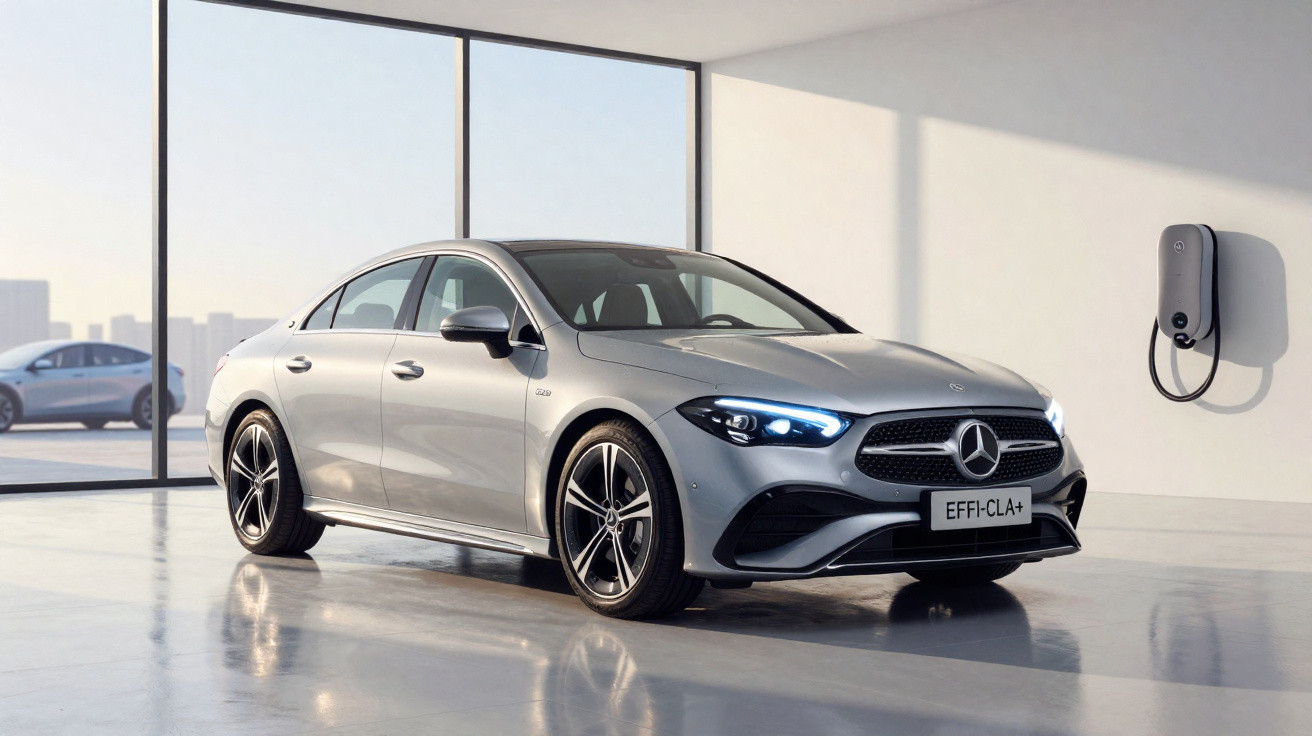
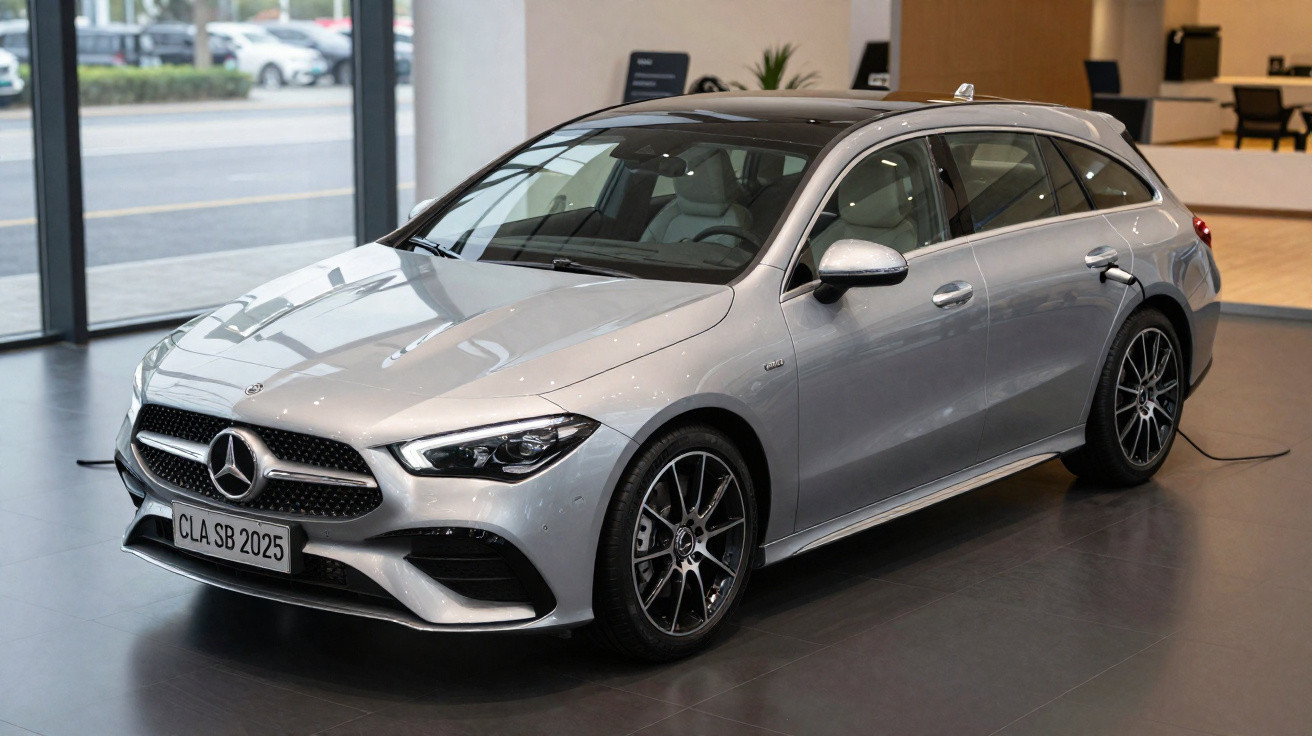
Mercedes is putting the new CLA 250+ on the road as an electric car, striking directly at the needs of buyers looking for range, pace and a premium feel in one vehicle.
This compact four-door with AMG Line enters a class previously dominated above all by one name: Tesla. What makes it particularly interesting is not only its official range of up to 792 kilometres, but also how efficiently the new Mercedes performs in everyday driving – and whether it can beat its US rival on electricity consumption.
Mercedes CLA 250+ aims to outdo Tesla on efficiency
For years, Tesla has been the benchmark for efficiency. German electric cars offered comfort, quality and plenty of technology, yet often had to compensate for their range and consumption with larger batteries. With the third generation of the CLA, Mercedes is changing its approach decisively: less showmanship, more kilowatt-hour discipline.
The CLA 250+ AMG Line is built on a new electric platform. Its centrepiece is a battery with around 85 kWh of usable capacity. Combined with an aerodynamically optimised body and an efficient drivetrain, the saloon delivers up to 792 kilometres from that battery in the WLTP cycle – a figure that sounds like science fiction even to experienced EV drivers.
“The new CLA shows that a German premium electric car is no longer following Tesla on efficiency, but is on level terms and in some respects even ahead.”
Technology at a glance: figures that matter day to day and on long journeys
| Body and interior space | |
| Dimensions (H x W x L) | 1.47 m x 1.86 m x 4.72 m |
| Vehicle type | compact saloon / four-door coupé |
| Boot capacity | 405 litres, plus a large front boot |
| Seats | 5 |
| Drivetrain and performance | |
| Transmission | 2-speed automatic |
| Torque | 335 Nm |
| Number of motors | 1 |
| Battery and charging | |
| Battery capacity | 85 kWh |
Its wheelbase is fairly long for a compact model, creating plenty of room for the battery while also helping with straight-line stability. The 2-speed gearbox is intended to keep the motor within its efficiency range at urban speeds and running at low revs on the motorway.
Strengths: range, charging performance and driving feel
Extremely usable range
In the long-distance test category, the CLA 250+ makes an immediate positive impression. Achieving the theoretical 792 kilometres in real conditions requires a very gentle driving style and predominantly urban or country-road use. Even so, its practical range sits in a zone where charging stops become a minor consideration.
- In mixed everyday use – town driving, country roads and some motorway travel – 550–650 km is realistic.
- At the advisory speed on German motorways, consumption settles at roughly Tesla levels, and is sometimes even slightly lower.
- Drivers who spend a great deal of time in urban traffic can get close to the WLTP figures thanks to effective regenerative braking.
That places the CLA in a class where even high-mileage drivers can manage with only a few rapid-charging stops each week.
Charging times: short in view of the range
Mercedes is prioritising a consistent charging curve rather than maximum peak output at the charger. In other words, the CLA does not merely hit the rapid charger with its highest output briefly; it maintains a high level across a broader state-of-charge range.
“The charging time may initially appear unremarkable, but becomes more appealing with every extra kilometre in the battery – because each minute at a rapid charger returns an enormous amount of range.”
Charging from around 10 to 80 per cent can deliver highly competitive times, depending on the available infrastructure. That is largely because the electric car is efficient and simply travels further per kWh than many rivals.
Driving behaviour: comfortable, with AMG sharpness
With the AMG Line, Mercedes highlights the sportier side of the CLA. Its styling and suspension are set up more firmly, without entirely sacrificing comfort. Testing reveals very neutral handling:
- Direct, accurate steering that is not overly light.
- Strong straight-line stability on the motorway, including at higher speeds.
- Well-balanced suspension: firm enough for enjoyment through corners, yet still comfortable over long distances.
The 335 Nm of torque delivers brisk response, especially from lower speeds. Compared with a Model 3 Performance, the CLA feels more restrained, but it is clearly aimed at drivers seeking assured reserves rather than outright acceleration excess.
Interior: plenty of technology, limited cosiness
Design and ergonomics with drawbacks
The cockpit demonstrates just how consistently Mercedes is pursuing its digital strategy. The vertical dashboard layout is immediately noticeable. It looks modern, although many testers find it somewhat cold. Where earlier Mercedes models used flowing lines and softer shapes, a more technical aesthetic now takes centre stage.
There are also several ergonomic decisions that are likely to prompt debate:
- Numerous controls have moved into the touchscreen.
- Physical buttons remain only for the most important functions.
- Some settings require several taps, distracting the driver from the road.
Anyone moving from a traditional Mercedes will need time to adapt. Once accustomed to it, the concept works, but it does not feel genuinely intuitive in every respect.
Interior space: adequate in front, tight in the rear
Driver and front passenger sit comfortably, with seats that offer good lateral support and long-distance comfort. In the rear, the coupé-like roofline becomes apparent. Taller adults reach the headroom limit sooner, while legroom is acceptable for a compact car but not especially generous.
Storage is a clear positive. Alongside the 405-litre rear boot, the CLA 250+ provides a fully usable front boot. This ‘frunk’ is especially handy in everyday EV use, for example for charging cables, bags or a laptop rucksack.
Infotainment and connectivity: strong as long as you tap rather than turn
The CLA plays to its strengths in infotainment. The system responds quickly, has a modern graphical appearance and offers clear menus. Smartphone integration with Apple CarPlay and Android Auto operates reliably, while the navigation system intelligently calculates charging routes, including stop durations and battery state of charge.
“Those accustomed to touchscreen operation will find one of the most mature systems in the segment here.”
The downside of this touchscreen-first approach is that tactile feedback and operation by feel are lacking. Many drivers would have preferred an additional rotary controller or more direct-access buttons, especially for climate and audio functions.
Weaknesses and criticisms
Ergonomic compromises and a restrained atmosphere
Although the vertical dashboard looks tidy, it also feels somewhat detached. Anyone expecting a warm, lounge-like atmosphere is more likely to be disappointed. Lighting effects and ambient illumination help, but cannot fully offset the underlying layout.
There are also the aforementioned usability compromises: many functions sit one menu level deeper than necessary, while some switches are absent altogether. The cockpit therefore looks uncluttered, but can cost a few nerves in daily use.
Optional technology that buyers might expect as standard
There is one minor disappointment with the electrical architecture. The 400-volt DC/DC converter, which optimises certain charging and onboard electrical functions, is not fitted as standard. It was initially missing from the price list altogether, but now appears as a paid option.
For a modern electric car in this price bracket, that feels less than fully consistent. Customers need to look carefully at which technology they order to receive the full range of functions.
What lies behind the efficiency hype
Why is efficiency such a major subject? Put simply, it determines how much range can be extracted from every kilowatt-hour. High efficiency means that a vehicle:
- can manage with smaller batteries,
- replenishes a large amount of range more quickly,
- generates lower electricity costs per kilometre.
This is precisely where the CLA 250+ comes in. Aerodynamic optimisation, efficient thermal management and the 2-speed gearbox keep consumption under control even at higher speeds. For drivers in Germany who cover many motorway kilometres, that is a genuine advantage.
A practical example illustrates this: a car consuming 20 kWh per 100 kilometres with an 80 kWh usable battery can theoretically travel 400 kilometres. Reduce consumption to 16 kWh, and the range rises to 500 kilometres with the same battery. Charging time changes very little, but each stop takes you substantially further.
Who should consider the Mercedes CLA 250+ AMG Line
The new CLA is aimed at drivers seeking a stylish, relatively compact but long-range electric car – and who do not necessarily want to sit in an SUV. Those who regularly cover long distances stand to benefit significantly from its efficiency and strong charging curve.
It is less suited to families with tall teenagers in the rear or to people who require maximum versatility. Dedicated fans of physical buttons will not be happy with the touchscreen-heavy cockpit either.
The question of how the CLA 250+ compares directly with Tesla on costs remains interesting. Efficiency and charging behaviour clearly favour the Mercedes, while Tesla still holds advantages in price and the density of its rapid-charging network. However, buyers looking for premium appeal, long-distance range and German build quality in one package will find the CLA 250+ AMG Line among the most interesting models currently in this class.
Comments
No comments yet. Be the first to comment!
Leave a Comment