
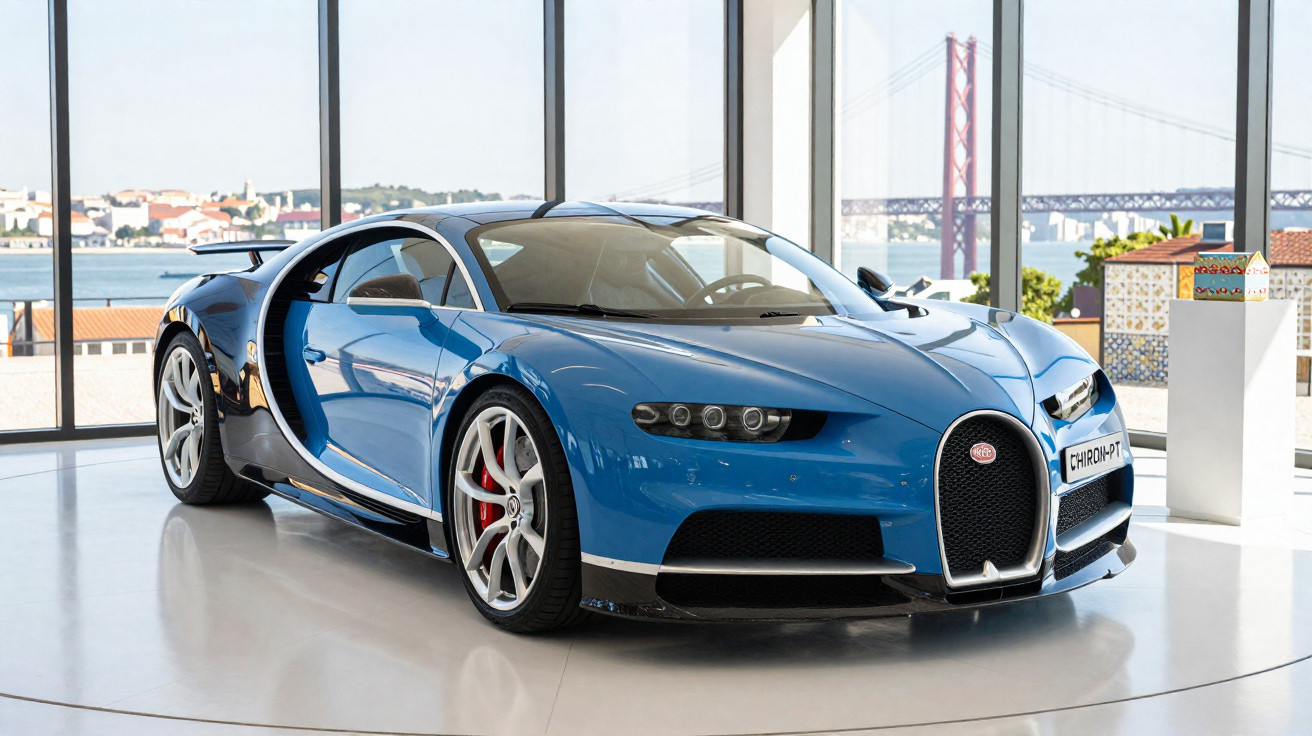
The Bugatti Chiron made its international debut in Portugal. It has swept across the Alentejo plains at more than 300 km/h, leaving the international media impressed. The Chiron is defined by numbers: figures that are striking both for how small and how enormous they are. Here is a closer look at some of them:
6.5
This is the number of seconds the Bugatti Chiron needs to reach 200 km/h. It dispatches 100 km/h in under 2.5 seconds, while 300 km/h arrives in only 13.6 seconds. That is the same, or almost the same, time a 75 hp Volkswagen Up takes to reach 100 km/h - or a 350 hp Porsche 718 Cayman S needs to get to 200 km/h.
7
The Chiron’s DCT, or dual-clutch transmission, has 7 gears. It is the same unit used in the Veyron, although it has been strengthened to cope with 1600 Nm of torque. A modest amount, then…
9
At full throttle, the 100-litre fuel tank can be emptied in 9 minutes. The Veyron took 12 minutes. Progress? Not really…
RELATED: Discover the Bugatti Chiron’s multi-million-pound factory
10
An enormous engine generating even bigger figures. To keep it running without “melting”, the car needs 10 radiators, each with a different role.
16
The engine has 16 cylinders arranged in a W configuration, displaces 8.0 litres and uses 4 turbochargers - two small and two large - operating sequentially. At low revs, only the two smaller turbos are active. The larger units do not come into play until 3800 rpm.
22.5
Its official average fuel consumption is 22.5 litres per 100 km. That rises to 35.2 in urban driving and falls to 15.2 outside town. These official figures were certified under the lenient NEDC cycle, so real-world consumption is likely to be less restrained.
30
A total of 30 prototypes were built during the Bugatti Chiron development programme. Together, they covered 500000 kilometres.
64
The typical Bugatti customer owns an average of 64 cars, along with three helicopters, three private jets and a yacht. Their Chirons will cover an average of 2500 km each year.
420
This is the electronically limited top speed. The 1200 hp Veyron Super Sport, without a limiter, reached 431 km/h, making it the fastest car on the planet. An attempt to beat the Veyron’s record is already planned, with the top speed expected to exceed 270 mph, or 434 km/h.
500
This is the total number of Bugatti Chirons that will be built. Half of the production has already been allocated.
516
The official CO2 emissions figure is 516 grams per km. It is certainly not the solution to tackling global warming.
1500
That is the number of horsepower produced. It is 300 hp more than the previous Veyron Super Sport and 50% more than the original Veyron. Torque is just as remarkable, reaching a mighty 1600 Nm.
1995
The official declared weight, with fluids but without the driver.
3800
The centrifugal force, in G, experienced by every gram of tyre. This is greater than the load that Formula 1 tyres must withstand.
50000
The force, in Nm, required to twist the Chiron’s structure by 1°. It is comparable only with the LMP1 prototypes seen at Le Mans.
2400000
The price of the Chiron in euros. More or less. Before options. And before taxes.
They are all remarkable figures. With its presentation in Portugal, Bugatti did not miss the opportunity to record the Chiron’s journey through the country. Here are some of those images, set against some very familiar scenery.

Comments
No comments yet. Be the first to comment!
Leave a Comment