
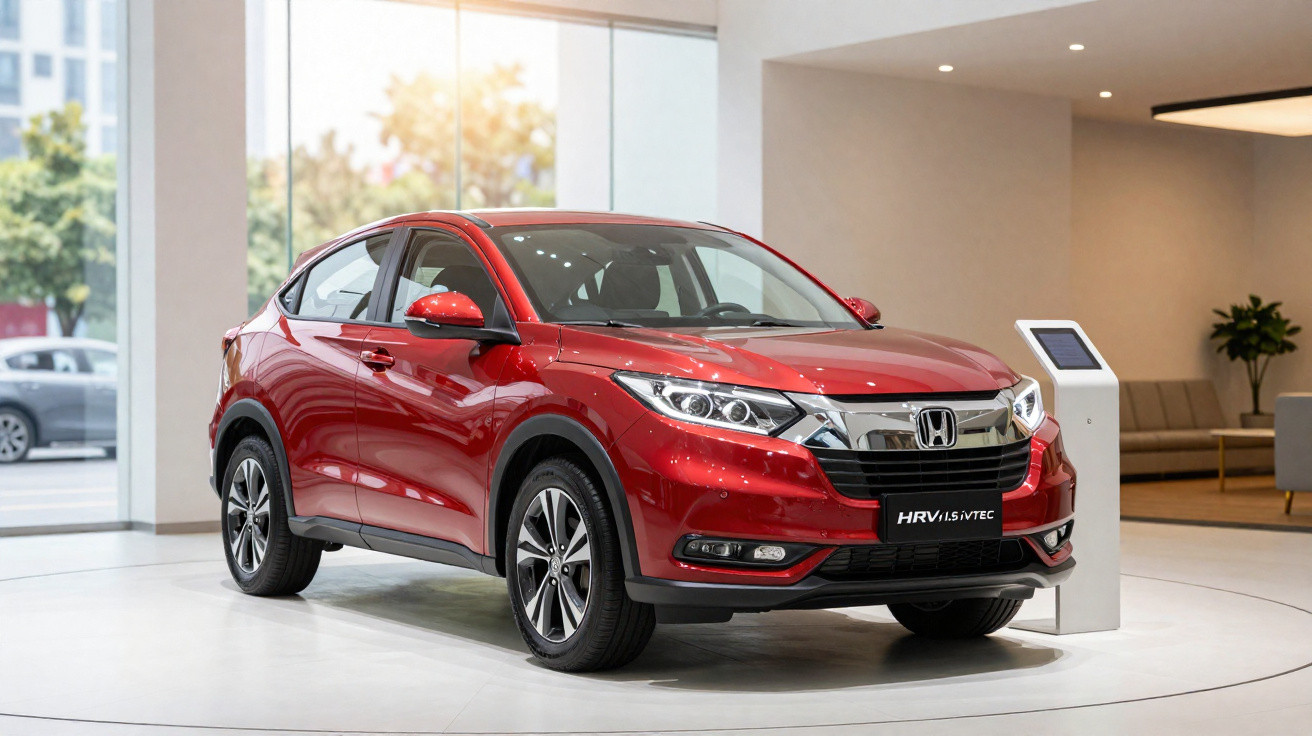
The Honda HR-V remains a highly successful model for the Japanese brand in markets such as North America and China, though Europe is another matter.
In Europe, the HR-V’s career has been defined by… discretion. The ‘old continent’ is generally one of the hardest markets to crack and, in a segment as crowded as the B-SUV class - with around 20 models to choose from - it is easy for several offerings to be overlooked, even when they may be every bit as valid as more successful rivals.
Could European buyers - and Portuguese buyers in particular - be overlooking the Honda HR-V unfairly? It is time to find out.
Limited sex appeal, outstanding practicality
A revised HR-V arrived in Portugal last year, bringing exterior styling updates, fresh front seats and new interior materials. Most of the attention centred on the arrival of the HR-V Sport, fitted with the 182 hp 1.5 Turbo that left such positive memories when I tested it in the Civic. That is not the HR-V under test here, however: this is the naturally aspirated 1.5 i-VTEC in Executive trim, one of the best-equipped versions.
Personally, I do not find it especially attractive. It is as though Honda’s designers could not decide whether to be bold or to please everyone, leaving the overall design short of conviction. Yet, what it lacks in sex appeal, it more than makes up for through its practical qualities.
Because it shares its technical foundations with the smaller Jazz, it benefits from that model’s excellent packaging. The result is superb passenger space - among the best in the segment, enough to make a small family car from the class above envious - as well as very strong versatility.
Its 470 l boot capacity deserves particular mention, once the space beneath the removable floor is included, as does the flexibility provided by the “magic seats”, as Honda calls them. It does not offer sliding rear seats like the class-leading Renault Captur, for example, but folding the seat bases upwards against the backrests opens up a whole range of possibilities.
Front-seat usability
While the second row and boot rank among the HR-V’s strongest competitive points, its appeal fades somewhat in the front seats. The main issue is usability, particularly when operating the infotainment system and climate-control panel.
Why is that? In places where there should be physical controls - rotary dials or push buttons - there are haptic controls, which can become frustrating to use and impair usability. The infotainment system also trails rival offerings, both because of its somewhat dated graphics - they already looked old when the car was new - and because its operation could be more intuitive.
These criticisms apply to several Honda models, although the Japanese manufacturer has been taking steps to address them. Physical buttons have started to return, as seen in the updated Civic and the new-generation Jazz, which also receives a new infotainment system. It is difficult to understand why the HR-V underwent such a recent update without receiving similar improvements.
Despite these less successful aspects, the Honda HR-V interior makes up for them with above-average build quality. Most of the materials are hard and not always especially pleasant to the touch, apart from the various leather-trimmed elements.
Behind the wheel
It took me a while to settle on a comfortable driving position, despite the generous adjustment range for both the steering wheel and seat, but I eventually found one. The steering wheel itself is excellent - with the right diameter and thickness, plus pleasant-feeling leather - whereas the seat, although comfortable enough, lacks sufficient side and thigh support.
The entire dynamic set-up of the Honda HR-V is geared more towards comfort, with a generally soft feel to the controls - while remaining precise - and in the way the suspension responds.
Perhaps for that reason, it deals competently with most road imperfections, helping to deliver a good level of comfort on board. This softness does allow some body movement, though it is never excessive or uncontrolled.
Buyers seeking sharper dynamics in this segment have other choices: the Ford Puma, SEAT Arona and Mazda CX-3 are more satisfying in that respect. The HR-V proved to have stronger dynamic credentials as a comfortable long-distance car, with convincing stability even at high speeds. Aerodynamic noise is intrusive, however, while tyre noise is better suppressed.
One major Honda HR-V strength is its excellent manual gearbox - one of the best, if not the best, in the segment. Its mechanical, slick feel makes it a delight to operate - why are there not more gearboxes like this? Its only flaw is the long gearing, although it is not as long as that found in another SUV from the segment above, the CX-30; this is a way of keeping fuel consumption at acceptable levels.
Speaking of fuel consumption…
… the gearbox’s long ratios seem to work. The naturally aspirated 1.5 i-VTEC showed a moderate appetite: slightly above five litres (5.1-5.2 l/100 km) at 90 km/h, rising to somewhere between 7.0-7.2 l/100 km at motorway speeds. On urban/suburban trips, it stayed at 7.5 l/100 km, a very reasonable figure considering the type of driving this engine demands.
We are “forced” to use the (long-geared) gearbox more frequently than expected and to work the engine harder than an equivalent turbo unit, as its 155 Nm is available only at a high 4600 rpm. If the experience were more enjoyable, I would not criticise it as much.
However, the 1.5 i-VTEC becomes rather noisy under greater load and also felt somewhat lethargic when building revs. Despite a limiter close to 7000 rpm, there seemed little point in extending it beyond 5000 rpm.
Part of the explanation may lie in the fact that it had covered fewer than 400 km and still felt somewhat tight. With a couple of thousand more kilometres on the clock, it might have responded with more energy, but a markedly different character would not be expected. In this case, the Civic’s 1.0 Turbo seems clearly better suited to the HR-V and its intended use.
Is it the right car for me?
Although the market’s lack of attention towards the Honda HR-V feels somewhat unfair, it is difficult to recommend it with this 1.5 engine when rivals offer powertrains that are far more pleasant and flexible to use, and better suited to its purpose.
Today, the 1.5 i-VTEC is the “only” engine available for the HR-V in Portugal. The 1.6 i-DTEC is no longer sold, while the excellent 1.5 Turbo sits at a… “social distance” of 5000 euros, too great a gap for it to be considered an alternative.
Even harder to understand is that Honda has offered a much-liked 1.0 Turbo in its range for several years, an engine that would “fit like a glove” in this model. Should it not have been introduced in the HR-V too?
I think so… I was also expecting a more thorough interior revision to improve usability when it was updated. All these aspects ultimately harm the assessment of this model. That is a pity… because the Honda HR-V is one of the B-SUVs I have found most suitable for family use - not least because it is the one that most resembles an… MPV in character - offering excellent space, accessibility and versatility.
This is one of today’s most competitive segments, and nobody can afford to relax. The second generations of the heavyweight Renault Captur and Peugeot 2008 have raised the class benchmark and stripped models such as the HR-V of arguments, as they now offer more competitive interior dimensions alongside the stronger points they already had in their powertrains or even… sex appeal.
Comments
No comments yet. Be the first to comment!
Leave a Comment