
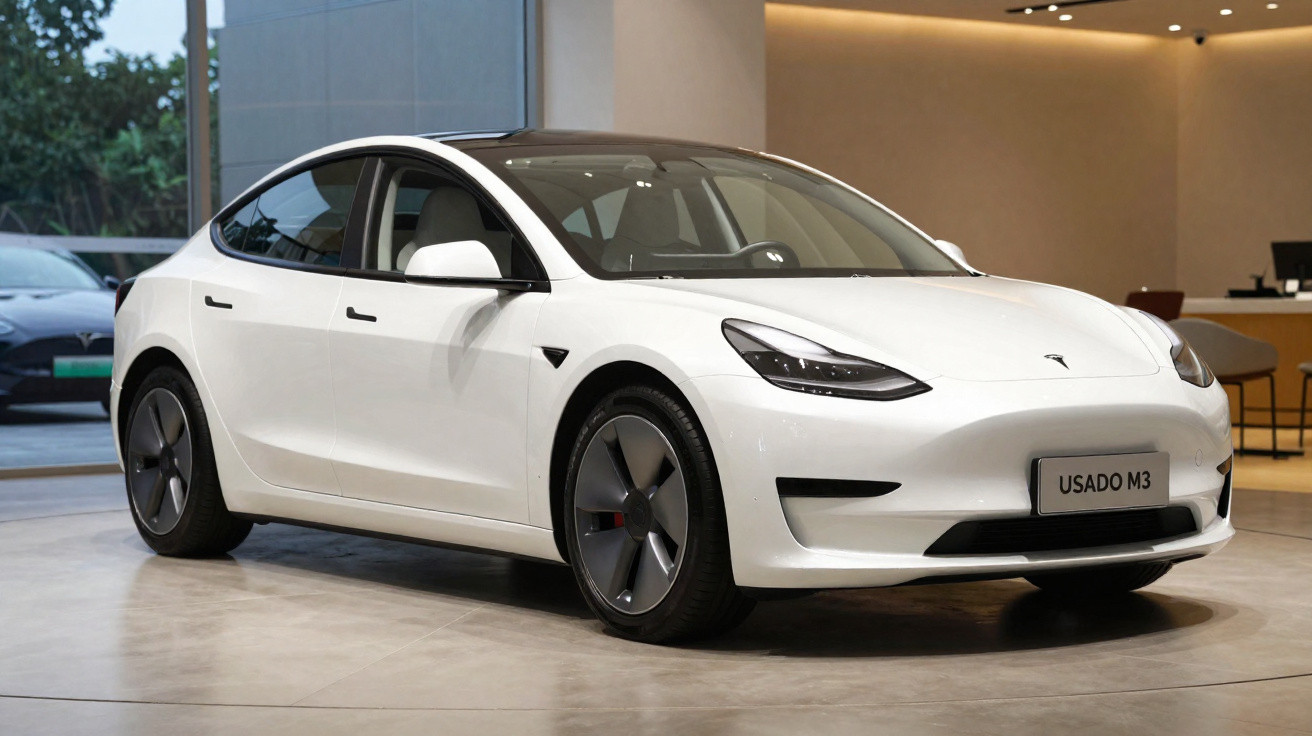
A used Tesla Model 3 can represent good value, but there are a few warning signs you should look out for.
Looking for a Tesla Model 3 on the used-car market is a sensible starting point - as the following sections will show. It is particularly appealing if low running costs and technology matter to you. Alongside video games and a flatulence simulator (yes, really), it also offers features with genuine everyday value.
This buying guide covers the first generation of the model, which arrived in Europe in 2019 and remained on sale until 2023. There are hundreds of examples currently available on the used market.
It achieved something that very few electric cars had managed up to that point: it made the idea of an electric car with enough range for longer journeys more accessible, without an eye-watering price tag. That was true when it was new, and it remains true as a used car.
We explain everything in this article and in a video on our YouTube channel:
With support from Piscapisca.pt - the portal with the largest number of cars for sale in Portugal - this buying guide examines everything you need to know before buying a Model 3. We cover the most frequent issues, the areas requiring attention, price trends and the cost of key wear-and-tear parts. You will find all of this in the video and in the sections below.
Tesla Model 3 exterior
The Tesla Model 3 still looks current from the outside. Its minimalist styling has aged well, with flush door handles, a glass roof, and clean, neutral lines. In fact, that last quality is precisely why it remains contemporary: the styling is uncluttered and inoffensive. It may not stir the emotions, but it is unlikely to put buyers off either.
Every used example discussed in this article belongs to the pre-Highland generation, built until 2023. This means that certain finishing details - particularly on the earliest cars - fall short of the standard European buyers were used to.
Before making a purchase, inspect the alignment of the body panels, along with paint defects and wear. For imported examples, especially those from Nordic countries, any potential corrosion spots also deserve close attention.
High technology, but average quality
Compared with the exterior, the cabin is just as generic, although it is more radical and more accomplished. There are both strong points and weak points, so let us begin with the positives.
A 15-inch display brings together virtually every function in the car. It is the element responsible for the futuristic atmosphere that attracts so many Model 3 buyers, although it can also be a vulnerability: if the screen fails, access to almost everything is lost.
Fortunately, the infotainment system - including the display and processing unit - has proved highly reliable. It is not a major concern.
Physical controls, as shown in the image gallery, are almost entirely absent. Thankfully, the user interface is very well designed. Even six years after its European launch, it remains one of the best systems available in the car industry.
There is more than enough room for four adults, the boot is spacious, and the frunk - a storage area beneath the bonnet - adds further practicality. Less convincing are some of the plastics and the durability of certain trim pieces, which can differ significantly depending on the model year.
On the road
When considering driving impressions alone, there are two ways to assess the Tesla Model 3. Someone moving from a small hatchback to a Model 3 will feel they have made a huge upgrade. A driver coming from a premium-brand car that is less than 20 years old, however, may not notice a meaningful step forward - and could even see it as a step backwards in certain respects.
This is worth saying to avoid the extreme views of both the brand's critics and Elon Musk's enthusiasts. As with almost everything in life, the truth lies somewhere in the middle, and the Tesla Model 3 is no exception.
With that caveat made, this fully electric car's performance deserves recognition. As mentioned in the video, whichever version you choose, this model's acceleration is beyond doubt. It is efficient, quick and... affordable. Few ways of having more than 350 hp in the garage are as economical.
Ride comfort could be better, as the suspension is less capable than it should be. Over poor road surfaces, the Model 3 feels firmer than desirable. There are also several unwanted noises to contend with. In this respect, older Model 3 examples are worse. Tesla's assembly quality improved considerably over the years, to the point that some of these criticisms no longer apply to the Highland version launched in 2023.
Its handling is very precise. Is it exciting? Once again, the answer depends on who you ask. Petrolheads will miss the sound of an internal-combustion engine and complain about the weight. The average driver, meanwhile, will recognise it as a safe car.
Rear-wheel-drive versions may engage their traction and stability-control systems more frequently in low-grip conditions. However, this does not change the overall assessment of the model.
Price trends
Razão Automóvel, in partnership with Piscapisca.pt, aims to contribute to greater transparency in the used-car market. At this link, you will find data supplied by consultancy MotorCV concerning Tesla Model 3 price trends in the Portuguese market:
Naturally, the older the model, the lower its price - a principle that applies to every car. In the Tesla Model 3's case, though, there is another reason to favour newer examples: build quality improved over time.
Running costs
As highlighted in the featured video, running costs are one of the greatest advantages of fully electric cars. And aside from build and assembly-quality concerns, Tesla's electric components are robust.
It is common to find cars with more than 200,000 km showing battery degradation of around 10%. Given that degradation is greatest during the first years and then tends to stabilise, this is an encouraging sign.
As we explain in the video, it is also possible to carry out a battery health check. It is a transparent process that gives greater confidence to both buyers and sellers. Replacement and wear-item costs are competitive too.
Our choice
It depends. Do you prioritise the lowest price and cover relatively few kilometres? Choose the Tesla Model 3 SR (Standard Range), preferably one already fitted with LFP batteries - we explain how to identify the battery chemistry in the video.
If you plan to travel longer distances and view this model as the family's main car, the LR (Long Range) versions may be worthwhile instead.
Alternatives
If the Tesla Model 3's strengths have not completely convinced you, Piscapisca.pt offers plenty of strong alternatives to this electric saloon. The Volkswagen ID.4, for example, can already be found at prices of around €23,000.
If space is the priority, you could also turn your attention to the Skoda Enyaq, which is available from roughly €25,000. More recent Kia e-Niro examples, from 2023 onwards, can also be good choices for buyers seeking a comfortable and spacious electric car.
For those after a more premium proposition, two models are worth considering: the Volvo XC40 Recharge, from €27,000, and the Polestar 2, from €25,000. The latter is a direct Tesla Model 3 rival and stands out for its interior finish and dynamic handling.

Comments
No comments yet. Be the first to comment!
Leave a Comment