
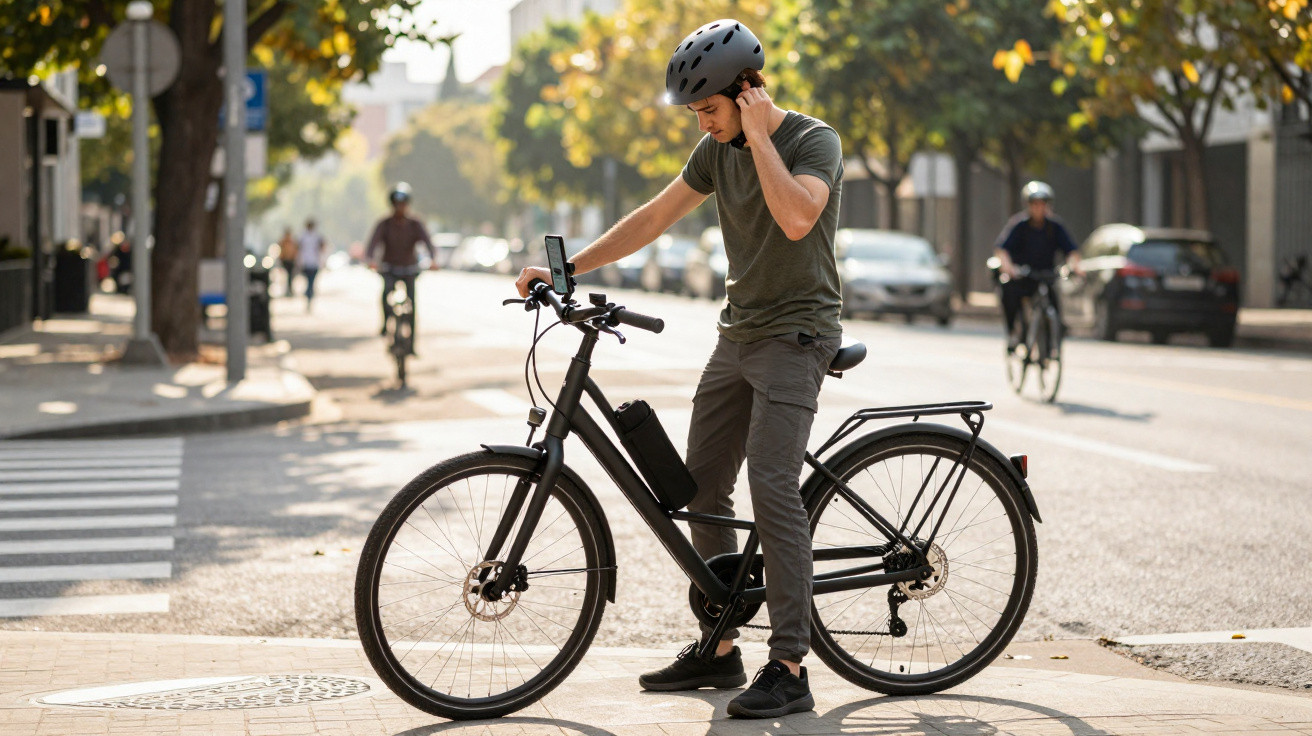
The motor, battery and glossy frame may be the first things you notice in the shop, yet the less glamorous details have a much bigger effect on everyday e-bike use. The small accessories fixed to the bike or carried in a bag determine whether each journey is easy and reassuring, or feels like a test of endurance.
The e-bike honeymoon fades quickly without the right kit
Anyone who has replaced several weekly car trips with an electric bike will recognise the pattern. At first, the speed and effortless riding are exciting. Soon afterwards, everyday problems appear: punctures, rain, unfamiliar routes, theft concerns, forgotten lights, and the occasion when you have to wheel a flat-battery bike home after dark.
The e-bike itself is only half the investment. The other half lives in your backpack, on your handlebars and locked around your frame.
When ordering an e-bike, accessories can seem non-essential. A few months later, they tend to feel more like vital infrastructure. Some improve safety, others add comfort, and a handful simply prevent you from arriving late with chain oil on your clothes.
Mini pump: the compact tool that rescues your commute
Electric or manual, but always carry one
A puncture is more troublesome on an e-bike than on an ordinary bicycle. You will often be farther from home, while the extra weight makes the bike harder to push. With a mini pump, a journey that might otherwise be abandoned becomes a 10-minute interruption.
Premium electric mini-compressors can now fit into a jersey pocket and weigh only slightly more than a chocolate bar. Connect one to the valve, press a button, and the tyre reinflates while you look at your messages. Pressure is generally more accurate, reducing the chance of under-inflating the tyre and getting another pinch puncture 1.6 km later.
Traditional hand pumps remain a very sensible choice. They cost less, need no battery power and can stay attached to the frame for years. They require more effort, but that is still preferable to being stranded at the roadside while the motor and battery are of no help.
On an electric bike, a puncture repair kit without a pump is like a spare wheel without a jack.
What an effective portable pump needs
- Support for both Presta and Schrader valves
- Sufficient pressure for the tyre type: up to 4 bar for city tyres and 7+ for road tyres
- A hose or flexible head that prevents valves from bending
- A mount or strap, ensuring it stays with the bike
Phone mount: a live e-bike dashboard on your handlebars
E-bike riders often travel through unfamiliar areas of town or follow a cycle route they have only briefly checked on a map. Taking out your phone at traffic lights-or, worse, trying to look at it while holding it-is dangerous and generally illegal.
A sturdy phone mount deals with this problem. It positions your smartphone where you can quickly see navigation, battery status in a companion app and incoming calls. For city riding, the improvement is substantial: there are no more uncomfortable stops to inspect directions and no need to wear headphones that block out surrounding sounds while following spoken guidance.
Choose a mount that tightens securely around your handlebar diameter, holds the phone on more than one side and allows switching between portrait and landscape views. Low-cost plastic mounts may be adequate on smooth cycle paths, but a metal or reinforced model soon proves worthwhile on city streets full of potholes.
Lock: an e-bike without proper security is an open invitation
Why a basic cable lock creates problems
E-bikes are often among the first bikes stolen from crowded racks. Their higher value makes them especially attractive, and thieves know exactly which cheap locks to target. Lightweight cables and narrow chains can be cut with bolt cutters in seconds.
High-security U-locks and recognised ratings
Across many European markets, insurers will only provide theft cover where locks meet specific standards, such as SRA or comparable rating schemes. Such locks undergo timed testing against saws, levers and cutting equipment. The aim is not to be “unbreakable”, but to be “such a headache that thieves move on”.
A solid U-lock does more than protect your frame. It also signals to opportunistic thieves that your bike is not a quick win.
A U-shaped lock with an insurer-recognised security rating should cost a mid-range amount. In return, you would normally expect hardened steel, a dependable locking cylinder and enough room inside the shackle to secure the frame and one wheel to a fixed object. Pick it up before buying if possible: if it feels like a toy, it will probably perform like one when someone brings out tools.
How to lock an e-bike properly
| Step | What to secure |
|---|---|
| 1 | Put the U-lock through the frame and around a fixed anchor, such as a rack, pole or ground loop. |
| 2 | Lock in at least one wheel where possible. |
| 3 | If the battery detaches easily, remove it and carry it with you. |
| 4 | Do not secure only the front wheel, as it can be removed in seconds. |
Helmet: more than a shell, it is an everyday comfort item
Intelligent helmets with lights, audio and calls
Electric bikes encourage higher average speeds, even when you do not feel as though you are working harder. That extra speed makes a crash more serious. A helmet can turn a head-first fall from a brain injury into bruising.
Connected helmets offer additional functions. Some incorporate LED indicators, brake lights, speakers and voice control into a single item. After several days, indicating a turn with a thumb press while keeping both hands on the handlebars feels remarkably natural. Their integrated speakers sit outside the ears, allowing you to hear traffic while following navigation instructions or answering a short call at low speed.
Water-resistant models keep their electronics working in ordinary rain, while current batteries recharge rapidly via USB-C. For people who commute regularly, that convenience makes a “safety item” something they put on automatically.
For riders who want simplicity
Many riders have no desire to listen to music or answer calls through their helmet, which is perfectly reasonable. A simple, well-ventilated helmet carrying European CE or US CPSC certification still performs the essential role very effectively.
The best helmet is the one that fits so well you forget you are wearing it after five minutes.
Adjustable retention systems, good padding and generous ventilation are more important than elaborate graphics. Try several sizes and make sure the helmet does not shift when you shake your head with the straps unfastened. If you ride at night, choose reflective detailing or an integrated rear light.
Repair kit: making breakdowns into brief pit stops
An e-bike makes longer trips seem easy, which is exactly why being stuck halfway through one is so inconvenient. A small multi-tool and puncture repair kit will come to the rescue more often than you may expect.
A practical kit will usually contain tyre levers, self-adhesive patches, a small sheet of sandpaper or a metal rasp, plus Allen keys that fit the main bolts on your bike. On an electric bike, consider the fittings that hold the battery mount, display, mudguards and rack in place. Tightening these parts immediately can stop irritating rattles and may even prevent components from falling off altogether.
Keep the kit permanently in a saddle bag or frame pouch. Its weight is insignificant beside that of the motor and battery, but its reassurance is not.
Selecting e-bike accessories for your real routine
No single accessory setup suits every rider. A person travelling across town twice daily on cycle lanes needs different equipment from someone tackling rural climbs at weekends.
- Daily commuter: a tough lock, powerful lights, a weatherproof phone mount, mudguards and a straightforward repair kit.
- Leisure rider: a comfort-led saddle, a well-ventilated helmet, a basket or panniers for picnics, and a basic tool kit.
- Sporty e-biker: a lighter helmet, compact electric pump, multi-tool with a chain tool, and a minimal but robust lock for café stops.
Start with what you do most often, not with what looks best on a product page.
Compatibility can still catch people out. Handlebar diameter determines which mounts and lights will fit. Valve type affects pump and CO₂ inflator compatibility. Frame shapes dictate which locks and bags can be used. Check specifications twice before ordering, or take the bike to a shop once to test the equipment in person.
Insurance, theft and the unexciting details that count
As e-bike prices rise, many riders arrange theft insurance or fully comprehensive cover. Policies frequently state a minimum lock rating, a time restriction-for instance, cover only during specified hours when the bike is secured at a home address-and require photographic evidence of the bike and lock together.
Paying a little extra for a certified lock may be the difference between a successful claim and an unwelcome shock. Retain the lock receipt and record its serial number. Keep several photographs of the bike correctly locked in case they are required later.
Everyday scenarios that prove the value of accessories
Imagine a wet November ride home from work. You leave a little late. With a phone mount, waterproof lights and a comfortable helmet, the journey remains largely relaxed. Without them, you are handling a slippery phone, straining to see in the dark and hoping motorists notice you in time.
Now consider a weekend trail ride. At 16 km from the nearest shop, a broken chain or loose bolt is a manageable adventure with a multi-tool, but a long walk without one. These small items do more than resolve problems: they make those problems into stories that you can laugh about later.
A few helpful terms for new e-bike riders
Accessories often use terminology that can confuse first-time riders. “IPX4” on a helmet or light indicates protection from splashes coming from every direction, which will normally cover everyday rain. Higher figures, including IPX7, indicate protection during brief immersion.
For locks, independent certifications or star ratings show that an outside organisation has attempted to defeat the product in standardised test conditions. They cannot guarantee security in every situation, but they provide a stronger starting point than marketing claims alone.
After living with an e-bike for several years, motor wattage becomes less of an obsession than these quieter practicalities. Accessories may not be glamorous, but they are what make a pleasant electric gadget into a dependable everyday vehicle.

Comments
No comments yet. Be the first to comment!
Leave a Comment