
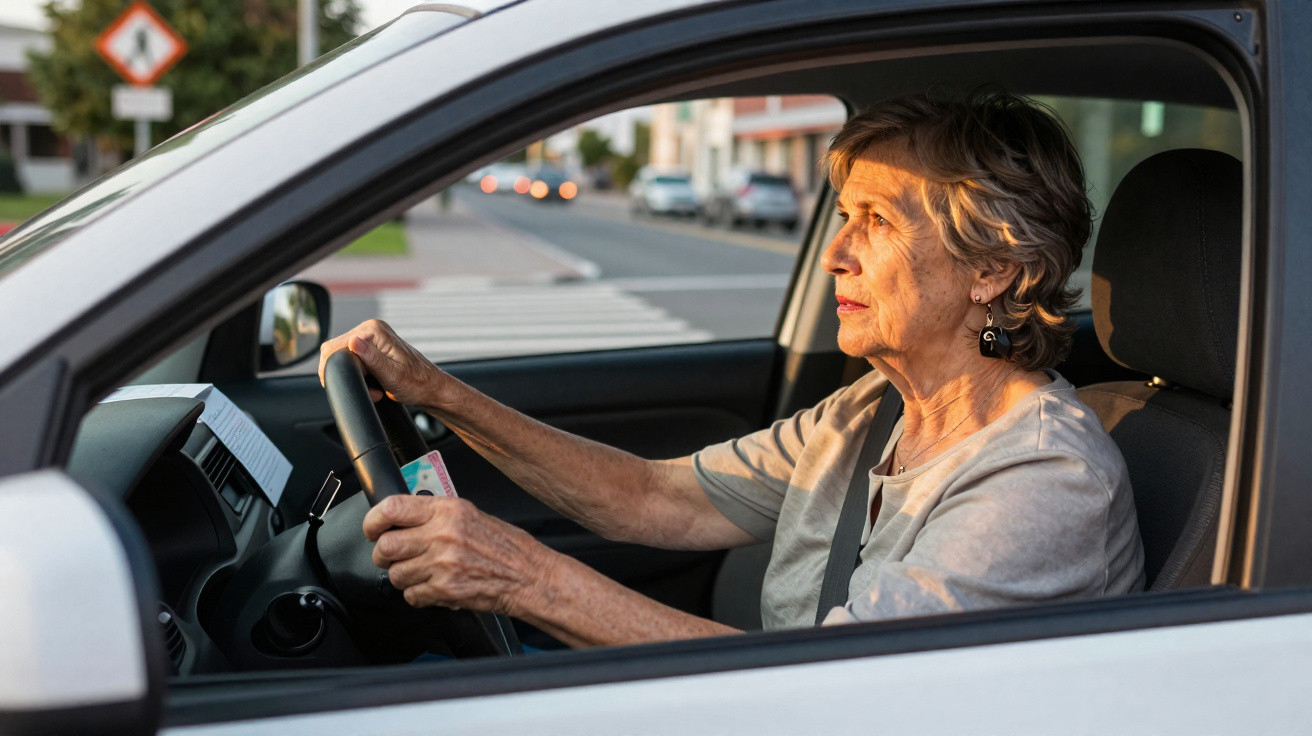
Behind him, an impatient queue of cars lengthens, their headlights flashing like weary sighs. At the following junction, a teenager on an electric scooter slips through the traffic, music playing in his ears and only one hand on the handlebars. Two very different worlds occupy the same road without properly noticing one another. In country after country, governments are discreetly revising the rules that determine whether people may continue driving at 70, 80 or even 90. Is this a respectful concession to older people, or a risky gamble with public safety? The response changes according to your perspective - and the speed of the traffic.
When a driving licence is a lifeline - or a liability
Visit any suburban café at 10 a.m. on a weekday and listen to the conversations. At a window table, alongside discussions of grandchildren and medication, there will almost certainly be a tale about driving. Someone’s neighbour “had to give up the car.” Someone’s brother “failed the vision test at 78.” That small plastic driving licence can suddenly feel as important as a passport to ordinary life. For many older drivers, surrendering it means more than the end of road trips. It can mean no unplanned visits, no evening errands and no longer having the reassuring feeling that “I can manage on my own.” It becomes the line between independence and a gradual sense of confinement.
Consider Margaret, 82, who lives in a quiet cul-de-sac on the outskirts of town. Her children are an hour away, the final bus departs before supper, and the nearest supermarket is 12 minutes away by car. She had driven cautiously for years: never received a speeding ticket and always refused to use her phone at the wheel. Then her renewal notice arrived, requiring a medical assessment, reaction test and eye examination. She passed two of the three. A minor delay on the brake-response machine made the examiner frown. She was then issued a restricted licence: daylight driving only, within the local area and no motorways. Her family regarded it as a reasonable compromise. To Margaret, it felt like a subdued accusation - as though it said: “We don’t really trust you anymore.”
The discussion about older drivers seldom acknowledges that emotional blow. Policymakers rely on graphs and risk curves: collision rates per kilometre, eyesight requirements and cognitive decline. Road-safety campaigners cite research indicating that drivers over 80 are more likely to suffer serious injuries in a crash, including at low speeds. But figures cannot convey what it feels like to be questioned about whether your hands still belong on the steering wheel. Beneath it all lies a harsh, straightforward question: when does a driving licence stop being a safety belt for everyday life and become a possible weapon on the road? There is no universal age at which that happens. Instead, every society draws the boundary in a different place.
Testing, coaching and small changes that save lives
The countries that manage this conflict most effectively usually see older drivers not as a “problem” to remove from the roads, but as people who can be supported. One useful approach is to introduce regular, low-pressure driving reviews beyond a particular age. Rather than a frightening one-off examination, these are brief recurring checks: eyesight tests, reaction exercises and a trip around the block with a qualified instructor. When handled well, they resemble a driving health check rather than a punishment. They can reveal modest improvements, such as altering the seat height, broadening mirror coverage, changing glasses or moving to a car with better automatic braking systems. Such small changes can discreetly lower risk without taking away the keys.
Older motorists often recognise their own limitations, yet pride and anxiety about losing independence may lead them to conceal them. A more compassionate method is to discuss “safer routes” rather than “no more driving”. Sticking to familiar roads, avoiding difficult roundabouts, staying away from rush-hour traffic and poor weather are straightforward measures that safeguard everybody. Driving after dark, for example, is among the first tasks many older people begin to find challenging. Rather than treating it as forbidden, some driving programmes encourage them to plan essential trips for daylight hours and share that plan with relatives. Let’s be honest: nobody really does this every day. Even so, once a person starts noticing errors behind the wheel, even a half-hearted plan is a step forward.
There is another measure that requires no legislation whatsoever: frank and considerate conversation within families. Adult children can compare observations gently: “Have you noticed more scratches on Dad’s car?” or “Did Grandma miss that stop sign last month?” They can then speak with the driver, rather than talking about them.
“Don’t come with accusations, come with curiosity,” says one geriatric driving specialist. “Ask, ‘How do you feel when you drive at night now?’ and listen, really listen.”
When emotions run high, some families turn to a straightforward checklist to structure the discussion:
- Recent near-misses or minor bumps
- Becoming lost on familiar routes
- New medication affecting alertness
- Changes to eyesight or neck mobility
- Moments of panic or confusion at junctions
These are not final judgements, but warning signals. Identified early enough, they may prompt coaching, medical assessments or a transition plan instead of an abrupt and brutal “no more driving.”
A question that will not fit on a plastic card
Amid all these disputes, one fact repeatedly returns: societies are ageing rapidly, and so are the people using their roads. The number of drivers over 70 rises each year, particularly in rural and semi-rural places where buses are infrequent and pavements simply disappear. Remove too many licences overnight and thousands of people are left confined to their homes, separated from social activities, medical appointments and even the basic choice of buying their own groceries. Allow every licence to remain regardless of circumstances and society takes a chance on more collisions, hospital admissions and tragedies that were apparent long before the impact.
On a calm Tuesday morning, a retired teacher drives into a supermarket car park and, without realising, stops across two spaces. Near the exit, a young cyclist swerves as she misjudges his speed. Nothing occurs. There is no headline or statistic. There are only two people whose lives almost changed. These small, unseen near-misses happen every day around ageing drivers, just as they happen around speeding teenagers and distracted parents. The real issue is how many we are prepared to overlook before changing the way licences, renewals and support are managed. It is also how many we are willing to accept as the price of allowing people to grow old without reducing their world too soon.
Some specialists support a combination of measures: more flexible rules for early screening, firmer requirements when genuine decline is identified, and greater investment in alternatives such as community transport, ride-sharing credits for older people and safer roads for all. Others caution that adding tests for older drivers could make them scapegoats, even though distracted driving, speeding and phone use among younger adults produce far more crashes in absolute numbers. At a human level, the conflict comes down to one question: should elderly motorists be regarded as fragile risks to control, or as experienced road users who need updated tools and candid feedback? More than any regulation, that answer will determine how safe we feel at the next pedestrian crossing - and how we hope to be treated once our own hair turns grey.
| Key point | Detail | Why it matters to the reader |
|---|---|---|
| Age-based reviews | Regular, calm driving and health checks after a certain age | Shows how safety can improve without sudden licence loss |
| Family conversations | Spotting early warning signs and speaking respectfully | Offers a practical way to protect loved ones and other road users |
| Independence vs. risk | Balancing older people’s mobility needs against public safety | Helps readers consider more than clichés about “dangerous old drivers” |
FAQ:
- At what age do drivers become “too old” to drive safely? There is no fixed age. Some people remain safe drivers into their late 80s, while others struggle in their 60s. Health, reflexes, eyesight and medication matter far more than the number of candles on a birthday cake.
- Are crashes involving older drivers always more serious? Older drivers are usually physically more vulnerable, meaning injuries can be more severe even in low-speed collisions. This is one reason many countries advocate earlier checks and lower speeds in busy areas.
- Do stricter licence rules for seniors actually reduce accidents? Research is mixed. Medical assessments and eyesight tests are useful, but the greatest improvements often happen when they are combined with safer road design and better alternatives for people who stop driving.
- How can an elderly driver know when it’s time to cut back? Signs to watch for include getting lost on familiar routes, feeling overwhelmed at junctions, fresh dents on the car or friends declining lifts. These are times to speak with a doctor or driving assessor, rather than suffering in silence.
- What can families do if a loved one refuses to stop driving? Begin with specific incidents rather than accusations, and recommend a professional driving assessment. At the same time, help create alternatives: shared lifts, taxis and community buses. Giving up the car is less painful when everyday life does not collapse with it.






Comments
No comments yet. Be the first to comment!
Leave a Comment