
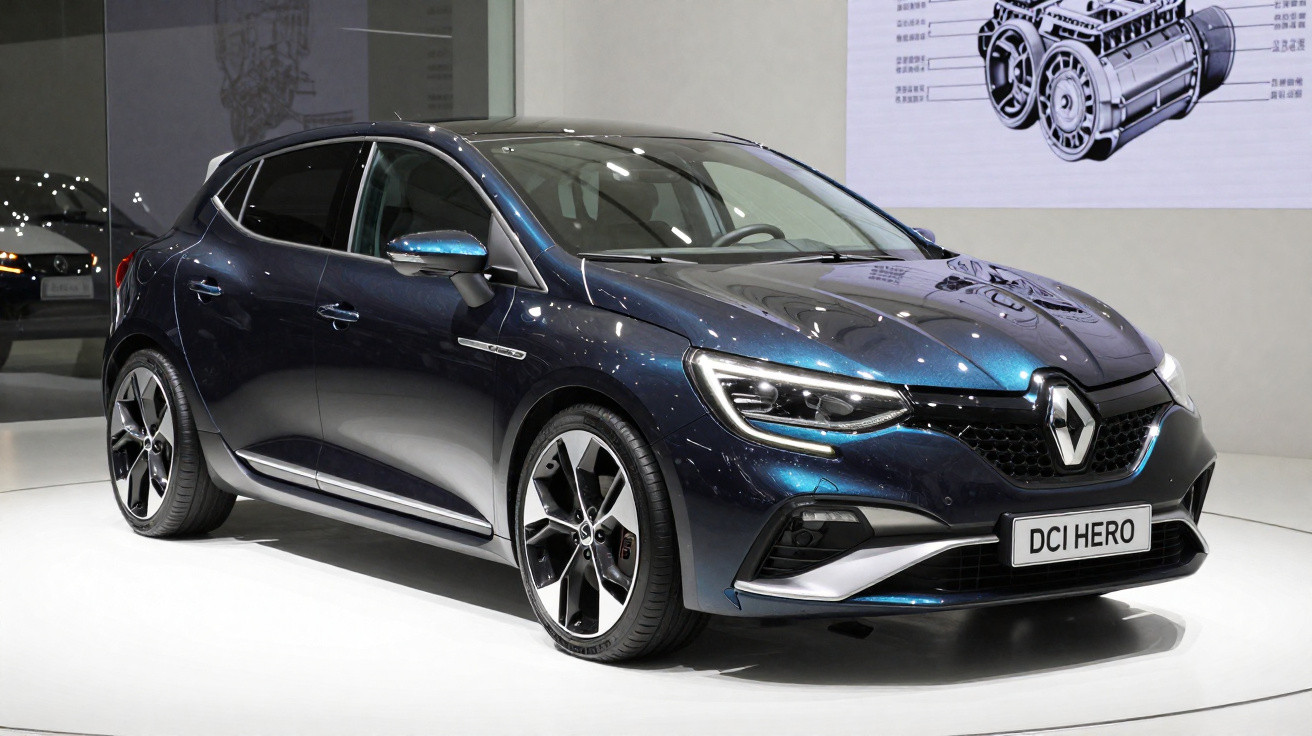
For weeks, rumours suggested that Mercedes might turn to BMW engines. The story has since been denied, but it brought to mind another - very real - connection between the Stuttgart brand and Renault.
Yes, Mercedes has already used a Renault engine - and it currently uses another, albeit bearing the Horse badge, the French marque’s internal-combustion engine division in a joint venture with Geely. Nor was it just any engine.
We are talking about the K9K, best known as the 1.5 dCi: one of the most widely produced Diesel units of the past 25 years, celebrated for its efficiency, simplicity and durability - although we will come to the big-end bearing shells shortly. Its fuel consumption was so low that I believe I still hold the “unofficial record” for the most economical (and slowest...) lap of the Estoril Circuit:
A hero without a cape (or big-end bearing shells...)
The K9K arrived in 2001, when Renault was establishing itself as a benchmark for compact Diesel engines. With a capacity of just 1,461 cm³, it used four cylinders, common-rail direct injection and, in the more potent variants, a variable-geometry turbocharger - from the 105 hp versions onwards (K9K 732 and later).
It subsequently gained an intercooler, a particulate filter and successive electronic-management upgrades, yet its fundamental character never changed: low fuel use, smooth running and robustness.
With a 76 mm bore and an 80.5 mm stroke, it represented a well-balanced mechanical package. It was capable of serving in thousands of different models and meeting several European emissions standards, from Euro 3 to Euro 6. A genuine example of longevity.
That said, the first generation of the K9K 1.5 dCi carried a poor reputation for many years. Premature wear of the big-end bearing shells, unreliable turbos and a temperamental injection system caused some headaches for owners.
As you may have gathered from the video shared above, I was one of those owners. However, perhaps because I used only good-quality oil (always!), I experienced issues with just two injectors, at 170,000 kilometres.
At around 220,000 kilometres, I asked for the big-end bearing shells to be changed as a precautionary measure. Fortunately, the work proved unnecessary: there were no signs of wear. I sold my Renault Mégane II with 300,000 kilometres on the clock and, as far as I know, it is still on the road...
Later, I bought a 2005 Renault Scénic II and had no engine problems whatsoever. Clearly, the K9K unit outlasted other Renault components, such as the electric window mechanisms, central locking and electric handbrake. But let us return to the “hero” of this Autopédia article...
Renault 1.5 dCi engine: from 65 hp to 116 hp
Over almost two decades, the 1.5 dCi steadily gained power and refinement. It began modestly with 65 hp and 160 Nm of torque, eventually reaching 116 hp and 260 Nm in its final versions. Throughout, it retained very low fuel consumption and above-average reliability - provided servicing was carried out properly and on schedule.
As mentioned earlier, this engine’s lifespan was so remarkable that it went through four generations over 20 years. The most troublesome, as I have already explained, was the first, produced between 2001 and 2005.
The second generation, built from 2005 to 2010, brought improvements in both output and reliability. Its most significant development, however, was the adoption of a six-speed manual gearbox. Fuel economy benefited, as did compliance with stricter emissions rules.
Some argue that the third generation, sold from 2010 to 2016, was the most dependable of all. The weaknesses of earlier versions had been addressed, while the K9K had not yet been required to meet emissions regulations as demanding as those imposed on the fourth generation, from 2016 to 2021.
During this period, Renault’s 1.5 dCi engine powered models including the Clio, Mégane, Scénic, Kangoo, Modus, Dacia Sandero, Logan and Dokker. Through the Renault-Nissan Alliance, it also found its way into the Micra, Juke, Note and Qashqai. Perhaps more surprisingly to some, it was also fitted to the Mercedes-Benz A-Class, B-Class and Citan.
A proudly German French engine
For Mercedes, the K9K engine was a pragmatic choice. The aim was to offer entry-level versions with low fuel consumption and reduced running costs, ideally suited to fleets and markets where diesel still dominated. Portugal was one such market for many years.
The decision was not only strategic but technical as well: the 1.5 dCi was compact and light, and it fitted perfectly within the transverse-engine layout of the German marque’s smaller models. The outcome was an unlikely but effective union between strong German brand appeal and French engineering.
Returning to Portugal, it was the perfect match for the national car market for many years. Renault and Mercedes consistently occupied first and second place in the sales charts, respectively. Both were largely buoyed by the humble yet hard-working K9K.
Although it remained 100% French, the engine received several modifications for Mercedes service, chiefly to make it run more smoothly. In 2018, we wrote about those differences:
An icon disguised as a workaday engine
Today, the K9K is regarded with respect - and a certain amount of nostalgia - by enthusiasts and mechanics alike. It survived more than two decades of emissions regulations, millions of kilometres and an enormous variety of models.
In a world preparing to leave Diesel behind, the 1.5 dCi will go down in history as one of the last truly universal engines. An engine born at Renault, adopted by Nissan and Dacia... and which, for a time, made the three-pointed star shine with a French accent.
And yes, I also prefer petrol engines, but some Diesel engines deserve more than a footnote. The K9K is one of them; the PD130 is too, but that is a story for another day...
Comments
No comments yet. Be the first to comment!
Leave a Comment