
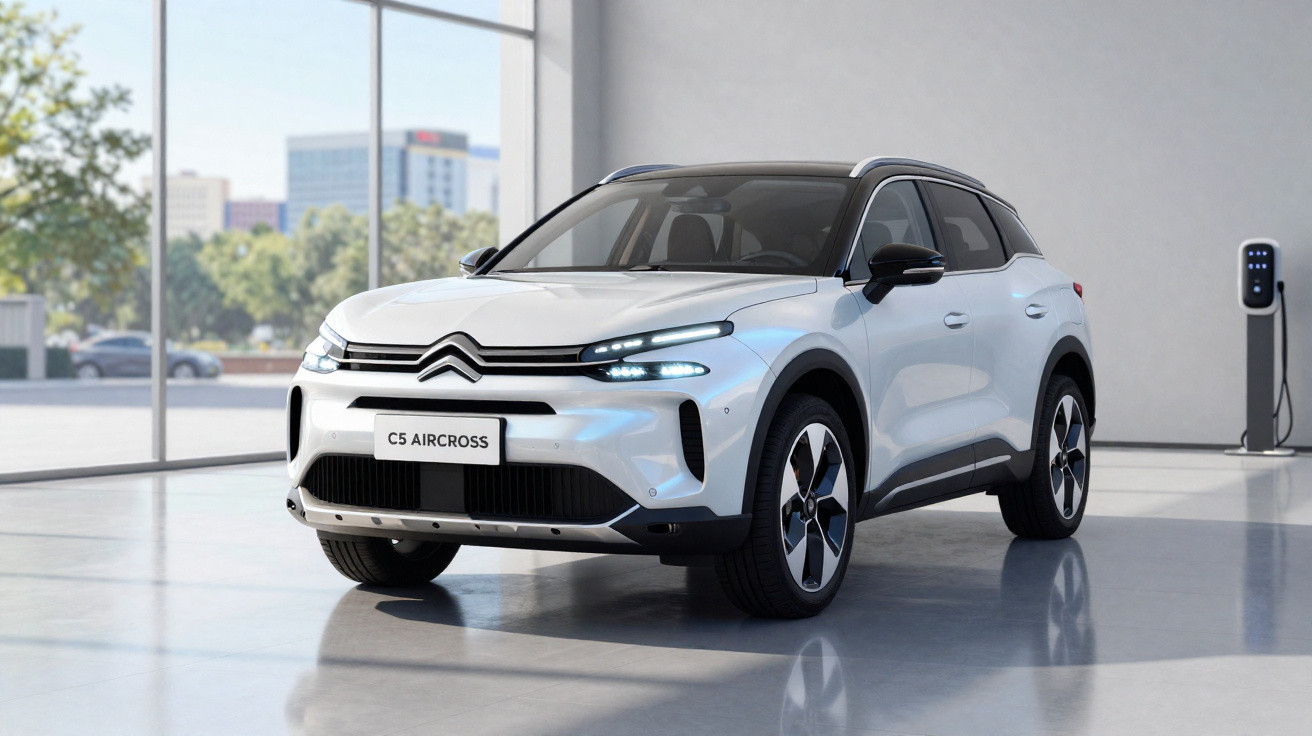
All plump proportions and a childlike stare, it looks rather like an oversized toy. The new Citroën C5 Aircross has been renewed from nose to tail and gains an all-new electric version. We take the wheel of this 680 km-range cushion on wheels.
Although it is not as tiny as the Peugeot cousin’s, the Citroën C5 Aircross steering wheel remains vastly easier to turn. Rest your little finger on one of the wheel spokes and away you go: a three-point turn is dispatched with remarkable ease. Since getting lost is not an everyday occurrence – at least, one hopes not – this exceptionally light steering is hardly essential.
Its supple damping matters far more, and here the C5 Aircross delivers. Speed bumps, uneven road joins and manhole covers are absorbed with composure. The dampers with hydraulic bump stops can still thump at low speeds, but overall ride comfort is of a very high standard. It is soft and, inevitably, not especially dynamic either, as body movement is plentiful.
A Citroën C5 Aircross at ease on motorways
Pair that with the heavily assisted steering and the result is a combination that offers little sense of what is happening beneath the tyres. Take it easy, then, especially as performance is plainly not startling, with a 0-100 km/h time that should only just dip below 9 seconds for our Long Range version. That is sufficient in absolute terms, but rather sluggish beside rivals that accelerate more briskly.
There is no hiding the fact that the Citroën C5 Aircross would rather cover motorway miles in complete serenity. Fortunately, the semi-autonomous driving system fitted as standard on the top-spec MAX trim works flawlessly and also includes automatic lane changes. Equally impressive, the sound insulation reduces turbulence to little more than faint whispers of air, despite the lack of laminated glazing. The route planner works efficiently and its forecasts prove accurate.
Strong range, but disappointing charging
Built on Stellantis’s STLA Medium platform, the Citroën C5 Aircross uses the same 97 kWh battery as the Peugeot 3008. Produced by French specialist ACC, this sizeable pack provides a 680 km WLTP range. That is meaningful given that motorway consumption of 23 kWh/100 km results in a 420 km driving range.
The optimism disappears abruptly when it is time to replenish those lost kilowatt-hours. While the 400V platform is said to support 160 kW DC charging, reality is quite different. The battery pack behaved rather unpredictably, peaking at just 50 kW even with the state of charge at 40%. This is difficult to understand, as we had carefully preconditioned the battery before charging.
A Citroën C5 Aircross with a basic electric set-up
At another charging station, with a similar battery level, the Citroën C5 Aircross this time hovered around 105 kW fairly consistently up to 60% charge. Better, certainly, but still not enough to reach the promised figures. Moreover, charging performance proved fairly erratic throughout our test. It is a puzzling issue which, we hope, was limited to our particular test car.
Turning to home charging, the SUV can accept up to 11 kW via a wallbox. We strongly recommend this option given the battery capacities available (73 or 97 kWh). Off-peak electricity customers will nevertheless have one small frustration: they cannot schedule a charging end time. Only the start time can be set, after which the car charges continuously until it reaches 80 or 100%.
Relatively nimble in town
There is no denying that the Citroën C5 Aircross has grown compared with the previous generation. Yet at 4.65 m long and 1.90 m wide, it is still not especially imposing. This makes it fairly manageable in urban areas. Its sharply defined 360° camera deserves praise, making obstacles easy to judge. The turning circle is another positive, unlike visibility. The particularly long bonnet can hinder manoeuvres, while the windscreen is narrow.
Rear three-quarter visibility is similarly restricted by a notably thick C-pillar. As for the brake pedal, it feels spongy at the start of its travel, which does little to inspire confidence. This weakness can partly be offset using the steering-wheel paddles that adjust regenerative braking across three levels. The strongest setting is surprisingly powerful, but it never provides a One Pedal function, which would be useful in town.
Spacious and comfortable
Fortunately, there are fewer compromises when it comes to life on board. The Citroën C5 Aircross offers generous space both in the front and rear. By replacing its individual seats with a fixed rear bench, versatility has declined, but comfort is marginally improved: the rear seat cushions are remarkably soft, while the adjustable backrests are attractively padded.
The central tunnel is minimal, allowing a third passenger to travel in reasonable comfort, though they must make do with a firmer backrest than those at either side. Rear occupants get air vents, but no ventilation adjustment controls, unlike the 3008, which can be specified with three-zone climate control. The boot, meanwhile, holds 651 litres with the seats in place and as much as 1,668 litres with the rear bench folded down. Storage spaces are generous.
An unmistakably distinctive Citroën C5 Aircross
How could a Citroën avoid taking the road less travelled? The C5 Aircross follows family tradition with a decidedly unusual design. First seen on the facelifted Berlingo, the C-shaped front lights are now supplemented by Matrix LED technology, a first for the chevron brand. Along the sides, there is ample plastic cladding, joined by optional 20-inch wheels, a size never previously offered by the marque.
Even more striking in styling terms, the rear wears spectacular Y-shaped light clusters that extend into the C-pillar. The visual effect is dramatic and certainly draws attention. Small coloured inserts on the front end and doors offer further personalisation. They are welcome, as the C5 Aircross colour palette is unexpectedly subdued for a Citroën, a brand naturally associated with originality.
Smart design, but reduced quality
The Citroën C5 Aircross completely revises its cabin presentation, with a straight-edged dashboard featuring a 13-inch vertically oriented touchscreen. The system is reasonably intuitive, and the climate controls, although touch-operated, remain permanently within reach. In front of the driver is a 10-inch instrument display, supported by a head-up display. It represents a major step forward in modernity compared with the previous model.
However, this newcomer takes a step backwards in perceived finish. The upper dashboard is made entirely from hard materials, which also appear on both the front and rear door panels. That feels a little underwhelming, with only plentiful recycled-fabric inserts attempting to make up for it. Covered by a gloss-finished panel, the steering-wheel buttons do not feel particularly premium. In addition, the glossy black centre console is prone to scratches.
A well-equipped Citroën C5 Aircross
The C5 Aircross keeps its pricing low, starting at 34,300 € as a mild hybrid and 39,490 € as an electric model. Those remain substantial sums, of course, but they sit below the Peugeot 3008’s entry price. The chevron-badged SUV does not skimp on standard equipment, however, including adaptive cruise control, keyless start, the 13-inch touchscreen, dual-zone climate control and 18-inch wheels.
The mid-range PLUS trim, from 37,240 €, adds a reversing camera, keyless entry, tinted rear windows, navigation, ambient lighting and rear air vents. Finally, the range-topping MAX, available from 40,180 €, completes the package with Matrix LED headlights, an electric tailgate, a 360° camera, a head-up display, an electrically adjustable driver’s seat and a heated steering wheel.
Prices are competitive given the equipment provided. The line-up is currently incomplete, though, as the Long Range electric version we drove cannot yet be ordered. ACC batteries are being allocated first to the Peugeot e-3008 and DS N°8. Citroën will have to wait. For an indication, the Citroën C5 Aircross MAX with the standard battery costs 45,370 €. Since the long-range Peugeot e-3008 requires nearly 6,000 € extra over the standard version, it is almost certain that the identically equipped battery version of the C5 Aircross will not qualify for the ecological bonus in MAX trim.
Our verdict on the Citroën C5 Aircross
Comfortable, distinctive and spacious, the Citroën C5 Aircross also has the good sense to be priced below its cousins. Yet it does not forgo modern equipment or the long-range battery, which will shortly join the catalogue. As an extra benefit, it is built in France at Stellantis’s Rennes-La Janais plant. Could it be Stellantis’s best-value proposition?
Citroën ë-C5 Aircross Long Range MAX
50,000 € (Estimate)
Verdict
8.5/10
What we like
- Outstanding comfort
- Convincing range
- Comprehensive equipment
- Relatively reasonable prices
What we like less
- A complete lack of dynamism
- Unconvincing finish quality
- Temperamental rapid charging


Comments
No comments yet. Be the first to comment!
Leave a Comment