
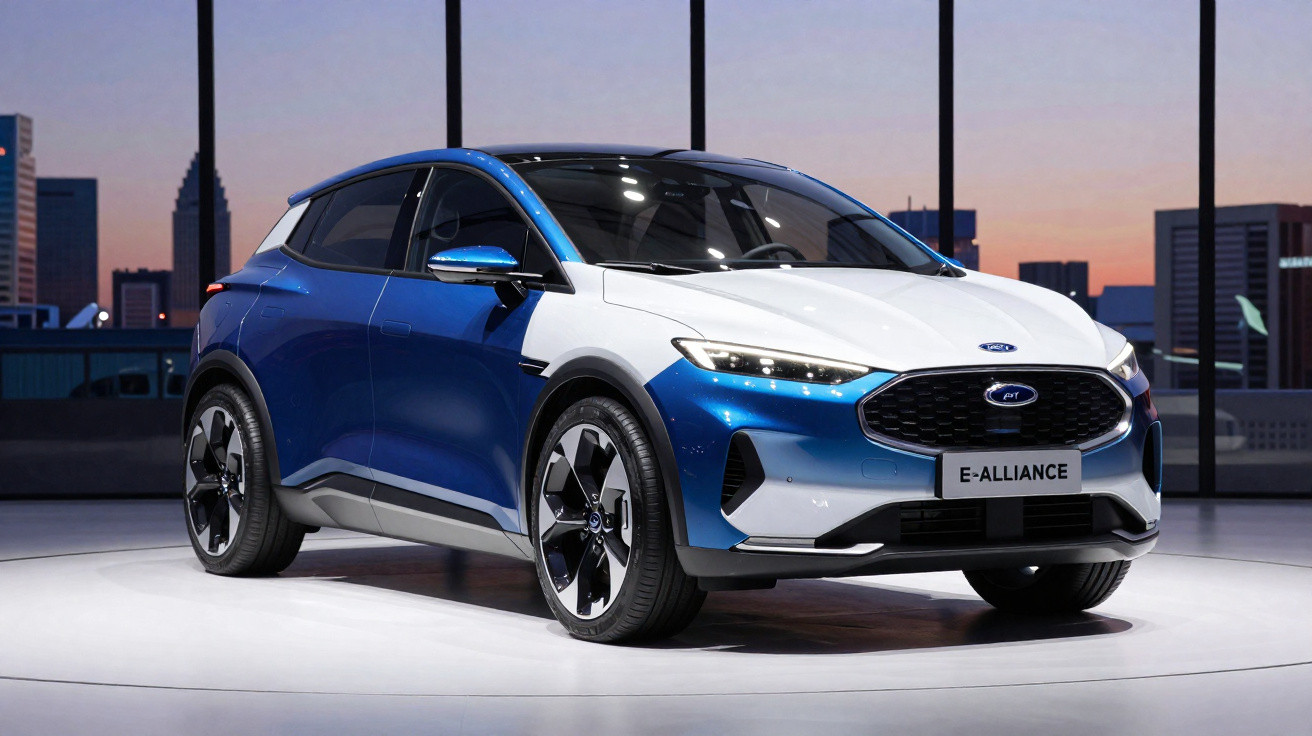
A long-established US manufacturer is pulling the emergency brake and seeking backing in Europe – of all places, from Renault.
Its aim is to stand up to China’s growing power in the electric-car market.
The mood in Europe’s electric-vehicle business is shifting. Rather than going it alone, manufacturers are increasingly turning to alliances to keep pace with the extraordinary speed of Chinese rivals. Ford has now taken a strikingly clear new direction: the US group is bringing Renault in as a strategic partner, explicitly responding to China’s cost and technology drive.
Why Ford is turning to Renault now
Ford and Renault have signed a memorandum of understanding that amounts to far more than a loose collaboration. At the heart of the agreement are jointly developed mass-market electric cars and electric vans for Europe. Production is scheduled to begin in 2028.
Ford is deliberately avoiding the construction of new factories of its own and is buying into Renault’s existing EV platforms – a radical strategic shift for the US giant.
The vehicles will be built at the ElectriCity network operated by Ampere, Renault’s subsidiary, in northern France. The complex includes the Douai, Maubeuge and Ruitz plants, which employ about 5,000 people in total. Several new models are set to roll off the production lines there.
Joint compact electric cars for the “affordable” market
The partnership will focus on at least two compact entry-level electric cars. They are aimed at buyers seeking an inexpensive EV that works for everyday use – precisely the segment in which Chinese brands are currently gaining substantial ground.
The cars will use the AmpR Small platform, which Renault already deploys for several models:
- Renault 5
- Renault 4
- the next generation of the electric Twingo
This architecture is not exclusively a European project. Parts of its development were carried out with Asian partners, while many of its components come from China. Renault has therefore created a global modular system that cuts costs and shortens development cycles. This is exactly where Ford is joining in, rather than spending billions on an entirely new European platform of its own.
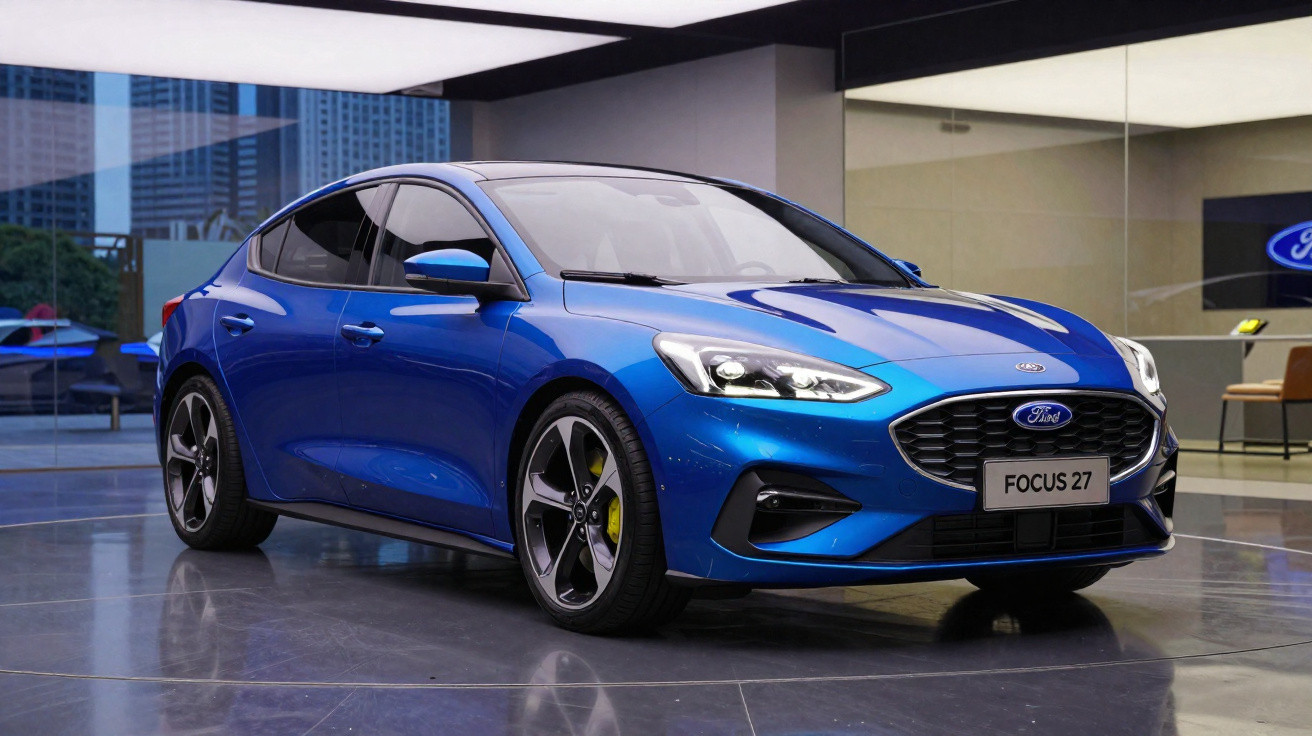
For Ford, this is about more than efficiency. The company has already greatly reduced its traditional combustion-engine line-up in Europe, and the familiar Focus range has only just left the catalogue. Management’s approach is clear: Ford intends to retain a presence in the affordable passenger-car segment while keeping financial exposure low.
Ford chief executive Jim Farley is pursuing a “highly efficient” industrial model: share rather than build everything from scratch, particularly in response to pricing pressure from China.
Vans form the second pillar of the alliance
The deal covers not only passenger cars but also light commercial vehicles, a sector in Europe that is rapidly moving towards electric propulsion. This transition is being driven by fleet customers, logistics firms and tighter climate requirements in cities.
Ford is specifically interested in Renault’s new family of electric vans, including:
- Trafic Van E-Tech
- Estafette E-Tech
- Goelette E-Tech
These models are expected to offer ranges of up to around 450 kilometres and are clearly designed for urban operations. One detail demonstrates how seriously Renault takes real-world usability: the Trafic E-Tech has a turning circle of 10.3 metres, making it about as manoeuvrable as a Clio, yet the long version provides up to 5.8 square metres of load space. Meanwhile, the Estafette lets occupants stand upright inside the cabin – a practical benefit for delivery drivers and tradespeople.
By using these platforms, Ford avoids the costly task of creating a dedicated electric-van range for Europe. In a market where standards, safety requirements and investment demands are high, this could save the group years of work and billions in spending.
For Renault, the agreement secures production volumes and reinforces the credibility of its new generation of electric vans – backed by a heavyweight such as Ford.
The quiet geopolitical signals behind the partnership
Beneath the surface, the partnership is about more than technology and cost: it also has an industrial-policy dimension. Ford could certainly have chosen to use the European production capacity of Chinese manufacturers. In the short term, that would probably have been cheaper.
Instead, the US group has selected a European partner with substantial French manufacturing sites. At a time of rising trade tensions with China, this sends a clear message to Brussels and Washington: Ford is supporting European value creation rather than expanding Chinese factories within the EU.
The arrangement does not, however, operate entirely without China. Renault is deeply connected to Asian supply chains, particularly for batteries and electronics. That is already causing noticeable displeasure in Chinese trade media. Some observers there see Renault as a company that, despite close co-operation on components, is slowing the expansion of Chinese brands in Europe.
Europe searches for an answer to China’s electric-car offensive
The Ford-Renault alliance reflects a wider trend. Chinese manufacturers are flooding the European market with electric cars that are often less expensive than European models despite offering comparable, or even superior, technology. Many western groups struggle to match those prices without giving up substantial margins.
Partnerships like this could become one building block in addressing that cost advantage:
- shared platforms reduce development and manufacturing costs
- higher volumes lower the price per vehicle
- closer integration of passenger cars and commercial vehicles improves factory utilisation
For European sites, this could mean greater production utilisation and a better chance of keeping up in the electric era – provided the models also appeal to customers.
What the alliance means for consumers and competitors
For motorists in Germany, Austria and Switzerland, the co-operation could bring more choice in the lower and middle price brackets. If Ford uses Renault platforms, several outcomes are possible: lightly rebadged versions, or distinct bodywork with American styling and French engineering underneath.
The key question will be whether Ford uses the new models to take on Chinese offerings directly in the budget segment – for example, through aggressive prices for fleet buyers, car-sharing operators or commuter vehicles with limited range but attractive leasing terms.
Rivals such as Volkswagen, Stellantis and Hyundai-Kia will be watching such alliances closely. Many already have their own highly streamlined EV platforms or battery-maker partnerships. Ford’s move raises the pressure to bring affordable compact electric cars and electric vans to market even faster.
Opportunities, risks and unanswered questions
The alliance offers clear benefits, but it also involves uncertainties:
| Aspect | Potential | Risk |
|---|---|---|
| Costs | shared investment, lower unit costs | dependence on joint decisions |
| Brand profile | more models, a broader range | risk of “standardised models” without a clear identity |
| Industrial policy | stronger European factories | conflicts with Chinese partners and suppliers |
| Technology | faster access to a modern EV platform | Ford has limited influence over the underlying architecture |
For customers, a practical question will arise later: how different will the Ford versions really be from their Renault counterparts? Will the distinction be limited to the badge, or extend to driving feel, software, infotainment and service offerings? That will determine whether the alliance is seen as a smart sharing project or simply a cost-cutting exercise.
There is also an often overlooked issue: electric vans have a key role in the cities of the future. Delivery services, tradespeople and municipal fleets all face the move to electric power. Once Ford offers these Renault-platform vehicles in large numbers, they could visibly reduce inner-city emissions and encourage new business models, such as night-time logistics or especially quiet delivery services.
Terms such as “platform” and “modular system” may sound dry, but they determine how quickly new models reach the market and at what price. AmpR Small is a strong example: one technical base developed once can support several vehicle types. This not only lowers costs but also improves the likelihood that spare parts will remain available for a long time and that software updates will continue for years. Ideally, this means better residual values and fewer maintenance and repair concerns for buyers.




Comments
No comments yet. Be the first to comment!
Leave a Comment