
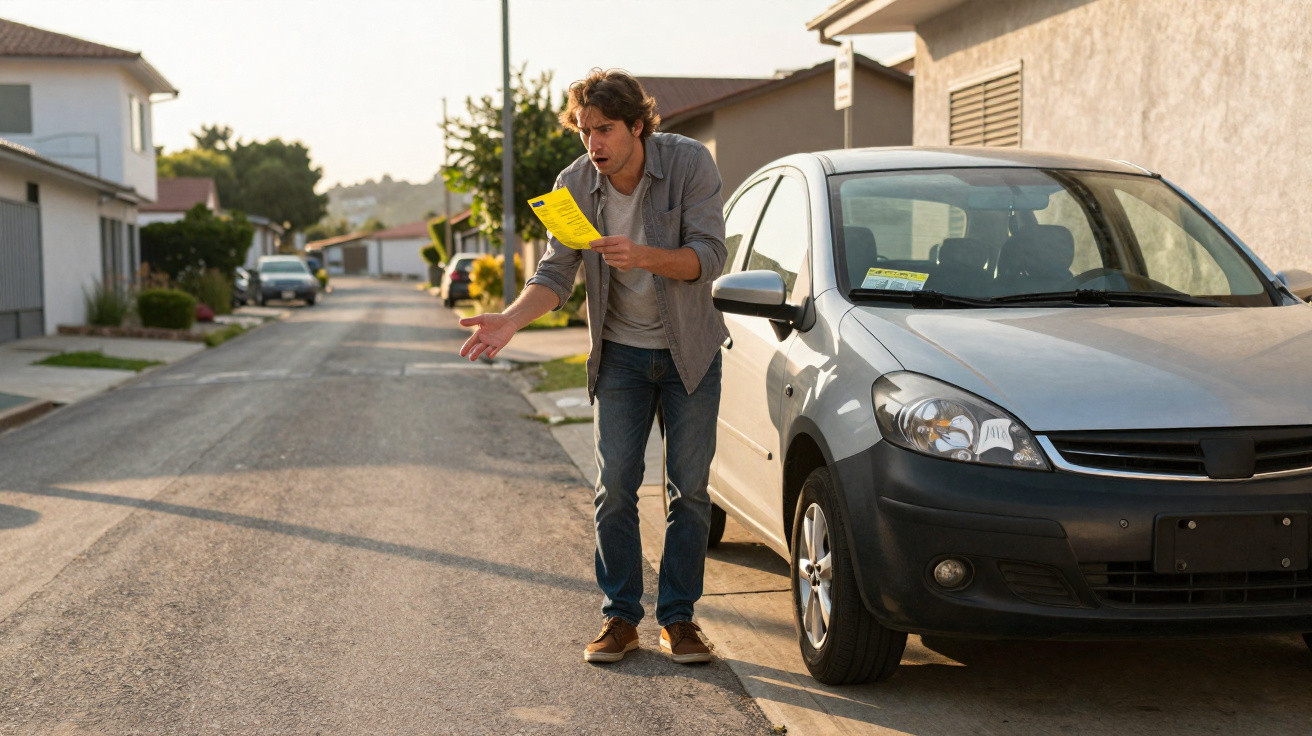
The yellow envelope was already beneath the windscreen wiper as he came round the corner. It was a silent cul-de-sac with no passing traffic or shops: only a terrace of weathered brick homes and a cracked strip of tarmac used for parking. There were no painted bays, kerbs or pavements.
Holding the ticket, he read the allegation: “Contravention – parking on the pavement.”
He checked his tyres. Both were on the road. There was nothing more than tarmac running into the edge of a resident’s front garden.
A neighbour on the opposite side offered the familiar half-smile and half-shrug that means: “Happens all the time, mate.”
The penalty was genuine. The pavement was not.
That was when the real story began.
“Parking on the pavement” where there is no pavement
The motorist was Mark, a 38-year-old electrician who spends more of his time on UK side streets than in his own sitting room. That month, he had parked on the same section of road three times, always close to the edge to leave enough room for vans to get through.
There was no kerb, raised paving, or dropped kerb. Only a scuffed line where passing feet had worn down the grass.
The notice said he had been “parked with one or more wheels on or over a footpath.” In legal terms, that footpath supposedly included a pavement that did not exist and on which nobody could actually stand.
Later that night, Mark studied the photographic evidence. It showed his car, a strip of tarmac and no room for pedestrians - only an assumption.
His experience is far from unique. Throughout the UK, councils are steadily increasing enforcement against so-called pavement parking, including on roads where a proper pavement was never constructed.
In 2023, certain local authorities recorded tens of thousands of penalties for “obstruction of the highway” and “footway parking”, affecting motorists on country lanes, partly completed housing developments and difficult cul-de-sacs.
Social media is full of photographs of tickets attached to windscreens where the supposed “pavement” amounts to a muddy verge or a barely visible band of gravel. The formula is familiar: a baffled driver, an unclear rule and a certain-looking civil enforcement officer.
One London borough set a new record for parking penalty revenue last year. Local people had spotted the shift well before it made the headlines.
What is happening sits at the intersection of three forces: legal definitions, the streets people actually use and councils short of money.
Under traffic law, a “footway” or “pavement” may be any part of the highway not intended for motor vehicles, rather than only a clearly kerbed and surfaced pedestrian route. A bare tarmac edge beside a fence can therefore be treated as pedestrian space, even when no ordinary person would describe it as a pavement.
Meanwhile, residents are encouraged to keep the carriageway open for emergency services, cyclists and pushchairs, yet may be penalised for moving a vehicle a few inches aside. The boundary between consideration and a fine is regularly impossible to see. Quite literally.
How to protect yourself when the pavement is “invisible”
When parking on streets without clearly defined pavements, the first rule of self-preservation is straightforward, if frustrating: behave as though a pavement is there regardless.
Watch for the physical features relied upon by councils and enforcement officers: a band of tarmac that simply appears suitable for walking, a grass verge marked by foot traffic, or a boundary wall that seems to signal where private land begins.
As a basic test, picture an adult pushing a buggy along the road edge. If your tyres occupy the space where that person’s feet could go, you may be in the risk area.
Take a fast photograph of the way you have parked, particularly where the layout is unclear. That two-second precaution could prove invaluable later.
Drivers repeatedly make the same understandable errors. They follow the example set by other vehicles and assume it must be permitted. A row of cars on a verge or parked tight against a fence can lead them to think, “If that was illegal, someone would have said something by now.”
They may also fail to appreciate how inventive enforcement can become when budgets are under strain. Some councils regard any movement onto a surface outside the carriageway as enforceable, whatever it appears to be on the ground.
On a personal level, an unexpected penalty can feel like criticism rather than mere paperwork. It does not simply say that you parked incorrectly; it suggests you ought to have known the rules in a place with no obvious markings.
An appeal against a ticket such as Mark’s should begin with research, not outrage.
Check the precise contravention code. Ask the council for its photographs. Find the Traffic Regulation Order covering the street, if one exists. Then set the legal language alongside what can genuinely be seen on site.
“The law doesn’t always match reality, so your job is to drag reality into the frame,” a motoring law advisor told me. “Photos, maps, measurements – these are your leverage.”
- Photograph your parking position from multiple angles every time.
- Record the full street scene, rather than only the vehicle.
- Draw attention to missing kerbs, signs, markings and pedestrian indicators.
- Write any appeal in a composed, factual manner.
- Request the legal basis on which the area is defined as a footway.
What this strange fine says about our streets – and us
Mark eventually submitted an appeal containing three straightforward photographs and a single direct question: “Where exactly is the pavement I am accused of parking on?”
His images showed one uninterrupted expanse of roadway from one brick wall to the other. There was no kerb, level difference or feature separating “car space” from “people space”.
Several weeks afterwards, the council discreetly withdrew the ticket, sending a brief note that read much like a shrug. There was neither apology nor explanation, only administrative quiet and the sentence: “The authority has decided to exercise discretion on this occasion.”
The penalty disappeared, but the uncertainty remained.
We are at an unusual point in the way streets are shared. Cars are ubiquitous, pedestrian safety is at last receiving greater attention, and councils face pressure to tackle disorderly parking.
Yet housing estates are also being fitted into residual plots of land, creating incomplete pavements, inconvenient verges and narrow roads. Rules created for broad Victorian streets and formal footways are being applied to places that resemble a patchwork.
On a difficult day, the situation can seem like a trap. On a better one, it is simply untidy and human: neighbours attempting to accommodate one another in environments that were never properly planned.
At a more fundamental level, Mark’s story touches on something commonplace. In a cul-de-sac at 7 pm, the real rules are generally unstated: do not obstruct a driveway, do not prevent the bin lorry from passing, and do not irritate the person whose window faces your exhaust.
Then a ticket arrives one morning, reminding the entire street that another set of rules exists - drafted elsewhere and enforced by someone who does not live there.
Every day, we improvise in the shared spaces around us. On some days, that improvisation is courtesy; on others, it is a contravention code.
Let’s be honest: nobody really reads the local road rules for every side street where they park.
The next time you ease your car onto what appears to be “just the side of the road”, Mark’s experience may come to mind. Not as a reason for fear, but as a quiet reminder to check the surface beneath your wheels twice.
Where does the road finish in legal terms? Where does a pavement start in an enforcement officer’s view? Those boundaries are not invariably marked by stone or concrete; often, they are established afterwards in official paperwork.
Perhaps the question is not solely about how we park, but whether our streets truthfully reflect how people actually live, walk and drive.
It is a discussion worth having - on the pavement, in the road, or on the indistinct strip between the two.
| Key point | Detail | Why it matters to the reader |
|---|---|---|
| Unclear definition of “pavement” | The law can sometimes regard any space not intended for vehicles as a footway, even with no visible kerb. | Explains why a ticket can be issued where no pavement plainly exists. |
| Importance of visual evidence | Wide street photographs, several angles, and evidence of absent markings and kerbs. | Shows what to document when challenging a fine considered unfair. |
| Structured appeal strategy | Examine the contravention code, request the council’s evidence, and remain factual and precise. | Improves the likelihood of having a penalty notice cancelled. |
FAQ:
- Can I really be fined for parking on a “pavement” that doesn’t exist? Yes. If the authority classifies part of the highway as a footway or pedestrian space, it can issue a ticket even when there’s no physical curb or paving slabs.
- How do I know where the pavement legally starts and ends? There’s no single visual rule. Look for curbs, different surfacing, grass verges or boundaries. In doubtful areas, councils often treat the outer strip of the road as footway.
- What should I include in an appeal for this kind of ticket? Include wide photos of the street, close‑ups of where your wheels were, a calm explanation, and a direct request for the legal basis defining that area as a footway.
- Does paying the fine mean I accept I was wrong? Legally, paying closes the case, but it doesn’t create a public record of guilt. If you strongly disagree, use the formal appeal stages before the discount period expires.
- Should I copy how other cars are parked on the same street? Not safely. Other drivers might simply be getting away with it that day. Use your own judgment and imagine where a pedestrian would naturally walk.





Comments
No comments yet. Be the first to comment!
Leave a Comment