
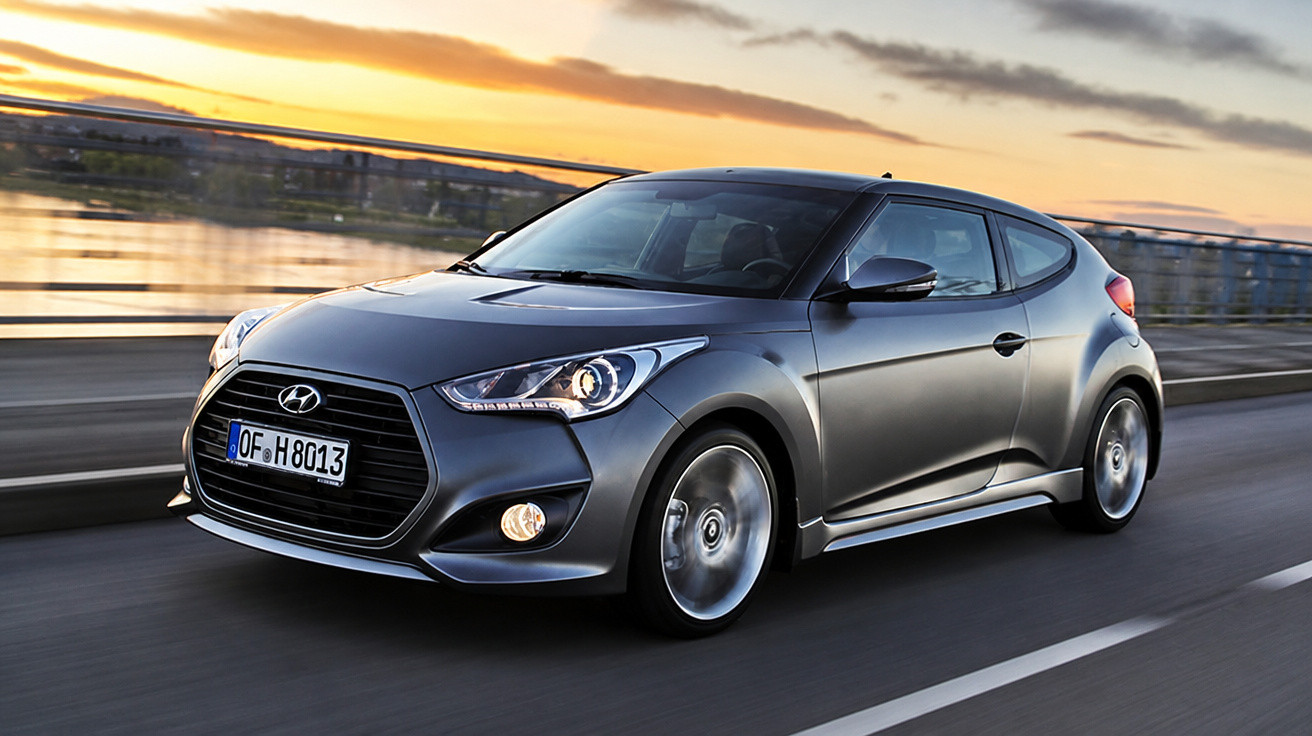
Hyundai Veloster Turbo: more than its doors
When the Hyundai Veloster first arrived, conversation invariably centred on its doors. Its unusual, inventive configuration - two doors on the kerb side and one on the road side - brought attention to both the Veloster and Hyundai itself. It conveniently also drew focus away from the fairly ordinary mechanical specification beneath.
The Veloster now has a turbocharger, however. So, useful as that door arrangement may be on the school run, it is time to ignore it and assess this as an affordable sports coupé. A fast-reacting twin-scroll turbo on the direct-injection engine lifts output to 186bhp, with torque rising to 264Nm. In keeping with that, it gains 18-inch wheels, firmer suspension, revised steering gearing and weighting, plus more substantial brakes. Just as you would anticipate.
A more purposeful Hyundai Veloster Turbo
It has a more serious appearance as well, particularly in the matt-black finish fitted to our test car. Normally, I consider this sort of paint a gimmick for people desperate for attention - the kind who wear sunglasses in the dark. On the Veloster, though, I will allow it: the finish absorbs light and softens the bodywork’s slightly overdone creases and bulges.
For the Turbo, the body kit comprises a larger single-grille opening, a spoiler, side skirts around the car’s lower edges, and, at the rear, two centrally mounted exhaust outlets as large as storm drains within a diffuser-style panel. The rear end is about as understated as a baboon’s. It certainly looks as though it means business.
Engine character and chassis impressions
The engine performs broadly as its figures imply. This Veloster Turbo differs slightly from the version sold in America, which produces more power at high revs, at 201bhp, but less torque. Even so, I suspect the UK tune is the preferable one, since the engine becomes rather gruff and joyless at high rpm; exploiting the mid-range boost is therefore the better approach.
My drive was brief and took place in exceptionally wet Germany, so do not regard these chassis impressions as final. Even so, the steering felt more progressive than that of the standard car, as it needed to be. I am less convinced that the ride required stiffening. Hyundai says it has added sound insulation to reduce road noise - a genuine UK issue with the regular model - although we will need more time with it to confirm that.
Strong equipment, formidable rivals
Hyundai has sold roughly 1,000 standard Velosters in the UK, demonstrating that buyers clearly respond to its styling and three-door layout. Equipment levels are generous, too. Yet at Turbo level, I would expect customers to place greater value on dynamics. If so, the competition offers some intensely tempting alternatives.

Comments
No comments yet. Be the first to comment!
Leave a Comment