
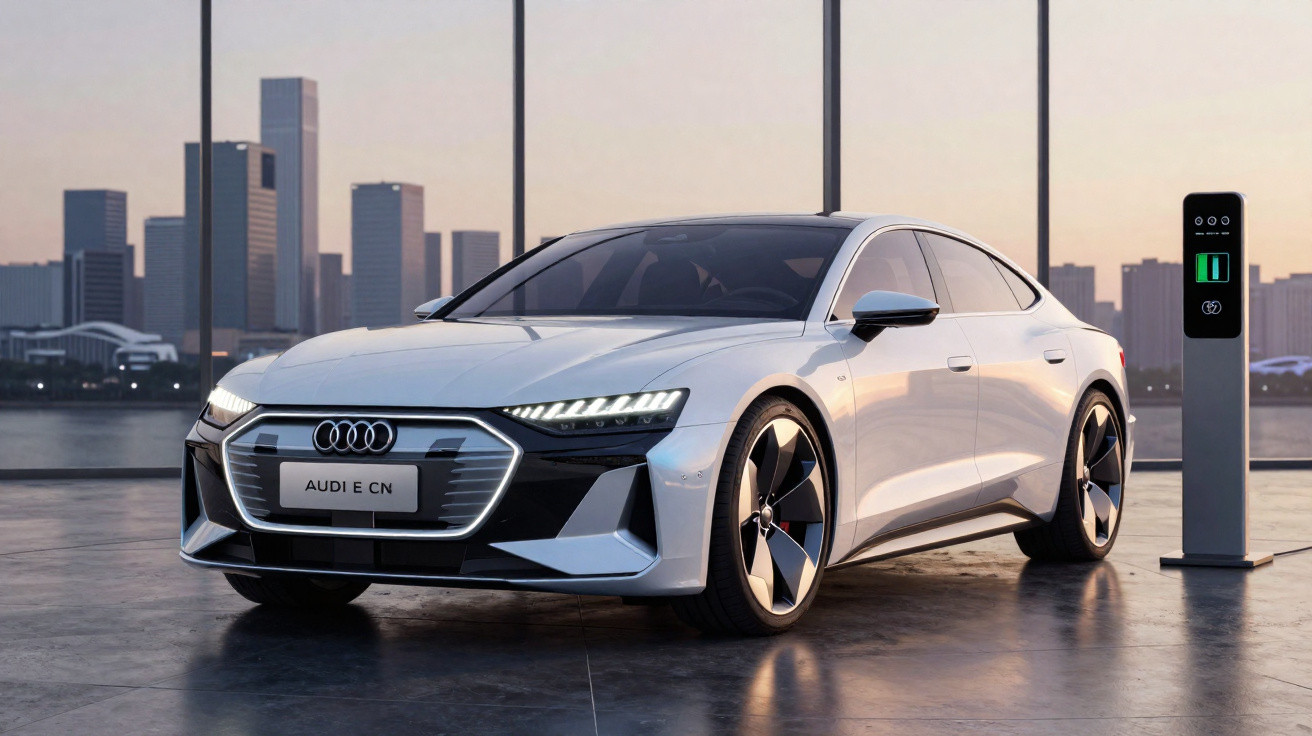
From today, there is an Audi and an AUDI. Can you spot the difference? It is simply the way the name is written: the latter uses capital letters only.
It may initially seem confusing, but the purpose is straightforward: to succeed in China, Audi’s second-largest market, while ensuring its product range meets the expectations of Chinese premium-car buyers. Those expectations differ from those of European and North American customers, and Chinese buyers are also considerably younger.
To make sure it hits the mark, Audi entered into a partnership with SAIC - the owner of brands including MG - in the middle of last year. SAIC provides the platform and technologies required by the Chinese market.
The first without the rings: AUDI E
Audi has now unveiled the AUDI E, a prototype previewing the first production model from this partnership, which is due next year. The rumours have proved correct: AUDI models will lose the iconic four rings that have identified the brand for almost its entire history.
As the images show, the new marque is represented solely by the letters forming the AUDI name, both at the front and rear.
Indeed, the exterior design of the AUDI E is markedly different from the Audi models seen on the road today. There is, for instance, no trace of the Single Frame grille that has defined the front end of every model from the brand this century.
Instead, there is a black rectangular surround with rounded corners, incorporating all of the visual and functional features: the headlamps, light signature and illuminated logo. It also houses the multitude of radars and sensors needed for automated driving. The rear uses a comparable solution, although there it takes on a trapezoidal shape.
The rest of the bodywork, described by AUDI as having a Sportback silhouette, is defined by clean surfaces and smooth forms, along with pronounced shoulders. Nearly all the sharp edges and creases normally associated with Audi have been removed.
The cabin is equally unlike the usual German-brand interior. It could scarcely contrast more with the interiors of the new A5 or Q6 e-tron. Minimalism is clearly the guiding principle, with virtually no buttons in sight.
Attention is focused on the curved 4K touchscreen, which stretches from the left-hand A-pillar to the right-hand A-pillar, spanning the full width of the interior. The prototype also does away with conventional door mirrors, replacing them with cameras.
The centre console includes storage for two mobile phones, while the doors feature illuminated wood and microfibre in a three-dimensional louvre design.
Exclusively electric, naturally
Unlike Europe, where electric-car sales are contracting, China is seeing the opposite trend. Sales continue to rise, so it is no surprise that the AUDI E is entirely, and exclusively, electric.
This generously proportioned prototype sits on a new platform jointly developed by Audi and SAIC, named Advanced Digitized. It features an 800 V architecture to enable ultra-rapid charging. AUDI says that 10 minutes of charging provides an additional 370 km of range under the Chinese CLTC cycle.
Its 100 kWh battery capacity nevertheless delivers 700 km of range, again according to the Chinese cycle.
Power and performance are certainly not in short supply in the AUDI E. It has two motors, one on each axle, producing a combined output of 570 kW - equivalent to 765 hp (!). Torque is equally substantial, at 800 Nm.
The pair of motors provides all-wheel drive - still called quattro - and enables the AUDI E to reach 100 km/h in just 3.6 seconds.
Next steps
The production AUDI E is expected to reach the Chinese market in mid-2025, and it will not be alone.
At least two further new models are under development. Like this one, they will be exclusively electric and are expected to sit in the D and E segments - equivalent to the A5 and A6 respectively.
Comments
No comments yet. Be the first to comment!
Leave a Comment