
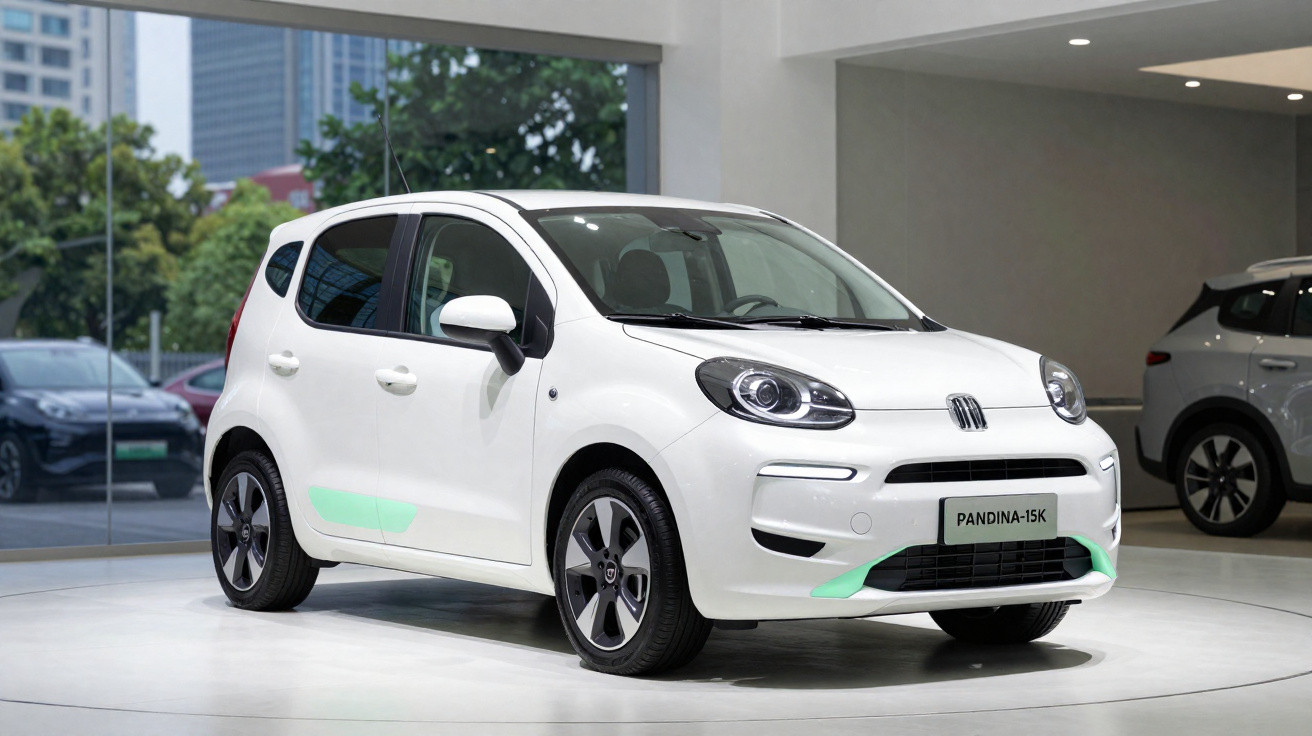
Fiat wants to regain a stronger foothold in the fiercely contested city car segment with a new entry-level model. Internally already being discussed as a possible successor to the “Pandina”, the car is expected to combine electrified technology, straightforward solutions and aggressive pricing. Plenty of details remain unclear, but the direction of travel is gradually becoming clearer.
New entry-level Fiat comes into focus
Fiat is approaching a significant reshuffle of its model range. Following the 500, 600 and Grande Panda, it currently lacks a genuine entry-level car of the kind once represented by the legendary Panda and Seicento. This new urban runabout is intended to fill that gap and boost volume sales.
Its official name has yet to be confirmed, although much points to Fiat retaining the “Pandina” badge. For now, that name identifies a version of the current small combustion-engined model. In future, it could be used for an entirely new and contemporary small car that signals the move into the next generation.
The new Fiat urban runabout is expected to be positioned as a particularly affordable electrified alternative below the Grande Panda, with a clear focus on sales volumes.
The concept is scheduled to debut at the Paris Motor Show. Fiat plans to display several concept cars there, with one widely seen as a fairly certain preview of the eventual production model. The earliest answers on its design, interior concept and final technology are therefore likely to arrive in the autumn.
Electrified, but not solely for plug-in fans
Fiat is said to be taking a pragmatic technical approach. The new small car should appeal to as many customers as possible, from commuters without access to home charging to car-sharing operators chiefly looking for durable engineering.
Powertrain range with several options
Current information points towards a three-part line-up:
- Mild-hybrid version: a small combustion engine with 48-volt assistance to reduce urban fuel use.
- Fully electric variant: zero local emissions, suited to short trips and commuters.
- Conventional combustion engine: uncomplicated technology, probably aimed at keeping the purchase price low.
This would continue Fiat’s strategy already seen with the 600 and Grande Panda: offering different powertrains so every target group can choose the package that suits them. This matters particularly for city cars, as requirements vary widely, from purely urban driving to the occasional holiday journey.
What “mild hybrid” means in everyday use
Mild-hybrid systems use a small electric motor and an additional battery. They restart the engine smoothly, provide assistance when pulling away and can briefly support acceleration. They rarely, if ever, drive the car entirely on electric power, but can noticeably cut consumption in stop-start traffic.
For a value-focused Fiat small car, this is appealing because the technology remains less expensive than a full hybrid while still offering tangible efficiency benefits – especially in the environment where the vehicle will be used most often: city traffic.
Affordable city contender – the €15,000 threshold
“Affordability” is the key term surrounding the new Fiat urban runabout. While many city and small cars have recently become more expensive or disappeared from the market altogether, Fiat reportedly intends to deliberately counter that trend.
According to the Italian press, the entry price could be below €15,000 – a signal to anyone looking for a simple, modern yet affordable city car.
That would put Fiat directly into the territory of models such as the Renault Twingo E-Tech, which is also intended to win over urban drivers as a low-cost electric alternative. Depending on specification and powertrain, the new Fiat is likely to sit somewhat above that figure, but the entry-level offering is clearly intended to lower the price barrier.
Its positioning is therefore clear: less luxury, more practicality. Expect hard-wearing plastics rather than elaborate ambient-lighting gimmicks. A simple dashboard with a large central display, straightforward climate controls and clever storage solutions is conceivable, rather than lavish leather trim.
Fiat and Citroën technology partnership under discussion
To maintain this price point, Fiat will need to reduce costs in many areas. The wider group could play a central role. Fiat, Citroën, Peugeot and Vauxhall all belong to Stellantis, where the strategy of sharing as many components as possible has been growing for years.
Rumours therefore suggest Fiat and Citroën could work more closely together on the new entry-level car. Citroën is reportedly considering a return for the C1. The two vehicles could use the same platform and share engines, electronic components and suspension parts.
- shared platform for both city models
- common powertrains (mild hybrid, electric and possibly combustion)
- similar basic body structure, but distinct styling
- synergies in purchasing, production and development
A similar approach already exists with the C3 and Grande Panda, which are closely related technically beneath their bodywork. For Fiat, this means lower development costs, a faster market launch and ultimately a more competitive price.
Market launch no earlier than late 2025
Anyone expecting to see the new mini Fiat in dealerships tomorrow will need patience. Current market analysis assumes the production model will not go on sale before the end of next year. Broad availability could extend until 2027, depending on production planning and demand.
| Aspect | Expected details |
|---|---|
| Concept debut | Paris Motor Show, autumn |
| Production-model unveiling | expected in 2026 |
| Market launch | late 2025 or later, broad availability by 2027 |
| Price target | entry-level model below €15,000 |
| Powertrains | mild hybrid, electric, possible combustion engine |
Why the new Fiat city car matters so much to the brand
More than just another model is at stake for Fiat. The marque’s roots lie in affordable everyday cars, from the post-war 500 through to the Uno and Panda. In recent years, this area has come under pressure, not only because of stricter safety and emissions regulations, but also due to rising production costs.
With its new entry-level car, Fiat can demonstrate whether the balance between modern technology and fair pricing is still achievable. If the manufacturer can bring an urban runabout with an electric option and hybrid technology to the level of earlier “people’s Fiats”, the affordable small-car segment could gain fresh momentum.
Opportunities and risks for buyers
For motorists, the new Fiat model brings both benefits and unanswered questions:
- Price advantage: Below €15,000, choices in the new-car market are scarce. A credible offering would be a lifeline for many buyers.
- Urban suitability: Compact dimensions, tight turning circles and simple controls are ideal for congested city centres.
- Electrified variants: Drivers covering mainly short distances could substantially reduce consumption with electric or mild-hybrid power.
- Range uncertainty: The electric version’s exact battery capacity and charging speed have not yet been confirmed – crucial factors for commuters.
- Residual-value question: New technology in affordable cars can make residual values harder to predict, especially with batteries that age quickly.
Anyone generally considering a city car does not need an in-depth understanding of terms such as platform, mild hybrid or entry-level battery, but should keep several points in mind: how long are their daily journeys really? Is charging available at home or at work? And is the extra cost of hybrid or electric power genuinely worthwhile compared with a simple combustion engine?
For the forthcoming Fiat model in particular, the answer will depend heavily on the final technical data: range, charging times, consumption and servicing costs will ultimately determine whether the low entry price also makes sense in the long term. Those watching the Paris Motor Show will receive the crucial pieces of the puzzle step by step.


Comments
No comments yet. Be the first to comment!
Leave a Comment