
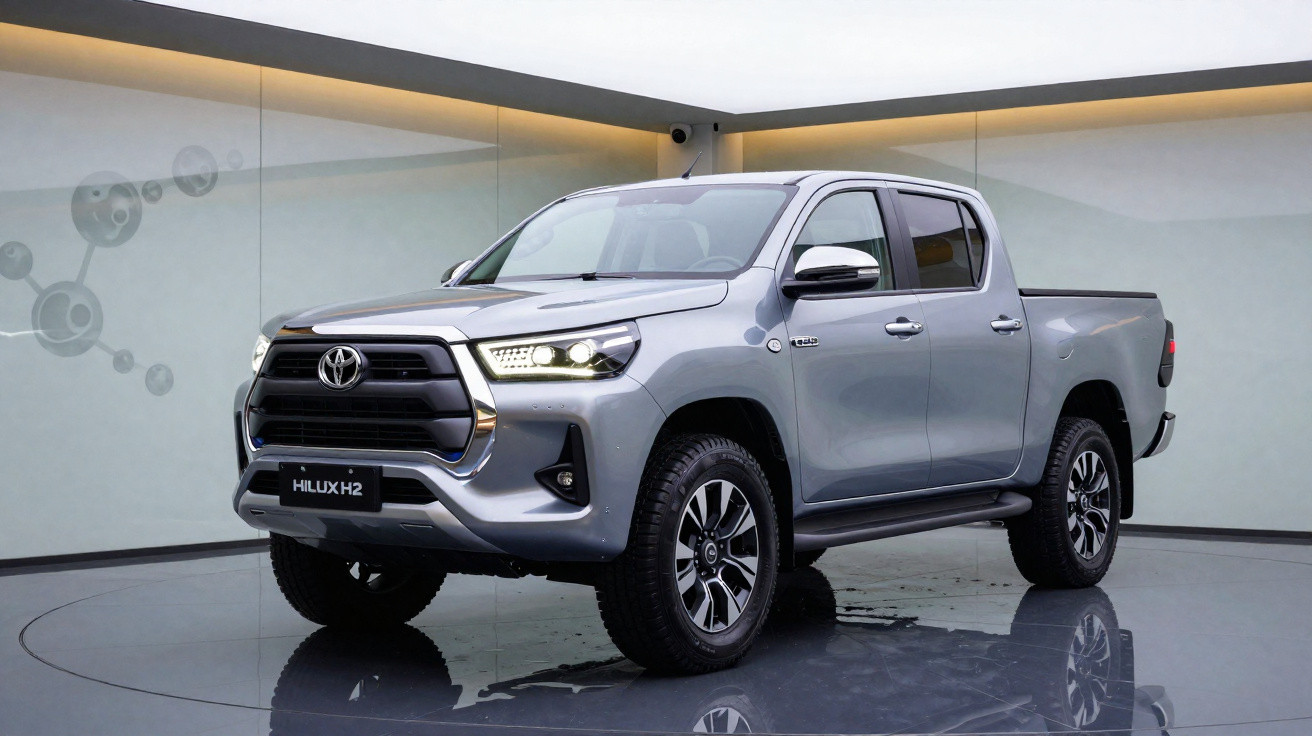
We first encountered the Toyota Hilux H2 (hydrogen) just over six months ago at the Kenshiki Forum - Toyota’s annual event for showcasing its latest developments. Now, however, the presentations are over and it is finally time to drive it. It is not yet a production model but a prototype, and the Japanese brand is also keen to assess the concept in real-world conditions.
For the moment, just 10 working prototypes exist, all built by Toyota Motor Manufacturing UK. Each will undergo an intensive testing programme intended to validate and further develop the hydrogen fuel-cell technology.
Each prototype is worth hundreds of thousands of euros, and I was handed the keys to one for an afternoon. I drove it - and occasionally pushed my luck - yet everything went smoothly. Here is what I found.
An alternative to battery-electric vehicles
Range, weight and charging time: in short, these are the key shortcomings currently associated with battery-electric vehicles. Fuel-cell vehicles readily address all three, although they bring challenges of their own, potentially more complicated ones. We will come to those shortly.
Toyota believes fuel-cell vehicles can provide a second route alongside electric vehicles in the difficult task of decarbonising transport.
According to the Japanese manufacturer, electric vehicles are not being called into question. Toyota’s approach is fundamentally pragmatic: “different needs, different technologies. One goal: less pollution”, a Japanese engineer told us as we once again examined the Hilux H2, looking for differences from the prototype we saw six months earlier.
Toyota is far from new to this technology. We have covered its work in this area several times, whether driving the Mirai or discussing the ‘hydrogen box’ that the Japanese brand already sells.
That is without overlooking the hydrogen fuel-cell bus produced in partnership with Portugal’s Caetano Bus. It was also present at this event and served as the shuttle taking us from the venue to the hotel.
The technology’s viable application
Although Toyota began by introducing this technology in passenger cars, the hydrogen fuel-cell’s true purpose may ultimately be found in commercial vehicles, both light- and heavy-duty.
The reality is that the Mirai and comparable models, such as the Hyundai Nexo, are a long way from becoming the success anticipated. The lack of a hydrogen refuelling network is perhaps the greatest obstacle to the wider spread of such vehicles. For now, hydrogen vehicles remain only a promise.
There are, nonetheless, some success stories: in cities such as Paris and Berlin, hundreds of Mirais operate as taxis. Yet commercial vehicles appear to offer the greatest potential for this technology to expand, with hydrogen fuel cells more effectively meeting the logistics sector’s decarbonisation requirements.
They immediately offer several benefits over battery-electric vehicles with equivalent roles: the entire system weighs less, allowing for greater payload capacity. At the same time, it delivers longer range and refuelling times that are virtually identical to those of combustion-engined vehicles.
The Toyota Hilux H2 is an excellent illustration of that potential. The Japanese manufacturer is preparing to launch a fully battery-electric Hilux in Thailand, and it will have a range of around 200 km - a larger battery cannot be fitted without compromising payload capacity. The Hilux H2, by contrast, claims up to 600 km, while promising payload and towing capacities equivalent to its combustion-powered counterparts.
Naturally, a comprehensive refuelling network will remain essential if this technology is to succeed in this sector. On this front, the European Union’s plan to establish a refuelling network along the TEN-T (Trans-European Transport Network), with stations every 200 km by 2031, must be delivered exactly as planned. In Portugal, the plans are significantly behind schedule.
There are also those who question the chain of processes required to produce hydrogen. While it is an abundant element, hydrogen is never found on its own, and separating it from other elements requires large amounts of energy. Its storage also demands very high pressures, further increasing costs. But on that point, never bet against human ingenuity:
The Toyota Hilux H2
Returning to the Toyota Hilux H2, or FCEV (fuel-cell electric vehicle), it initially appears to be simply another Hilux. Were it not for the prototype livery on the vehicles we tested, it would go unnoticed. The real ‘magic’ is revealed beneath the bodywork.
The FCEV system is essentially identical to that used by the Mirai, although Toyota’s engineers had to rethink the entire packaging arrangement because the pick-up’s front compartment is smaller than that of the saloon.
Three carbon-fibre hydrogen tanks sit in the centre of the chassis, each capable of withstanding 700 bar (!) of pressure. Together, they hold 7.8 kg of hydrogen. Behind them is a small battery with just over 1.2 kWh of capacity. Without the fuel-cell system, batteries at least 10x larger would be required to power the electric motor.
The 134 kW (182 hp), 300 Nm electric motor is mounted directly above the rear axle. Yes, this hydrogen Hilux has only two driven wheels. I asked one of the people leading the project why it was rear-wheel drive only, and they reminded me of its purpose: it is a testing and development prototype.
Several more years will be needed before something like this Hilux reaches “a showroom near you”, but when it does, the Hilux H2 will be a Hilux like any other and will, predictably, also have four-wheel drive.
Beyond the projected 600 km range, there are no further figures for performance or consumption. One thing is certain: there are no gas emissions.
The chemical interaction between hydrogen (H₂) and oxygen (O) in the fuel cell produces only one result: water (H₂O). Simply water, which can be discharged at the press of a button.
As these prototypes are fully operational, we were nevertheless able to gain a first, albeit brief, experience behind the wheel.
Driving the Toyota Hilux H2
Toyota laid out a route at JCB’s quarry, so most of the limited distance covered was on dirt and gravel. To provide some context, I was first allowed to drive a diesel-engined Hilux - the 2.8D with 204 hp, four-wheel drive and an automatic gearbox - over the same route. Only then did I take the wheel of the Hilux H2.
The contrast could hardly have been greater. The Toyota Hilux has many strengths, but refinement is not among them. Although the diesel Hilux completed the route with ease, the engine noise was a constant companion.
It is worth remembering that this Toyota diesel is not the typical European diesel engine; it was designed to withstand every kind of ‘torture’ and to operate in regions where fuel quality is not what we are used to.
Once installed behind the wheel of the Toyota Hilux H2, however, it took only a few metres - despite this being a test prototype - to see, and be surprised by, how much more refined it is than the diesel Hilux.
The Hilux H2 had no difficulty tackling the route either, even with only two driven wheels, but it did so with considerably greater smoothness, thanks to the lack of noise and vibrations and its pleasingly lighter steering.
It was even more comfortable because it absorbed surface imperfections more effectively. In this case, though, the credit belongs to the rear suspension, which differs from that of combustion-powered Hilux models: the H2 uses a De Dion layout rather than a conventional live axle.
Off-road ability? Well... it is rear-wheel drive only. You know what that means, do you not? But Toyota’s engineers are working on it.
The future of the Toyota Hilux H2
The drive was brief, but revealing. Its leap in refinement is surprising and its performance is convincing, yet some questions remain unanswered - capacities, TCO and so on. It will take a few more years to answer them. That said, we would not bet against Toyota delivering a final product that meets the expectations of customers in this vehicle category.
Based on what Toyota’s engineers said at this event about the future of its hydrogen fuel-cell technology, it is likely that the hydrogen Hilux that eventually reaches the market will improve upon this prototype in several areas.
Remember that the Hilux H2 inherited its system from the Mirai, the model that introduced the second generation of this technology in 2020. The Japanese manufacturer’s third-generation fuel-cell technology will arrive in 2026–27, promising greater energy density and efficiency (+20% range), while also costing less.
Toyota cites a 37% cost reduction with annual production of 100,000 fuel-cell systems. That rises to 50% with annual production of 200,000 units - whether for cars, pick-ups, lorries, buses or stationary systems. We should note that, in some markets, the Toyota Mirai currently costs around €65,000.
Carbon is the enemy
Finally, it is important to stress that hydrogen fuel-cell technology is only one of several paths Toyota is pursuing to achieve carbon neutrality by 2040. As the manufacturer has repeatedly said, carbon is the enemy to be defeated and, in its view, making mobility dependent on a single technology would be a disservice. “We have to challenge ourselves and find alternative paths. Our history is built on that search”, one of the people responsible for this project told us.
Toyota is perhaps the manufacturer developing the widest range of technologies to meet the goal of complete decarbonisation. These extend from hydrogen fuel cells to battery-electric vehicles, via the hybrid technology it pioneered, without forgetting the ‘old’ combustion engine. After all, Toyota believes the latter can become more efficient and use cleaner fuels, including synthetic fuels and hydrogen.
Our role is the easiest one: wait to drive and validate these and other solutions. We hope to have another appointment with this Toyota Hilux H2 in a few years’ time. The environment will be grateful.

Comments
No comments yet. Be the first to comment!
Leave a Comment