
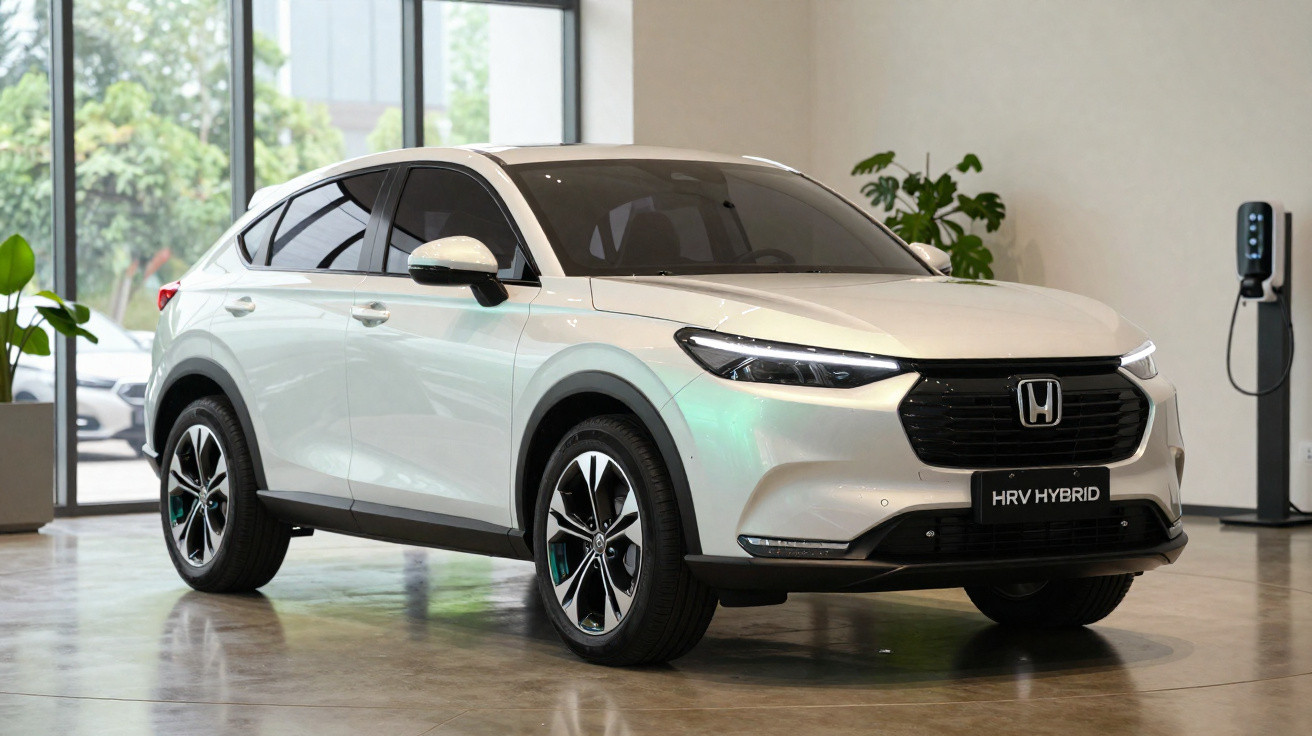
Launched several months ago, the new Honda HR-V is drawing ever closer to its arrival on the Portuguese market. It had been due to happen before the end of this year, but the semiconductor shortage affecting the motor industry means the launch will now take place in early 2022.
Offered exclusively with a hybrid powertrain, the Japanese SUV’s third generation continues Honda’s electrification strategy. The company has already confirmed that, with the exception of the Civic Type R, its European range will be fully electrified in 2022.
With more than 3.8 million units sold worldwide since its 1999 debut, the new HR-V Hybrid - its official name - is therefore an important “calling card” for Honda, particularly in the “old continent”.
Coupé-inspired styling
Horizontal lines, uncomplicated surfaces and a “coupé” profile define the HR-V’s exterior design, which adopts a look better suited to the European market.
The lower roofline, reduced by 20 mm compared with the previous model, makes a major contribution. At the same time, the move to 18-inch wheels and a 10 mm increase in ground clearance strengthen the car’s more rugged stance.
At the front, the new body-coloured grille and slim Full LED light signature stand out. From the side, attention is drawn to the more rearward and more steeply raked A-pillar. At the rear, a full-width light bar links the tail-lights.
Interior: what has changed?
Built on the GSP (Global Small Platform), also used by the new Honda Jazz, the HR-V retains the overall exterior dimensions of its predecessor while providing more room inside.
As on the outside, the cabin’s horizontal lines accentuate the impression of width, while its “clean” surfaces give it a more refined appearance.
In terms of technology, the centre of the dashboard houses a 9-inch HMI display, which supports smartphone integration through Apple CarPlay - without requiring a cable - and Android Auto. Behind the steering wheel sits a 7-inch digital instrument display showing the information most relevant to the driver.
The L-shaped air vents positioned at either side of the dashboard are also entirely new for this model. They direct air along the front windows, creating a kind of air curtain beside and above the occupants.
This solution promises greater efficiency and improved comfort for everyone on board. During my first encounter with this new Honda SUV, I was able to confirm that the new air-distribution system prevents air from being blown directly at passengers’ faces.
More space and versatility
The front seats are now positioned 10 mm higher, improving outward visibility. Combined with the fuel tank’s continued location beneath the front seats and the more rearward placement of the rear seats, this makes legroom even more generous.
In the few hours I spent with the car, it was clear that rear legroom will never be an issue. However, anyone taller than 1.80 m will find their head almost touching the roof. And despite this HR-V’s width, the rear is best limited to two occupants if they are to travel comfortably.
This has also had an effect on boot capacity, which has been slightly compromised - and the lower roofline does not help either. The previous-generation HR-V offered 470 litres of luggage space, while the new model has 335 litres.
In my view, however, the loss of load space with the rear seats upright is offset by the versatile solutions Honda continues to provide, including Magic Seats and a flat boot floor. These allow a huge range of items to be carried, including surfboards and two bicycles with their front wheels removed.
“All-in” on electrification
As mentioned above, the new HR-V is available solely with Honda’s e:HEV hybrid powertrain. It comprises two electric motors working with a 1.5-litre i-VTEC petrol engine operating on the Atkinson cycle, a 60-cell lithium-ion battery - the Jazz has only 45 cells - and a fixed-gear transmission that sends torque exclusively to the front wheels.
Mechanical changes also include the positioning of the power control unit (PCU). As well as being more compact, it is now integrated into the engine bay, while the distance between the electric motor and the wheels has also been reduced.
Combined output is 131 hp and 253 Nm of torque, enough for 0–100 km/h in 10.6 seconds and a top speed of 170 km/h.
Efficiency remains the focus of this hybrid system. Honda claims an average of 5.4 l/100 km, and during my first kilometres at the wheel of the HR-V I was consistently able to achieve around 5.7 l/100 km.
Three driving modes
The HR-V’s e:HEV system offers three operating modes - Electric Drive, Hybrid Drive and Engine Drive - along with three separate driving modes: Sport, Econ and Normal.
Sport makes the accelerator more responsive and delivers a more immediate reaction. Econ, as its name suggests, places extra emphasis on controlling consumption by adjusting accelerator response and air-conditioning operation. Normal provides a compromise between the other two modes.
The Electronic Control Unit switches automatically and continuously between Electric Drive, Hybrid Drive and Engine Drive, selecting the most efficient option for each driving situation.
However, as our first drive of this new Honda SUV demonstrated, in urban use it is possible to travel for much of the time using only the electric motors.
At higher speeds, such as on a motorway, the combustion engine comes into play and is responsible for sending torque directly to the wheels. Should more power be needed, for overtaking for example, the system immediately changes to hybrid mode. Finally, in electric mode, the combustion engine is used only to “feed” the electrical system.
Steering and suspension improvements
For this new HR-V generation, Honda has not only increased overall rigidity but has also introduced several upgrades to the suspension and steering.
It takes only a few kilometres to notice that this Japanese SUV is considerably more comfortable and even more pleasant to drive. The higher driving position, excellent all-round visibility and very comfortable front seats also play their part. They do not offer much lateral support, but they still hold occupants securely in place.
I was pleasantly surprised by the cabin’s sound insulation, at least when the combustion engine is “asleep”, the hybrid system’s smooth operation and the steering weight, which feels much quicker and more precise.
Even so, comfort is clearly prioritised over dynamism. When entering a bend at greater speed, the chassis reveals that pace and there is some body roll. It is not enough, however, to spoil the driving experience offered by this SUV.
When does it arrive?
The new Honda HR-V will not reach the Portuguese market until early next year, although orders will open to the public during November. Final pricing for Portugal - and the range structure - have not yet been announced.
Comments
No comments yet. Be the first to comment!
Leave a Comment