
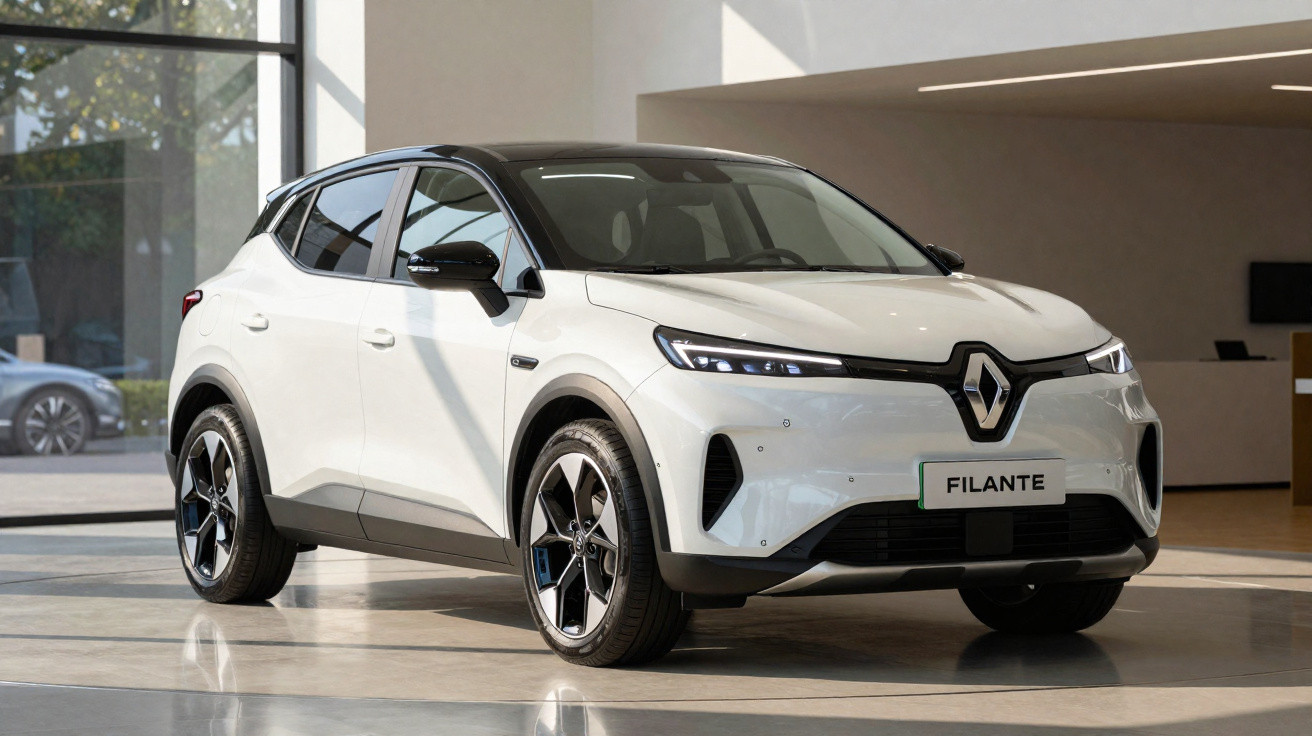
Renault’s new Filante is intended to bridge the gap between a practical family car and a stylish leisure SUV. As with the brand’s latest models, Renault divides the range into three trims: a technology-led entry model, a comfort-focused specification and a sportier flagship with Alpine influences.
New compact SUV is an important building block for Renault
Renault is expanding its SUV line-up with the Filante. It is aimed at buyers who find the Captur too small, while regarding the Austral as too large or too expensive. Its name references a historic concept car from the 1950s, but today it clearly represents a modern SUV designed for everyday use.
The compact SUV market remains fiercely competitive across German-speaking markets. Vehicles such as the VW T-Roc, Hyundai Kona and Peugeot 2008 fill this segment densely. Renault is therefore positioning the Filante not solely through styling, but above all through a clearly structured trim range.
“From the outset, the Filante will arrive with three clearly defined trims: Techno, Iconic and Esprit Alpine – with the latter serving as the sporty opening act and being exclusively available at launch.”
Three trims: Techno, Iconic and Esprit Alpine
For the Filante, the French manufacturer adopts naming already familiar to customers from the Austral and Clio. This makes the choice easier to understand in the showroom while strengthening brand recognition.
Techno: the technology-minded entry trim
Techno is the entry-level specification, although it is not intended to feel sparse. It is aimed at buyers who prioritise up-to-date technology and safety without paying for luxury equipment they are unlikely to use.
- Digital instruments and a central touchscreen
- Smartphone connectivity through Android Auto and Apple CarPlay
- Key driver-assistance systems, including lane-keeping assistance and emergency braking assistance
- Conventional cloth upholstery and durable materials
Renault generally uses the Techno trim as its lower price anchor. In terms of engines, this version is likely to receive the more sensible choices, including economical petrol engines and possibly hybrid options that reduce fleet fuel consumption.
Iconic: greater comfort and more visual appeal
Iconic sits above Techno in the range. In this form, the Filante moves closer to the upper end of the compact class, both in its appearance and in the perceived quality of its interior.
Typical Iconic features on current Renault models, which are highly likely to appear on the Filante too, include:
- Larger alloy wheels and additional exterior chrome details
- More premium seat upholstery, often incorporating artificial leather
- Extended ambient lighting in the cabin
- Extra assistance features and convenience equipment, such as keyless entry and a reversing camera
This specification is intended for drivers using their SUV as their main car who place greater value on a more pleasant cabin atmosphere, including commuters and families with only one vehicle in the household.
Esprit Alpine: sporty styling and an emotional flagship
Esprit Alpine is where the range becomes especially interesting. This trim brings styling references from Renault’s Alpine performance brand into the SUV segment and acts as the sporting spearhead.
“At launch, Esprit Alpine is the only version available – Renault is deliberately using its sporty appearance as an eye-catching introduction for the Filante.”
The latest Renault models typically give Esprit Alpine the following characteristics:
- Distinctive bumpers and sportier exterior additions
- Darkened badges and contrasting trim strips
- Sports seats with specific upholstery and Alpine details
- A steering wheel with prominent stitching and a sportier grip area
For the Filante, this trim is likely to be paired with the more powerful engine options. Renault is thus targeting customers who want to stand apart visually without immediately choosing a dedicated sports car.
Why only Esprit Alpine is available at launch
The decision to offer only Esprit Alpine at the beginning is no coincidence. Manufacturers often introduce a new model in well-equipped or particularly striking forms to establish it on the road and secure higher margins. The Filante is no exception.
Renault is pursuing several objectives with this approach:
- Sharpening the brand image: The sporty design conveys dynamism and modernity.
- A higher average transaction price: Statistically, early buyers are more likely to choose better-equipped versions.
- Clear positioning: Against rival models, the Filante is intended to be more than simply “another SUV”; it should be an emotionally appealing eye-catcher.
Techno and Iconic are expected to follow after a short period. Dealers will then be able to offer a broader spread of prices and equipment, including options for more price-conscious buyers.
Position in the Renault range and engine options
Official technical information about the Filante remains limited, although Renault’s European strategy suggests several likely possibilities. Three broad powertrain directions are conceivable:
- Modern small-capacity turbocharged petrol engines
- Full-hybrid systems for low urban fuel consumption
- Possibly a plug-in hybrid later on for company-car customers
Diesel engines now play only a minor role for Renault in this vehicle class, as demand is falling in many markets and emissions standards are becoming increasingly strict.
Within the overall range, the Filante will sit between the Captur and Austral. This gives customers moving from a compact car to an SUV another option, offering a higher driving position, more room and a more modern appearance.
Design and interior: what buyers can expect
Although the announcement concentrates on trim levels, Renault’s current design language indicates several likely styling themes. Recently, the brand has increasingly favoured clean lines, pronounced shoulders and distinctive lighting signatures.
Inside, the Filante is expected to use a layout similar to that of the Austral and Clio: an upright touchscreen angled slightly towards the driver, with a centre console below it incorporating storage areas and a simple control concept. Renault has invested heavily in software over recent years, resulting in more responsive infotainment systems and improved online services.
| Trim | Target group | Main focus |
|---|---|---|
| Techno | Price-conscious drivers, commuters | Modern technology, solid entry specification |
| Iconic | Families, high-mileage drivers | Comfort, appearance, perceived quality |
| Esprit Alpine | Design and sports fans | Sporty styling, emotional appeal |
What does “Esprit Alpine” mean in practical terms?
The term “Esprit Alpine” now appears on several Renault models. Alpine is the group’s performance and sports-car marque, known for the lightweight mid-engined A110 sports car. In the Filante, the emphasis is less on outright performance and more on bringing that image to an everyday vehicle.
In practice, this means a more dynamic look, sportier seats and slightly altered tuning, but no uncompromising track-focused set-up. Many buyers want a touch of motorsport feeling without sacrificing comfort or daily usability.
Which Renault Filante version suits which buyer?
Anyone viewing the Filante mainly as a practical everyday vehicle with strong usability is likely to be well served by Techno. Its price and equipment level are generally well matched, especially where safety and connectivity are the priority.
Iconic is geared towards customers who regularly cover longer distances or often travel with four people aboard. Higher-quality materials, additional driver aids and more comfort features are particularly worthwhile on long journeys.
Esprit Alpine shows its strengths for buyers who regard their car as a calling card. Those who value a sporty image but do not want to move into a significantly more expensive premium segment will find a visually distinctive alternative here.
Outlook: questions that remain unanswered
Several key details that matter to many prospective buyers are still absent: exact power outputs, fuel-consumption figures, boot capacity and, naturally, pricing. Renault is likely to release this information gradually as the market launch approaches.
It will also be interesting to see how the Filante compares directly with its group siblings, particularly in terms of driver-assistance systems, over-the-air software updates and smartphone integration. There has been enormous progress in these areas over recent model generations, and younger buyers in particular increasingly pay more attention to digital functions than to traditional horsepower figures.
Before selecting a trim, prospective owners would be wise to consider honestly which functions they will genuinely use every day. Many extras that initially seem tempting are later left unused, while apparently minor items such as an effective blind-spot warning system or a decent reversing camera can help on a daily basis.
Those already considering the Filante are likely to notice the first cars most clearly on the road in Esprit Alpine form. Once Techno and Iconic follow, the complete picture will emerge: a new compact SUV intended to meet as many customer requirements as possible through three clearly positioned trim levels.
Comments
No comments yet. Be the first to comment!
Leave a Comment