
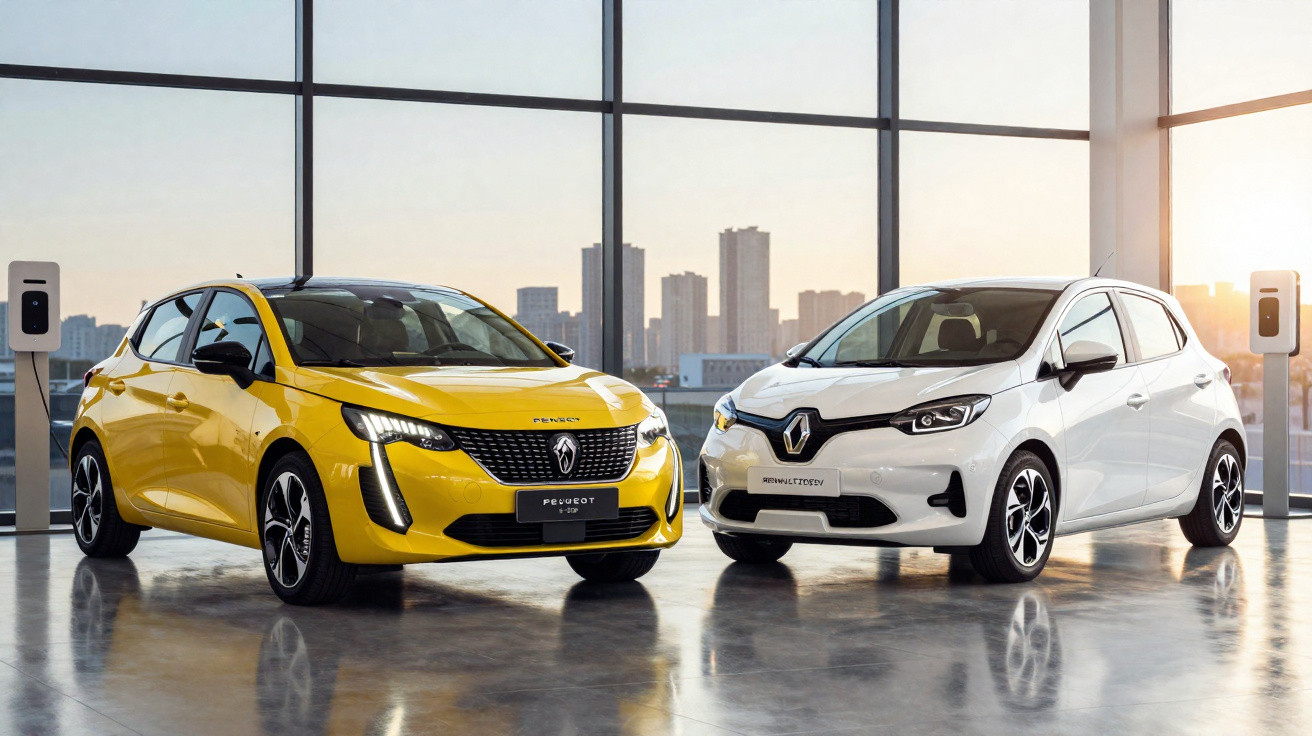
Never before have so many electric cars been bought in Portugal, and two models are unavoidable fixtures among the best-sellers: the Peugeot e-208 and Renault Zoe.
Both are clear choices for anyone looking for an electric car costing up to €35,000, although they take notably different approaches. Even so, they share several key points, starting with their power output and battery capacity and ending with the fact that both are front-wheel-drive models.
So, what really sets these two electric superminis apart? Which is better? We set out to answer those questions, and many more, in this video:
Peugeot e-208, the sportier choice
Design is always subjective, but one point is hard to overlook: the Peugeot e-208 has a more aggressive, sporting appearance, unlike the Zoe’s more restrained styling and softer, rounded shapes.
Its sharply defined lines give the e-208 greater visual impact. That applies both outside and in the cabin, which is also more eye-catching than the Zoe’s interior.
It features Peugeot’s i-Cockpit system, combining a digital instrument display - with a 3D effect on better-equipped versions - with a compact, sporty-shaped steering wheel. There is also a 10-inch central infotainment screen, compatible with Android Auto and Apple CarPlay, built-in navigation and even a wireless charging area.
In terms of space, the e-208 is somewhat tight in the rear seats. Passengers are still seated comfortably, but the Peugeot is clearly beaten by the Zoe here, particularly for knee room.
However, the lion-badged electric car stands out most on the road, where it delivers engaging driving manners and dynamics that can genuinely be enjoyable.
Its front-mounted electric motor produces 100 kW (136 hp), exactly the same output as the Renault model tested here. The Peugeot e-208 reaches 100 km/h in 8.3 seconds and has a limited top speed of 150 km/h.
The suspension is firm without becoming uncomfortable, the driving position is low, and body roll through corners is very well managed. As a result, this e-208 responds particularly well when the pace rises and the driver adopts a sportier style.
Its range is rated at 352 kilometres on the WLTP cycle, thanks to a 46 kWh battery. Claimed average energy consumption stands at 15.9 kWh per 100 kilometres.
Renault Zoe, the more family-friendly option
The Zoe’s exterior may not be as striking, despite the substantial progress it has made in this area, but the story changes inside. The Zoe has a minimalist yet carefully finished cabin, with good-quality materials that are assembled very well.
Yet it is the feeling of spaciousness inside the Zoe that most clearly separates it from its Peugeot rival. While this is true in the rear seats, it is even more apparent in the boot: the Renault Zoe offers 338 litres of luggage capacity, compared with just 265 litres in the Peugeot e-208.
This is largely explained by the fact that the Zoe is larger in every dimension. It is also heavier, at 1,577 kg - 47 kg more than the e-208.
That additional weight and higher centre of gravity, among other factors, are noticeable on the road. Although the Zoe we tested - the most powerful version with the largest battery - claims the same 100 kW (136 hp) as the Peugeot, it does not offer the same strengths while driving.
It is very easy, and pleasant, to drive, and performs strongly in terms of comfort. However, it is not as engaging to drive and its handling is less entertaining. In my view, the steering is too light, while the driving position is too high; the front seats cannot be adjusted for height because of the battery’s location.
Nevertheless, the Zoe outperforms the e-208 for range. With its slightly larger 52 kWh battery, it can claim 389 kilometres on a single charge. Claimed consumption for this version is 17.7 kWh.
How much do they cost?
These two fully electric French superminis also sit at very similar price points.
In the specification shown here, the Zoe starts at €36,950. However, the test car includes several optional extras that raise its final price slightly, including metallic paint, which costs €650. The Peugeot e-208, in the GT specification featured in the video, starts from €37,170.
Cheaper versions with less equipment are available in both cases. The Zoe is also offered with a slightly smaller battery. Depending on what you want from an electric car, these variants may be worth considering.
Victory by a narrow margin
As this is a comparison, there can only be one winner. The Peugeot e-208 takes the victory, albeit by a narrow margin, because the result could change according to what you value most in a car.
If you are looking for a more comfort-focused option, with greater room for the family - as the difference in boot capacity could prove decisive for some buyers - and longer range, then the Renault Zoe is unquestionably the model to buy.
However, if you want a car in this electric segment with sportier driving, more dynamic handling and a more aggressive, striking design, then the Peugeot e-208 is the model to choose.
| RATING | Peugeot e-208 | Renault Zoe |
|---|---|---|
| Design (11%) | 8 | 7 |
| Build Quality and Materials (14%) | 10 | 9 |
| Space, Connectivity and Equipment (14%) | 10 | 9 |
| Handling (9%) | 10 | 8 |
| Comfort (12%) | 8 | 10 |
| Performance (10%) | 8 | 7 |
| Consumption and Range (15%) | 9 | 10 |
| Price (15%) | 10 | 11 |
| Total (100%) | 73 | 71 |
Comments
No comments yet. Be the first to comment!
Leave a Comment