
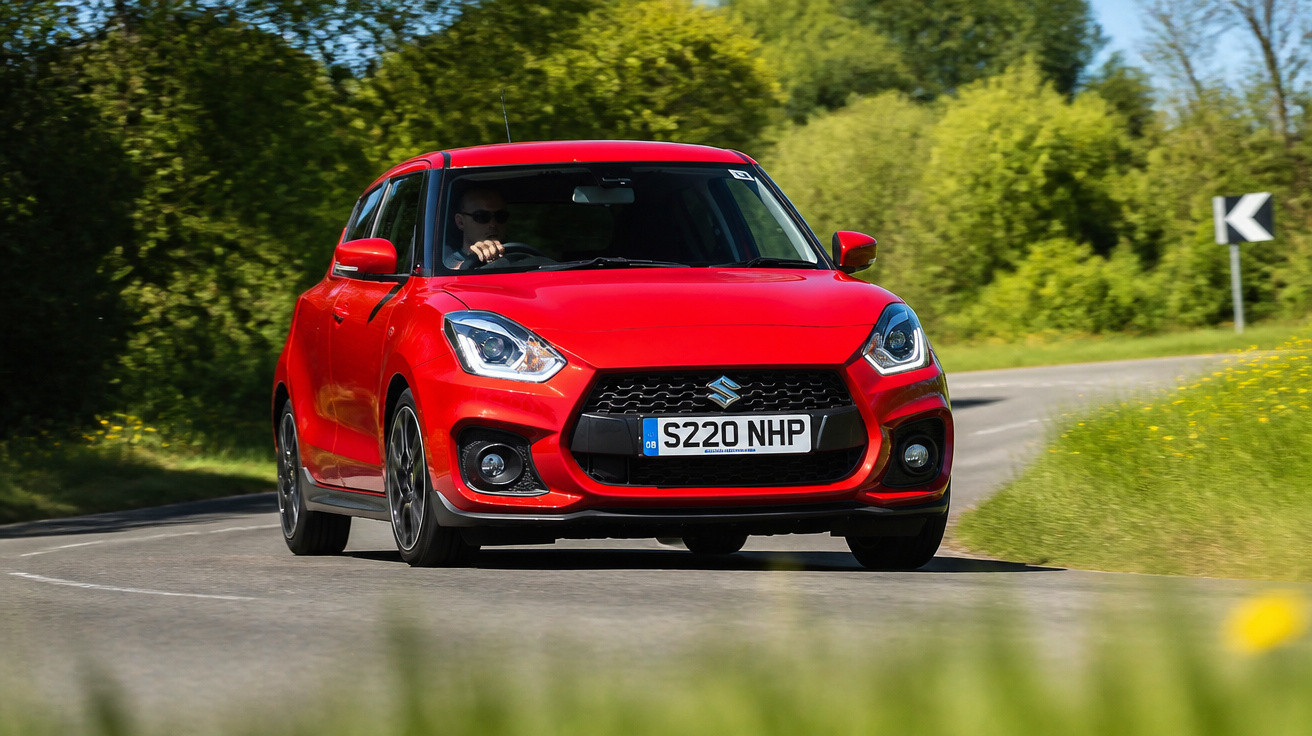
A facelift already?
Given that the Suzuki Swift Sport has only been available since 2018, a comprehensive facelift feels rather premature. For the 2020 model year, however, the changes are less about a dramatic makeover and more about the Swift acquiring slightly more mature tastes: red wine and Radio 4, perhaps. It is attempting to grow up a little.
The likeable hot hatch now gains a thoroughly sensible 48V mild-hybrid system. Its purpose is to cut emissions and fill in the torque curve with help from a 10kW motor. With new emissions legislation approaching, every manufacturer is feeling the pressure in one way or another.
Suzuki Swift Sport mild-hybrid performance
An electric boost means it must be much faster, surely?
Well, without disappearing too far into the spreadsheets, there are some interesting figures to consider. The 1.4-litre petrol engine develops 127bhp and 173lb ft, while the turbocharger comes on song from 2,000rpm. Suzuki says its Boosterjet technology gives the engine performance comparable with that of a naturally aspirated 2.0-litre unit.
Even with the extra batteries and electrical hardware, this is still a tiny 1,025kg car; the new technology adds only 15kg. It accommodates five people and provides 265 litres of boot space. Fuel economy of 50.1mpg is both commendable and realistic, while CO2 emissions fall to 127g/km, compared with 47mpg and 135g/km for the previous non-hybrid version.
The system works by placing a compact 48V lithium-ion battery beneath the front seats, while a small electric motor in the engine bay takes over the roles of alternator and starter motor. It allows more extensive start-stop operation - and the transitions are very smooth - while also supplying an electrical shove under acceleration to cover the turbocharger’s response gap.
There is an unwelcome catch, though: the Swift reaches 62mph in 9.1 seconds, making it a second slower than its predecessor.
Slower? What is Suzuki thinking?
No doubt Suzuki did not set out to make the Swift Sport less rapid, but it has been caught by the same emissions regulations that will remove the Jimny from sale in 2021, as manufacturers face fines when their average emissions exceed set limits. The reduced engine output is responsible for the Sport’s relatively unexciting 0-62mph figure, alongside the arrival of the mild-hybrid equipment.
How the Suzuki Swift Sport drives
What is it like on the road?
On the move, the car feels rather twitchy, almost as if it is searching for potholes. Plenty of road detail reaches the cabin and the steering wheel is lively in your hands. Not all of that feedback is helpful, though; it is as though Suzuki’s engineers have mistaken drama for theatre.
The Swift Sport fires out of bends, with the mild-hybrid system bridging the gap until the turbocharger arrives and begins to sing. You can flick easily between the gears - the new gearlever has a throw that is 10 per cent shorter - and build speed effectively. It is genuinely impressive: there is no evident turbo lag, and acceleration gathers pace consistently.
This Swift Sport occupies a narrow space between Dr Jekyll-like economical decency and Mr Hyde-style hooliganism, which may frustrate some buyers. Its ride is not unnecessarily stiff, though, and in town it is a friendly little sports car, happy to settle down when you do not want to launch away from every traffic light as though a Grand Prix has begun.
It is certainly swift, then, but it does seem to restrain the sportier side of its character. There is a degree of built-in composure, courtesy of the agreeable ride and secure, planted stance. Complaining about those qualities feels odd, yet the sharper edge expected from something explicitly sporty is difficult to find. The hot-hatch essence survives, but the car has become more adult. You may not leap out of bed early for a B-road run, although it makes the urban roundabout stage much more entertaining.
For anyone learning the ropes of brisk driving, the Swift Sport is an excellent starter for 10. It is approachable rather than aggressive, with no real bite or snarl; it is the difference between Arcade and Simulation mode. Personally, that suits me: I would rather not unexpectedly end up facing backwards in a hedge beside a baffled sheep on a Saturday afternoon.
Equipment, practicality and price
What comes as standard?
Suzuki has worked hard to inject some life into what is fundamentally a budget interior. A sporty red pattern across the top of the dashboard is used with restraint, the leather steering wheel feels good in the hands, and the ‘racing’ seats hold your muffin tops firmly in place. Those details cannot conceal the touchscreen’s retro, aftermarket appearance, although it does at least include Apple CarPlay and Android Auto.
The safety equipment list is extensive. There are automatic high beams for the LED projector headlights, lane-keep assist, a blind-spot monitor, reversing camera, city braking, rear cross-traffic alert and traffic-sign recognition. Adaptive cruise control is useful, while keyless entry is a welcome extra.
As expected, the Swift Sport also wears the usual go-faster add-ons, including a sports exhaust, smart front and rear bumpers, and a discreet roof spoiler. Six paint colours are available at no charge, while extra money buys a tasteful choice of decals and stripes, or a black roof and door-mirror pack.
Is there anything else to consider?
Perhaps it is a modern consequence of NCAP testing, but the onboard safety aids can verge on the irritating. The Brake Support system is especially noisy, continuing to issue warnings long after you have cancelled it or the risk has disappeared and gone home for its tea. It can be switched off, but it resets every time you return to the car, ready to trouble you again.
Similarly, the digital instrument display initially appears to offer a clever wealth of vehicle information as you cycle through it for the first eight times. In practice, it is mostly unhelpful and a little gimmicky.
It is not all negative. If practicality matters to you, the Swift Sport is reasonably useful, with a wide boot and decent room for both luggage and passengers.
Should you buy one?
This is where the difficulty lies. The Swift Sport is not inexpensive. It was never especially cheap before the hybrid update at £17,999, but its new asking price creates questions this little car cannot truly answer, notwithstanding the strong standard specification.
Consider the figures: the Swift Sport costs £21,570, yet spending a little more brings a Volkswagen Polo GTI at £23,360 or a Fiesta ST at £22,275. The Suzuki is venturing uncomfortably close to more rarefied territory.
Alternatively, you could look the other way at the tempting VW Up GTI, priced at £16,540. Think a little differently and the Mini 3-door Hatch Cooper in Sport trim reaches 62mph more quickly while saving you around a grand.
That is the issue. What was once an appealing entry-point hot hatch has been restrained so much that you would need to really want one to choose it over its rivals. That is a pity, because the Swift Sport remains a tidy little car.
Score: 6/10
Comments
No comments yet. Be the first to comment!
Leave a Comment