
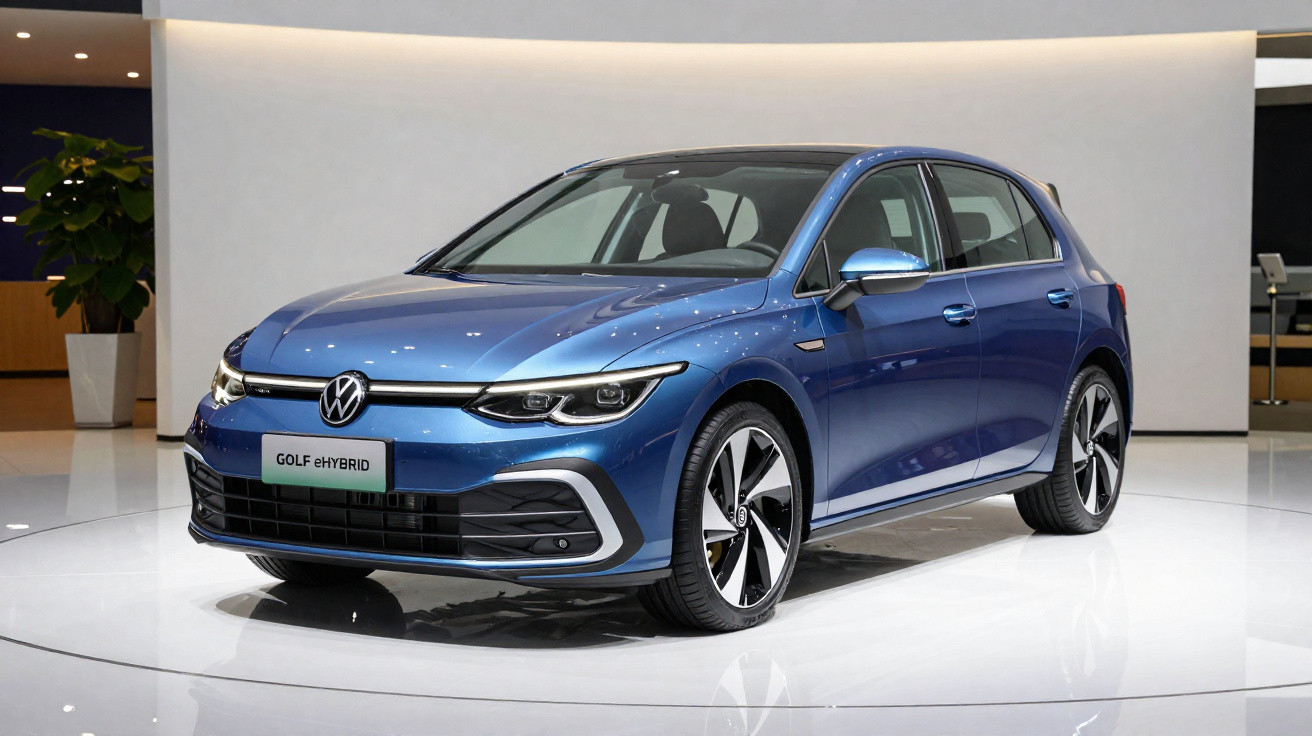
This eHybrid version gives the Volkswagen Golf greater versatility by adding a plug-in hybrid alternative alongside the more powerful, sportier GTE variant.
The GTE (245 hp) takes centre stage, yet this Golf eHybrid (204 hp) costs around £4,500 less - £40,055 for the eHybrid versus £44,610 for the GTE - and claims an electric-only range of 72 km, compared with the GTE’s 64 km.
But is that enough to make the eHybrid the plug-in hybrid Golf to choose? The answer lies in the following sections.
More than enough power
The Volkswagen Golf eHybrid uses a plug-in hybrid powertrain that pairs a turbocharged 1.4-litre four-cylinder petrol engine producing 150 hp with an 80 kW (109 hp) electric motor.
Together, the two units develop a maximum of 204 hp and 350 Nm. That represents a shortfall of 41 hp compared with the Golf GTE, whose electric motor is slightly more powerful at 85 kW (116 hp).
Lively and precise
Even so, the Golf eHybrid claims 0-100 km/h in 7.4 seconds and a top speed of 200 km/h. These figures are more than enough for it to feel brisk at all times, whether weaving through urban traffic or adopting a more sporting approach on open roads.
Do not misunderstand me: the Golf eHybrid has very few, if any, sporting ambitions, but it remains an engaging and reassuring car to drive.
When battery charge allows both motors to work together, this Golf delivers very satisfying punch and feels energetic from low revs. The six-speed DSG gearbox also deserves praise here, as it never hesitates and always performs as expected.
Also contributing are the well-judged accelerator pedal calibration, highly accurate steering and the chassis’s consistently balanced behaviour, all of which ensure this Golf’s dynamics remain impressively polished.
Volkswagen Golf eHybrid consumption and electric range
Both plug-in hybrid Golf versions share a 13 kWh lithium-ion battery, allowing the Golf eHybrid to travel for more than 70 km in fully electric mode.
That is the figure quoted by the Wolfsburg brand, although I was unable to match it during this test. Nevertheless, one thing is clear: achieving 50 km of “emission-free” driving between charges is comfortably within reach.
As for average consumption, while there was charge in the battery and the system was operating automatically, it was slightly above 2.5 l/100 km.
Once I stopped using the electric motor - either because the battery had run out or because I selected the option to retain energy for later - the Golf eHybrid returned average consumption slightly below 7 l/100 km.
Straightforward and effective
Although it never proves particularly thirsty, the Golf eHybrid naturally makes most sense when charged regularly, as this is when its fuel-saving potential can truly be exploited.
Its operation could hardly be simpler. It always starts in electric mode, switching automatically to hybrid operation when battery charge falls below a certain level or when the accelerator pedal is pressed more firmly.
Once the battery is depleted, it is useful to know that a full charge from a 3.6 kW wallbox takes approximately four hours. Using a 2.3 kW socket increases this to almost six hours.
Is it the right car for you?
The Volkswagen Golf eHybrid follows a usage philosophy very similar to that of the GTE, but for around £4,500 less.
It is certainly neither as powerful nor as focused on dynamic driving, but it stands out as the more rational plug-in hybrid choice in the German hatchback range.
It is balanced and enjoyable to drive, while still offering more than satisfactory levels of punch and agility. At the same time, it can deliver low consumption and efficient management of the entire hybrid system.
Naturally, as with any other plug-in hybrid, it is only truly worthwhile when charged regularly. Under those conditions, it becomes a highly appealing tool for weekly journeys, allowing you to cover at least 50 km in comfort without using a single drop of fuel.
Comments
No comments yet. Be the first to comment!
Leave a Comment