
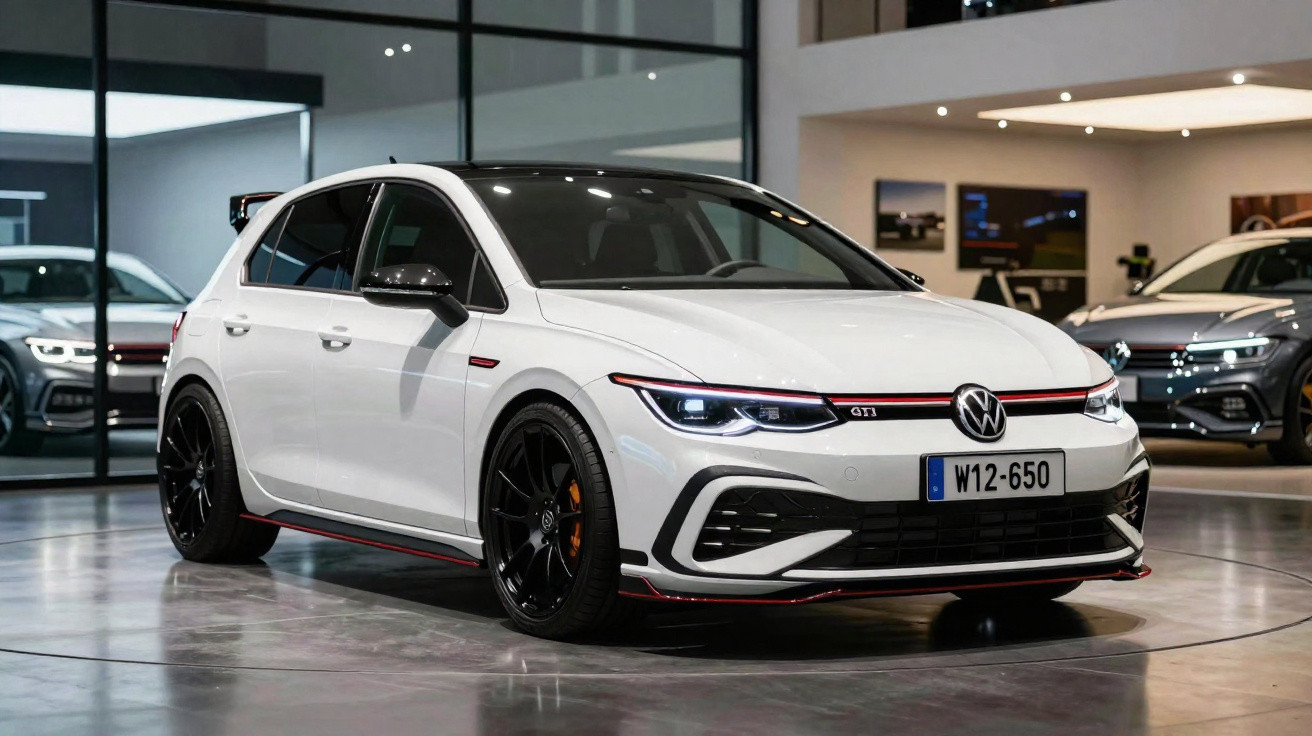
The Volkswagen Golf R 20 Years Edition is the most powerful production Golf ever, with 333 PS. What many people do not realise, however, is that this output is only halfway towards what could be regarded as the most extreme Golf of all time: the Volkswagen Golf GTI W12-650.
Powered by a 650 PS "monstrous" W12 engine, the Golf GTI W12-650 was unveiled in 2007 and brought the Wörthersee festival in Austria to a complete standstill. Every year, the event drew together more than 100,000 enthusiasts of the Wolfsburg marque.
Anyone who saw this Golf GTI W12-650 in person must have been left "open-mouthed" by one of the most remarkable creations in Volkswagen history. As expected, though, this prototype remained just that and was never even considered for production. The reason is easy to understand: very little of the Mk5 Golf GTI that served as its starting point was left unchanged.
Golf GTI W12-650: a "Frankenstein's monster"
The story began roughly two months before the 2007 Wörthersee festival. Volkswagen's designers and engineers were asked to devise a prototype that combined components from across the group and would become the centre of attention at the Austrian event.
To turn that idea into reality, the team assigned to this exciting project started with a fifth-generation Golf GTI. Only the bonnet, light units and doors - albeit modified ones - were retained. Everything else changed, beginning with the engine.
There was no hint of modesty in the choice. Rather than using the standard GTI's 2.0-litre turbocharged four-cylinder with 200 PS, they chose to "bring to life" this Golf with the 6.0-litre twin-turbo W12 from the Bentley Continental GT (!), an engine three times larger. Within the Volkswagen Group, only Bugatti's 8.0-litre quad-turbo W16 was bigger.
A mid-rear W12 installation
That decision created several challenges, as there was no way to fit such a huge engine into the Golf's engine bay. The answer? Volkswagen's engineers installed it behind the driver, removed the rear seats and created the only rear-mid-engined Golf GTI.
The W12 was not only three times larger; it also delivered more than three times the power and torque - 650 PS and 750 Nm.
To cope with these figures, Volkswagen's engineering team turned to Lamborghini's parts catalogue, ordering the rear axle and rear brakes from a Gallardo.
The front brakes came from Audi - specifically an RS 4 - while the gearbox was borrowed from the... Phaeton, Volkswagen's luxury saloon.
On top of that, and to keep all that power and force under control, the tracks of this hot hatch - or perhaps mega hatch? - had to be widened. It was fitted with 295 mm-wide tyres on 19-inch wheels, which required the entire body to be widened by 16 cm.
The suspension was lowered by almost 8 cm, while the chassis became "unrecognisable". It not only needed extensive reinforcement because of the extraordinary figures, but also required completely new calibration, especially as the GTI was no longer front-driven and its driven axle had moved to the rear...
Volkswagen Golf GTI W12-650 bodywork and cabin
As well as being wider, the Volkswagen Golf GTI body was comprehensively redesigned for its transformation into the W12-650. Beyond the enlarged width, the most obvious features were the new air intakes immediately behind the doors, helping the W12 to "breathe" and remain at the correct temperature.
The C-pillar became a type of buttress. The rear window was moved further back, allowing air to pass between it and the pillar, much like the arrangement on the Ferrari 599.
The rear bumper was equally unique, featuring an imposing central air diffuser and four exhaust outlets, with two on each side.
At the front, attention centred on the lower air intake, which stretched across the bumper's full width and was far more pronounced. It helped reinforce the muscular, aggressive appearance of this prototype.
Inside, where the cabin was trimmed in Alcantara, it was also virtually impossible to spot any resemblance to a "normal" Golf GTI.
Its motorsport influence was clear in the additional instruments located in the centre of the dashboard, the transparent switches directly below them, the absence of door trims and even the fire extinguisher positioned where the glovebox would normally be found.
Performance from the rear-wheel-drive Golf GTI W12-650
Ultimately, all this muscle - sent exclusively to the two rear wheels - meant the Volkswagen Golf GTI W12-650 was not the easiest car to tame. Even so, entertainment - or terror - and speed were assured: it reached 323 km/h and accelerated from 0 to 100 km/h in under 4 seconds.
The brief was not straightforward, but from today's perspective it is safe to say that the task was completed more than successfully.
Comments
No comments yet. Be the first to comment!
Leave a Comment