
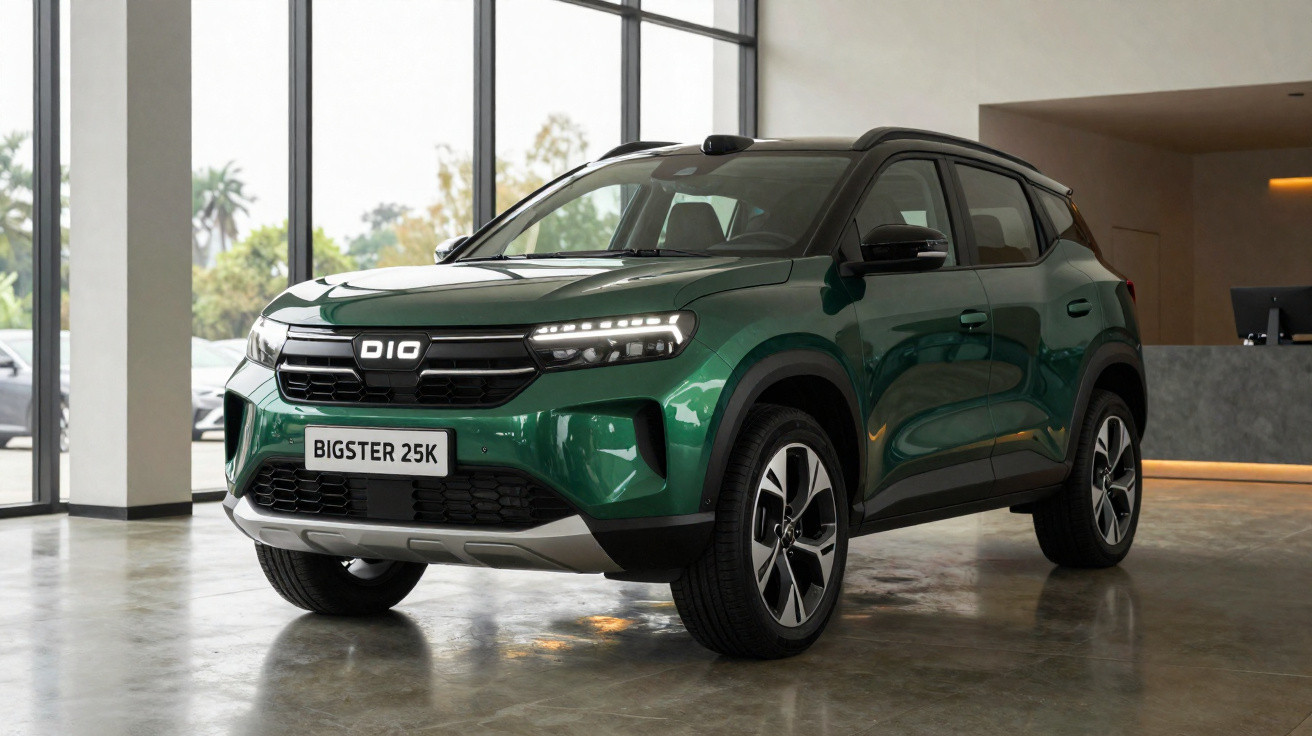
After winning over the B-segment, Dacia is now targeting the C-segment with the Bigster. As its name suggests, it is the largest model the Romanian brand has ever launched.
The formula is the same one that has made Dacia a leader among private buyers in Europe with the Sandero and Duster: an almost unbeatable value-for-money proposition. Indicative prices for mainland Europe place the Bigster below the €25,000 mark.
However, price is not the Dacia’s largest SUV’s only selling point. We travelled to Berlin, Germany, to see it first-hand and find out whether the Bigster offers more than just size. Here is what we found:
Size matters
It is with its dimensions that the Bigster makes the clearest statement. Compared with the Duster, it is larger in virtually every respect: it is 23 cm longer at 4.57 m, 5 cm taller at 1.71 m, and its wheelbase is 4 cm longer, at 2.70 m.
Only the width remains unchanged at 1.81 m, clearly showing that, despite their differences, the two models share the same CMF-B platform.
The extra size is also evident inside, both for rear-seat passengers and in the boot, which gains 150 litres over the Duster. Dacia quotes a 667-litre load capacity up to the parcel shelf.
With the rear seats folded down - using two small levers in the boot - it can carry items up to 2.70 m long. Transporting a pair of skis or flat-pack furniture from a well-known Swedish retailer should therefore be straightforward.
A matter of presence
Previewed by the concept car on which it was based, first shown in 2021, the appearance of the new Dacia Bigster cannot be described as a surprise.
While the production version loses many of the add-ons that made the Bigster Concept more adventurous, it retains its overall design. Those same cues had already heavily influenced the latest-generation Duster, which we have already driven.
Features including the prominent bumpers, enlarged wheel arches and bonnet with several sculpted recesses give the Bigster a muscular overall stance. The huge front grille, the light signature at both ends, and the side air intakes further accentuate its perceived width.
From the side, the wheels also stand out, ranging from 17 to 19 inches. There is also Indigo Blue paint, a shade making its Dacia debut exclusively on this model, which looks particularly effective with the black roof available on higher-specification versions.
Dacia Bigster interior: everything you need
Inside, the similarities with the Duster are unmistakable, especially in the layout of the screens, dashboard and steering wheel.
The Bigster does have several distinguishing features, beginning with the centre console - or rather, centre consoles - as Dacia has developed three separate designs. There is a low centre console, a mid-height alternative and, making its full debut, a raised unit incorporating an armrest with a cooled storage compartment.
The seats are another important highlight. In Journey versions, they raise comfort levels with softer upholstery and electric adjustment for the driver’s seat.
It is also worth noting that every Bigster comes as standard with a 10.1-inch central infotainment display, a digital instrument panel - 7 inches on lower-specification versions and 10 inches on top versions - dual-zone climate control, standard from Expression trim, and a rear parking camera.
New hybrid powertrain
The Bigster introduces a new engine range for Dacia, with particular emphasis on the Hybrid 155, which is an entirely new development even within the Renault Group itself.
The Hybrid 140 versions of the Duster and Jogger use a four-cylinder 1.6-litre petrol engine and a 1.2 kWh battery. In the Bigster Hybrid 155, the engine capacity increases to 1.8 litres and the battery grows to 1.4 kWh. Combined with two electric motors - one traction motor and one starter-generator - the system delivers a maximum output of 155 hp.
Managing this setup is the familiar Renault Group multi-mode gearbox, with four ratios for the internal-combustion engine and two ratios for the electric traction motor.
As well as gaining 15 hp and 20 Nm over the Hybrid 140 models, this new 155 hp hybrid system gives the Bigster greater towing capacity: it can “pull” around one tonne.
Even so, the powertrain’s greatest strength is its low fuel consumption. According to Dacia, the Bigster Hybrid 155 can operate in fully electric mode for up to 80% of urban driving time.
Unprecedented power output
For the first time at Dacia, the turbocharged three-cylinder 1.2 TCe engine is available with 140 hp, 10 hp more than in the Duster. It is paired with a 48 V mild-hybrid system featuring a small 0.8 kWh battery. Stored energy is then used to support the petrol engine during starting and acceleration.
Already familiar from, and tested in, the Duster, this engine is matched to a six-speed manual gearbox and, according to Dacia, can achieve average fuel consumption of 5.6 l/100 km.
The Romanian brand attributes the 10 hp difference between the two powertrains to changes to the turbocharger, which has a larger turbine in the Bigster.
Curiously, and somewhat oddly, this modification has not been applied to the Bigster 4×4 version, which retains the 130 hp 1.2 TCe engine already known from the Duster.
1,450 km range
The real highlight of the new Bigster engine line-up is the bi-fuel petrol + LPG version, a technology Dacia continues to back strongly and in which it is the European leader.
This variant uses the same 130 hp 1.2 TCe engine, combined with the 48 V mild-hybrid system, which continues to assist the engine whether it is running on petrol or LPG.
With two tanks holding a combined 99 litres of fuel - 50 litres of petrol and 49 litres of LPG - the new Dacia Bigster ECO-G 140 claims a record range of up to 1,450 kilometres.
How much does it cost?
The new Dacia Bigster will not arrive in Portugal until May 2025, so prices for the national market have not yet been finalised.
Nevertheless, Dacia has already released indicative prices for the European market: under €25,000 for the mild-hybrid versions, specifically the bi-fuel model, and under €30,000 for the Hybrid 155.
The entry-level price can be regarded as almost certain. The hybrid version, however, is expected to sit slightly above €30,000 because of Portuguese car taxation and its 1.8-litre engine capacity.
It is worth remembering that the Dacia Duster Hybrid 140 is currently available in Portugal for €29,000.

Comments
No comments yet. Be the first to comment!
Leave a Comment