
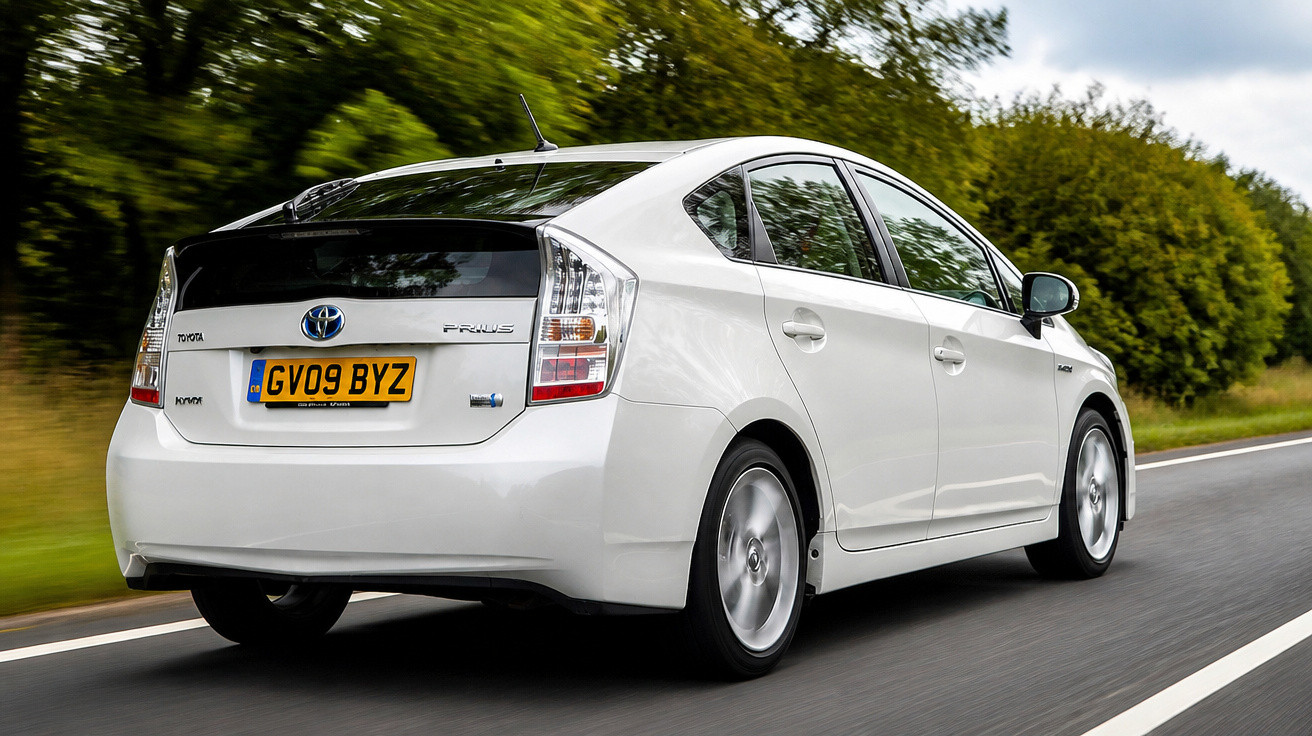
Facts and figures: they may be tedious yet impressive conversation stoppers, but they define this latest Toyota Prius and will still delight your inner nerd. The two figures that matter most are 72.4mpg and just 89g/km of CO2. Choose the range-topping T Spirit, however, and its larger 17-inch wheels change those numbers to 70.6mpg and 92g/km. More remarkably still, the electric hybrid system allows the lower figures to remain identical on the urban cycle.
Toyota Prius hybrid system and efficiency
This completely new Prius represents evolution rather than revolution. Anyone anticipating a leap on the scale of that between the first and second generations will therefore be underwhelmed. Broadly speaking, every area is improved, but Toyota has relied on much the same technology to deliver its marketing-friendly statistics. The familiar fundamentals remain: a petrol engine, electric motor and battery. They have been given an eco-minded flourish through options including remotely started air-conditioning - allowing the cabin to be pre-cooled via the key fob three minutes before you climb in - and roof-mounted solar panels that maintain ventilation while the car is parked.
That evolution should not be dismissed as Toyota shorthand for superficial cosmetic changes, though. Any component with room for improvement has been revised. Battery voltage rises from 500V to 650V; higher voltage means fewer amps and, in turn, lower heat losses in the cables. The battery itself is smaller, 90 per cent of the hybrid system is new, and even the exhaust gains a valve that routes heat more directly to the engine coolant, helping the whole system reach its ideal working temperature sooner.
The more apparent change is a fresh 1.8-litre engine, lifting total output to 134bhp. That is hardly a breathtaking number, but the added shove makes motorway travel far more relaxed, as the engine does not buzz with quite such extravagance. It ought to bring appreciably better fuel consumption on longer, faster trips, too.
Toyota Prius performance and driving modes
At least, that is the theory. We did not treat the accelerator particularly carefully, admittedly, but our average was only 53.6mpg - much the same as today’s crop of economy-focused conventional diesels. The increase in power also raises a question: if the Prius is fundamentally about fuel economy, why alter the output at all? Power has climbed by 24 per cent over the previous car, whereas economy improves by only 10 per cent and emissions by 14 per cent. The latter pair are moving in the right direction, certainly, but you cannot help wondering how much stronger they might have been had Toyota not pursued extra bhp.
There are now three selectable settings: Eco, Power and electric-only EV. Switching among them is exceptionally simple, using buttons positioned beside the fly-by-wire CVT gear selector. ‘Power’ does exactly what its name suggests, making the throttle less restrictive and overtaking considerably easier. It is not a diesel when it comes to in-gear shove, but at least the Prius can now overtake without seeming as though it is about to explode. As before, the electric motor contributes its torque to acceleration; under braking, it reverses its role, operates as a generator and replenishes the battery.
Select ‘Eco’, and it feels as if a tennis ball has been wedged beneath the accelerator pedal, although it does prompt gentler driving. Perhaps excessively gentle driving. In either ‘EV’ or ‘Eco’, electric-only running after pulling away from traffic lights lasts far too briefly. Press the accelerator any more firmly than a breath and the Prius beeps to say you are accelerating too hard, then returns to combined petrol-and-electric propulsion.
Toyota Prius comfort, equipment and environmental credentials
The Prius has other shortcomings. Road noise is much too intrusive, while wind noise is also present, if less objectionable. The steering remains lifeless as well, although that is probably not high on the Prius priority list. At least the ride is sufficiently comfortable on both the 17-inch wheels and the 15s.
Oddly, selecting the larger wheels rules out the solar roof, apparently because of weight and centre-of-gravity concerns. Given its hefty £1,450 price, it will probably appeal only to Hollywood eco-warriors, where there is also enough sunshine to make it work. Standard equipment will include a head-up display and a noticeably smarter interior. The cabin remains extremely practical, the centrally mounted dashboard looks good, and the usual assortment of clever, faintly patronising displays reports how well - and how economically - you are driving.
Yet that is not really the point. Eco-warriors, with knowledge medals attached to their hair shirts, had begun to question the previous Prius’s whole-life costs and the environmental harm caused by its manufacture and transport. Toyota is now keen to highlight how much of the Prius is recyclable, including 95 per cent of its battery; that its Japanese factory uses substantially cleaner energy sources; and that the car now incorporates a fair amount of plant-based plastic. Concerns remain about the source of the battery’s nickel, but steel and iron must also be extracted from the ground, so ‘normal’ cars are not radically different.
So, the new Prius is a good thing. Simply driving one almost makes you feel that you are helping the environment a little. The previous model had begun to lose that feel-good gloss, but this version restores the polish. It is not entirely guilt-free motoring, though it is nearer than ever before.
Comments
No comments yet. Be the first to comment!
Leave a Comment