
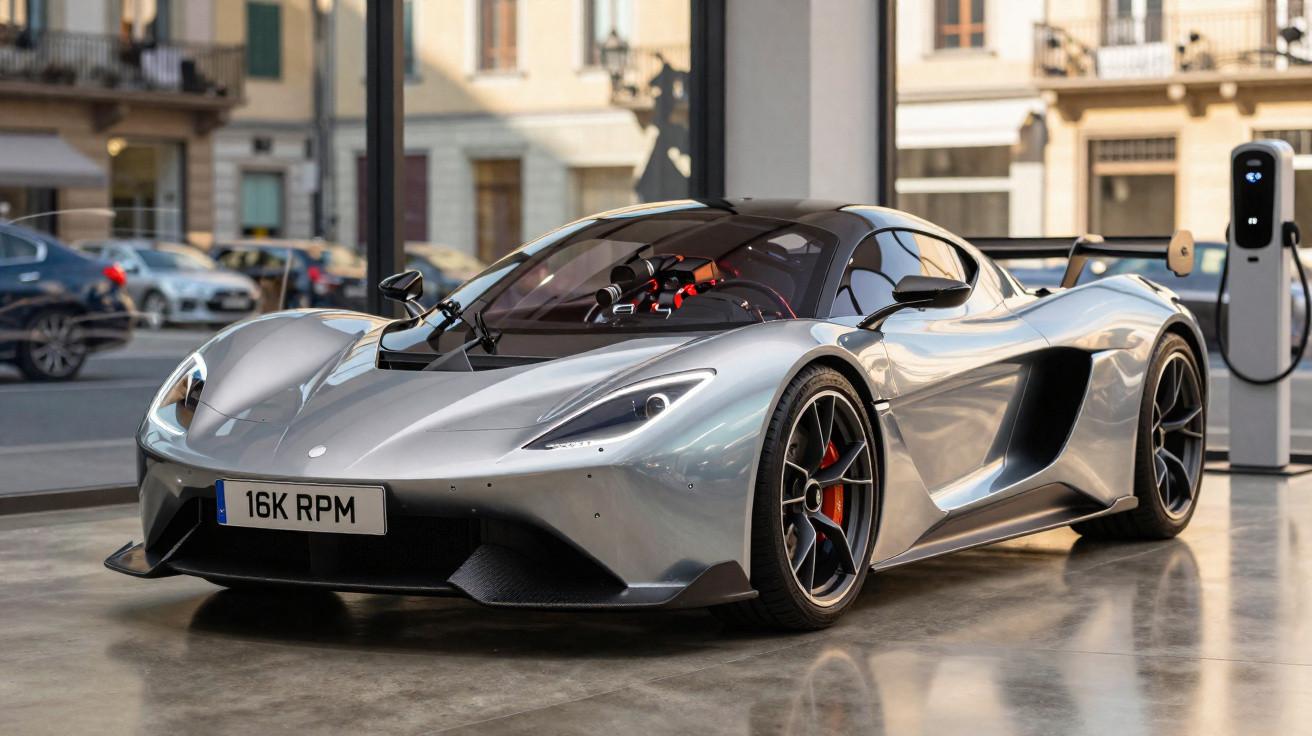
The dynamometer cell is compact, white and filled with a hum that recalls a hospital corridor. Then the technician engages the starter, and the entire building seems to transform. It begins with a low burr: the familiar offbeat rhythm of a five-cylinder, the sound Audi devotees still play on YouTube at 2 a.m. Seconds later, the throttle opens and the pitch rises, becoming sharper and more hostile, until something between dread and exhilaration vibrates through your chest. By 16,000 rpm, it is no longer simply “engine noise”, but a metallic shriek: as though a MotoGP bike had swallowed an old Quattro and chosen to survive.
Your eyes move to the laptop: 240 horsepower from an engine block small enough to nearly put your arms around.
Beyond this room, councils are restricting diesel vehicles and legislators are discussing zero-emission targets for 2035.
In here, petrol is battling for its final passport.
Europe’s most unusual small rebel: a five-cylinder at 16,000 rpm
By any conventional measure, this engine should not exist in Europe in 2026. It has five cylinders, displaces barely 2.0 litres, spins beyond 16,000 rpm and produces 240 hp with no turbocharger anywhere in the equation. It seems like a student engineer’s wild sketch that somehow made it out of the classroom and on to a proper test bench.
Its uneven idle rumble is immediate nostalgia for anyone raised on televised rally stages in the 1990s. Then comes the brutal, near-electric rush through the rev range, with the needle climbing quicker than your mind can read it. It does not burble; it cuts through the air like a buzz-saw.
Straight away, you understand that power is not the sole point; this is a declaration.
The project began in a part of Europe where small workshops still carry the scent of cutting oil and scorched clutches. A team of engineers, largely former OEM employees made redundant during major “electrification restructuring”, decided they did not want to devote their working lives to calibrating battery thermal maps. They hired a warehouse, installed a second-hand dynamometer and began working from whiteboards stained with coffee.
Their objective was almost childlike: create the lightest, most rev-hungry petrol engine capable of meeting the wording of Euro 7 for track-focused use and low-volume registration. There would be no hybrid system, turbocharger or comfortable compromise. Only revs, intelligent combustion and uncompromisingly clean exhaust after-treatment. That is how the five-cylinder was born, assembled like a protest placard made from forged aluminium and titanium.
Technically, the headline figure of 16,000 rpm conceals a more understated revolution. Its crankshaft is forged and cross-drilled, seemingly robust enough to outlast a minor war. The valve-train parts are so light that you hesitate before touching them. Pistons travel within cylinder bores coated to aerospace standards, cooling passages run throughout the block, and the lubrication system appears better suited to a superbike than a car.
It all serves a single purpose: to burn less fuel for every horsepower, over a shorter period, with exacting accuracy. Where lawmakers see “NOx” and “particulates”, the engineers see “combustion geometry” and “spray targeting”. Same war, different language.
Petrol suddenly appears less like a dead technology and more like a specialist craft being refined for survival.
Keeping petrol relevant when everything says “EV only”
The first “trick” is brutally straightforward: make engines compact, light and efficient enough to consume fuel like a city scooter while still providing genuine enjoyment. This five-cylinder is a 2.0-litre unit weighing roughly what an old 1.2-litre engine did, yet it reaches twice the revs most everyday cars will ever encounter. When you are not driving flat out, lower mass and reduced pumping losses mean less fuel used per kilometre.
The second approach is to use such engines only where they are at their best. Combined with a modest battery and a short-range electric drive system, this motor could supply the emotional element of driving while electrons handle tedious stop-start journeys. The combustion engine becomes an occasional star rather than the everyday workhorse.
That is Europe’s loophole: regulate the averages, and enthusiasts will find ways to maximise the peaks.
The familiar mistake is to assume that every vehicle must be either a 100% EV or an old-fashioned fossil-fuel guzzler. That all-or-nothing view removes nuance, and nuance is exactly where this small five-cylinder belongs. You would not use it every day on congested ring roads; an electric motor would handle that task quietly and cleanly. Once clear of town, though, you could release the mechanical intensity for which you paid.
Plenty of people own 400 hp SUVs but never take them beyond 3,000 rpm. Honestly, nobody truly does that every day. The future imagined by these engineers is another one: enough EV range for school runs and commuting, alongside a screaming petrol heart held back for weekends, mountain passes or an empty Autobahn at sunrise. Less guilt, greater purpose.
One lead engineer, a reserved Italian who still has rally posters on his office wall, expresses the idea memorably.
“We are not trying to save petrol for everyone,” he says. “We’re trying to keep a corner of the world where engines still sing. If that corner is smaller, fine. But it must exist.”
He then walks over to a whiteboard and sketches a simple triangle.
- EV in the city: quiet, clean, simple.
- Petrol on the open road: emotional, intense, limited.
- Software in between: managing what runs, when, and how hard.
He believes that triangle could enable small, clean, insane engines to endure under strict regulation. They would not be everyday appliances, but cultural artefacts that people can still drive rather than merely watch on Vintage YouTube in 2040.
What this “last hope” means for everyday drivers
What, then, does a 16,000 rpm unicorn have to do with somebody in a ten-year-old diesel Golf, nervously looking through EV subsidy schemes? In truth, quite a lot. Technology such as this does not remain in a laboratory: it filters down through smarter combustion methods, lighter materials and cleaner exhaust after-treatment to the next generation of downsized, real-world petrol engines.
Your future hybrid city car may never reach five figures on its rev counter, but it could employ the same friction-reduction technology or sophisticated cooling to use considerably less fuel. It follows the story motorsport has told for decades: extreme concepts are proven at the limit, then discreetly repackaged for normal cars.
We have all had that realisation when our supposedly “boring” hatchback turns out to have more power than a 1990s hot hatch. This is the route by which it happens.
There is a social dimension that is not always voiced. Many motorists still cannot afford a new EV, while others live in homes where overnight charging is unrealistic. For them, petrol’s disappearance is not an environmental argument; it is a financial disaster. These highly efficient, low-volume engines signal to policymakers that combustion can become smaller, cleaner and capable of coexisting.
That does not remove the need for decarbonisation, but it expands the available options. A Europe populated solely by silent crossovers would feel sterile. One in which a small number of mad but exceptionally clean engines remain within intelligent hybrid systems seems more plausible - and, frankly, more human.
Ultimately, this five-cylinder is less a product than a question posed to the continent. How much are we prepared to surrender in pursuit of zero tailpipe emissions on paper, and how much character are we prepared to exchange in the process? Engineers are demonstrating that petrol need not mean smoke, waste and noise simply for noise’s sake. It can represent low weight, precision and restrained excess.
Some will call it denial: a nostalgic final stand before the unavoidable. Others will recognise the European obstinacy that once gave us diesel, turbo F1, rally monsters and small city cars that refused to disappear.
The coming years will determine whether the scream from that dynamometer room becomes a museum exhibit or a template for a quieter, cleverer, yet still deeply mechanical future.
| Key point | Detail | Value for the reader |
|---|---|---|
| High-rev 5-cyl concept | 2.0L, 240 hp, 16,000 rpm naturally aspirated petrol engine | Demonstrates that petrol can be cleaner, lighter and still exciting in a post-Euro 7 world |
| Hybrid coexistence model | Use EV in the city, reserve combustion for open-road emotional driving | Provides a realistic prospect for drivers unable or unwilling to move entirely to EVs |
| Trickle-down tech | Advanced materials, friction reduction and combustion strategies | Suggests future affordable engines and hybrids with reduced fuel consumption and emissions |
FAQ:
Question 1 Is this 5-cylinder, 16,000 rpm engine already on sale in Europe?
Not as a mass-market product. It currently exists as a prototype and development platform for low-volume, track-focused applications, intended to influence future road-legal hybrid sports cars.Question 2 How can a 16,000 rpm engine comply with strict Euro regulations?
Through a combination of highly efficient combustion, advanced catalysts and particulate filters, precise fuel injection, and software limiting when and for how long peak power can be used on public roads.Question 3 Will ordinary drivers ever experience this kind of engine?
Probably not at 16,000 rpm. However, many technologies developed for it could appear in more affordable hybrids and small petrol engines, improving both efficiency and response.Question 4 Isn’t the future going to be 100% electric anyway?
Policy targets are heading that way, but many scenarios still include hybrids and low-carbon fuels, particularly in regions and sectors where full electrification is slow or impractical.Question 5 Should I stop buying petrol cars now and wait for EVs only?
It depends on your budget, charging access and driving habits. If you cover long distances, lack convenient charging or value a mechanical driving experience, a modern petrol car or hybrid can still be a sensible option over the next decade.

Comments
No comments yet. Be the first to comment!
Leave a Comment