
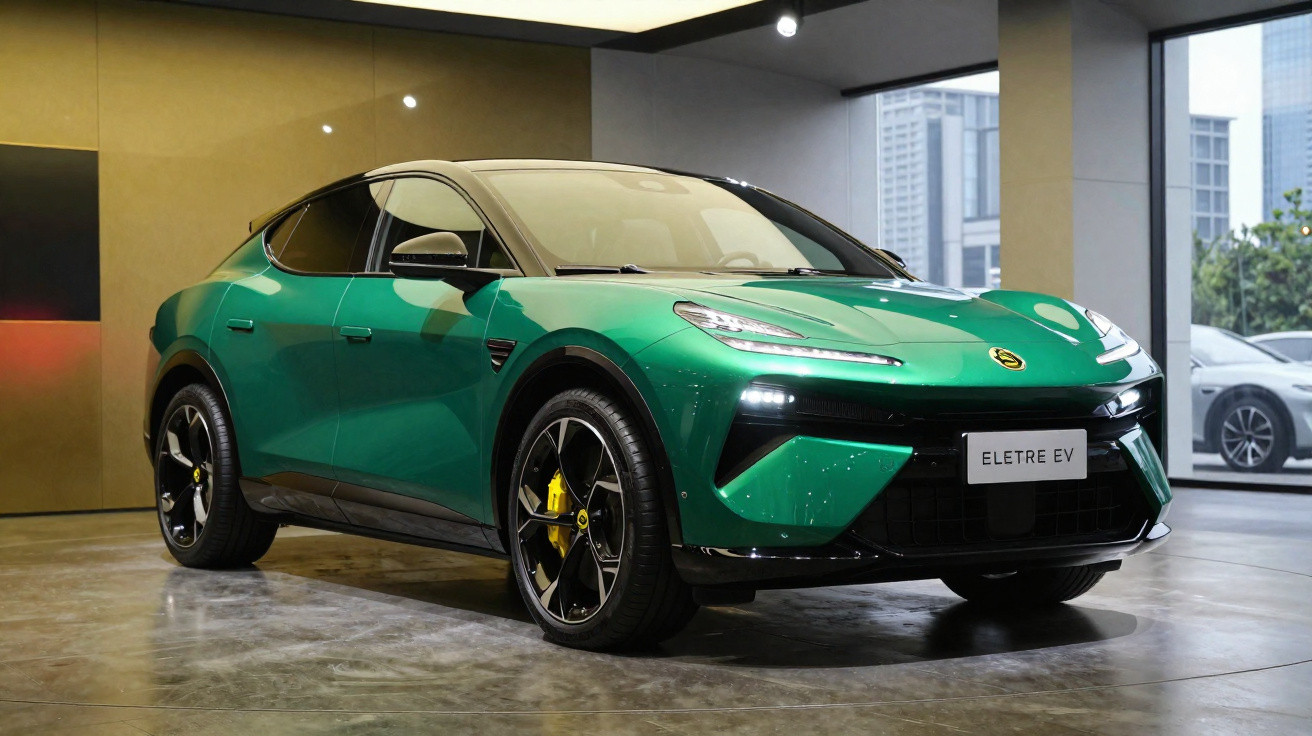
Lotus has been promised several revivals over the years, yet now - backed by Geely - few people doubt that its future will genuinely materialise. The Lotus Eletre is clear evidence of the transformation taking place at the Hethel marque.
After all, only a few years ago, who would have imagined a Lotus that could be fully electric, offer a 600-litre boot, carry up to five people and use a battery weighing as much as, or more than, an original Lotus Seven?
The Eletre has made all of that possible. Although Colin Chapman - founder of the legendary British brand - would probably have struggled to endorse this direction, the Eletre represents only the «tip of the iceberg» of the revolution Lotus is set to undergo.
Electrification is the priority
Since acquiring 51% of Lotus in 2017, Geely has aimed to completely redirect the British marque.
The strategy is to electrify the entire range. The first move was the exclusive Evija, which will be followed by four models over the next five years: the Eletre, another SUV, a saloon and a sports car jointly developed with Alpine.
Previous plans to relaunch Lotus Cars have repeatedly fallen short, but this time Geely’s financial resources and determination leave few doubts that a new Lotus will emerge.
Whether the brand can retain its traditional values remains far more open to debate, although those leading the project insist that its heritage will be honoured.
Matt Windle, Lotus’s Managing Director since the beginning of 2021, states that future models “will be the best to drive and the lightest in their segments”.
The restructuring of Lotus Cars has created a truly global organisation, reflected in the Eletre development motto: “Born English, Raised Globally”.
This refers to the joint work carried out by Lotus teams in the United Kingdom - at Hethel and Coventry, where Lotus Tech is based - as well as in Germany, at the Lotus Tech Innovation Centre in Frankfurt, and in China, where the engineering and production team was located.
Lotus Eletre figures
The Eletre will be offered in three versions, all using two motors, with one fitted to each axle. The entry-level Eletre and Eletre S produce 612 hp and 710 Nm, with a claimed range of 600 km; the Eletre R delivers 918 hp and 985 Nm, with 490 km of range.
Its performance figures are equally striking. The less powerful Eletre models cover 0–100 km/h in 4.5 seconds and reach 258 km/h, while the flagship version records 265 km/h and completes 0–100 km/h in 2.95 seconds.
Using an 800V electrical architecture, the Eletre features a battery with 112 kWh of capacity.
For charging, the battery can accept up to 350 kW of direct-current (DC) power, enabling a 10–80% charge in only 20 minutes. With alternating current (AC), maximum charging power is 22 kW.
With independent suspension at all four corners and a multi-link rear axle, the Lotus Eletre has sought to remain faithful to the British brand’s dynamic pedigree.
Gavan Kershaw, Director of Vehicle Attribute and Product Integrity, says that “the Eletre was developed to deliver everything expected of a Lotus dynamically, particularly highly communicative steering, controlled body movement and the ability to involve the driver in its primary task”.
One model, three versions
As mentioned, Lotus’s new electric SUV will be available as the Eletre, Eletre S and Eletre R.
All versions share, for instance, digital cameras in place of conventional door mirrors. Each module contains three cameras: one for rearward visibility, another to create a 360º overhead view, and a third that contributes to the autonomous-driving functions alongside a LiDAR sensor.
The mid-range Eletre S adds an active rear spoiler, configurable interior ambient lighting, a soft-close door system, tinted windows and an audio system with 23 speakers and 2160 watts over the standard model.
At the top of the range, the Eletre R gains rear-wheel steering, a more firmly tuned chassis, reduced ground clearance, a sports bonnet, a carbon-fibre package and an active front grille.
It also receives an additional driving setting, Track mode, alongside the Range, Tour, Sport and Off-road modes shared with the other Eletre versions.
Revolution inside the Lotus Eletre
While its exterior proportions and shape radically change what Lotus has represented throughout almost 75 years of history, the cabin follows the same approach.
Buyers can choose either five seats or four individual bucket-style seats, featuring fixed head restraints integrated into the seatbacks.
Front occupants have access to three displays. The central 15.1-inch screen houses all infotainment functions, while there is an instrument display in front of the driver and another screen for the passenger, with the latter two measuring 3 cm in height.
There is effectively a fourth “screen” too: the head-up display, which incorporates augmented-reality functions.
A light strip extends across the full width of the dashboard. As well as serving a decorative purpose, it provides information by warning occupants when battery charge is low, when the climate-control system temperature changes, or when an incoming telephone call is received.
In the two-seat rear configuration, rear passengers have a centrally mounted 9-inch display and a wireless mobile-phone charging tray.
All of these communication and information interfaces are managed by Hyper OS, the operating system Lotus debuts in the Eletre.
How much does it cost and when does it arrive?
With production scheduled to begin at the end of the year, Lotus has announced Eletre pricing for eight European markets, which will be the first to receive the Lotus Eletre during the first half of 2023.
A second group of European markets is expected to receive Lotus’s first-ever SUV in 2024, alongside the United States and regions across the Middle East and Asia-Pacific.
In Germany, one of the first markets where the Lotus Eletre will be sold, the entry-level model will start at €96,000; the Eletre S will cost €121,000, while the Eletre R will start at €151,000.
Comments
No comments yet. Be the first to comment!
Leave a Comment