
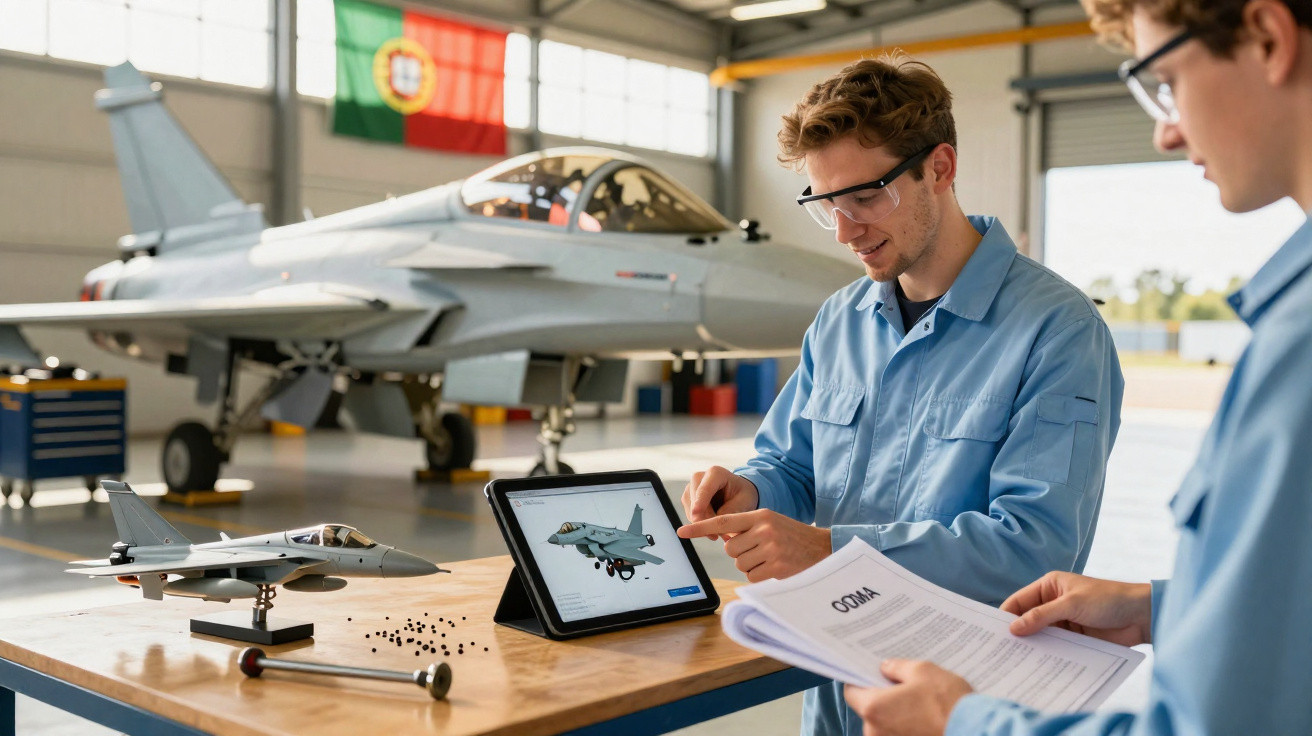
As the Portuguese Air Force assesses options to replace its existing F-16 fighter fleet, Swedish manufacturer Saab is attempting to advance its Gripen E offer by proposing local production. The plan would centre particularly on collaboration with Portuguese firm OGMA. Local media reports indicate that the companies have already signed a Memorandum of Understanding intended to set out an arrangement comparable to the agreement previously made with Embraer - OGMA’s majority shareholder - for the aircraft chosen by the Brazilian Air Force. Such a model could enable Lisbon to bring a wide network of domestic industrial companies into the programme.
Saab and OGMA propose local Gripen E production
Although no formal procurement procedure has yet been launched, Saab representatives have already described the Gripen E as an “excellent product” for the Portuguese Air Force. They also stressed that the service already knows the company’s reliability through its operation of other Saab-built systems.
Gripen business vice president Daniel Boestad was among the officials making this case. While acknowledging that Lisbon has not reached a final decision, he said Saab was prepared to permit Portuguese production of the aircraft. As he put it: “OGMA has great potential to produce the Gripen.”
It remains unclear, however, how many fighter aircraft the Portuguese Air Force might eventually order, or which weapons and integrated systems would be included. Boestad said it was currently not possible to establish the level of investment Portugal would require should it select the Gripen E, but referred to the examples of Thailand and Brazil. Thailand confirmed the acquisition of four aircraft for approximately €495 million in August 2025, whereas Brazil bought 36 aircraft for around €3.87 billion.
Gripen E adaptability and future technology
Setting out the Gripen E’s credentials as a Portuguese fighter aircraft, Boestad said: “It is a completely different aircraft, one of the most important and modern. I’m not referring only to flying fast or turning quickly, but to the ability to adopt new technologies (…) The speed of change, the speed of adaptation, is key for the future. That was the main factor when designing this aircraft. We designed the Gripen’s computer systems in a completely different way from other aircraft in order to implement these changes very quickly.”
Saab considers this feature especially significant in its promotion of the fighter, above all when measuring it against American rivals such as the stealth F-35. According to the executive, a crucial distinction is that customers could specify the software programmes they wished to add to the fighter. Engineers could then make the required modifications quickly enough for them to be available in days, rather than after months or years.
The F-35 candidacy as an alternative
While Saab seeks to present the Gripen E as the Portuguese Air Force’s future combat aircraft, Lockheed Martin has likewise been promoting its F-35. Its campaign benefits from substantial support from Washington, which could apply greater pressure on Lisbon once a decision is due.
As previously reported, the platform’s arrival would be regarded positively because it could align Portugal’s capabilities with those of numerous European countries that have chosen the F-35 as their future fighter. This would create opportunities for greater interoperability and make any future process to introduce a sixth-generation aircraft easier.
Nevertheless, the American stealth fighter faces a number of obstacles already identified by Portuguese military authorities, including factors that go beyond strictly technical or financial matters. In an interview reported last December, General Cartaxo Alves, Chief of Staff of the Portuguese Air Force, said F-35 delivery schedules would be lengthy if it were selected. He also stated that the costs of acquiring and operating it would be considerably higher than those of the Swedish competitor.
Aircraft numbers and programme costs
This would clearly influence both the eventual number of aircraft that could be bought and their future operational role, restricting the force’s capacity to carry out its missions. General Alves did not confirm the quantity that would be acquired during the interview, but cited a range of 14 to 28 units. By his calculations, this would entail investment of between €3 billion and €4.8 billion, still below the €5 billion the government was prepared to allocate to the programme.
A third contender: the Eurofighter Typhoon
Alongside what seem to be the strong Gripen and F-35 bids, Portugal is also examining a third aircraft type: Airbus’s Eurofighter Typhoon. Towards the end of October last year, Airbus announced the signing of a Memorandum of Understanding with the Portuguese Aeronautics, Space and Defence Industries Cluster, AED Cluster Portugal, to develop its own proposal. The company said it was ready to start the studies needed to define a plan that would likewise involve local businesses in manufacturing the aircraft.
At the time, the Eurofighter consortium aimed to build on the momentum from Germany’s purchase of 20 additional aircraft and the aircraft included in Spain’s Halcón I and Halcón II programmes, which correspond to the platform’s Tranche 4 and 5 variants. It had also secured a further export success beyond the central group of European countries that originally developed the aircraft: the United Kingdom sold 20 units to Turkey following British Prime Minister Keir Starmer’s visit to Ankara.
Images used for illustrative purposes.
You may also be interested in: The Portuguese Air Force aims to expand its Black Hawk fleet with the search for four new units



Comments
No comments yet. Be the first to comment!
Leave a Comment