
Blink, and the crucial moment is gone. We almost missed it ourselves.
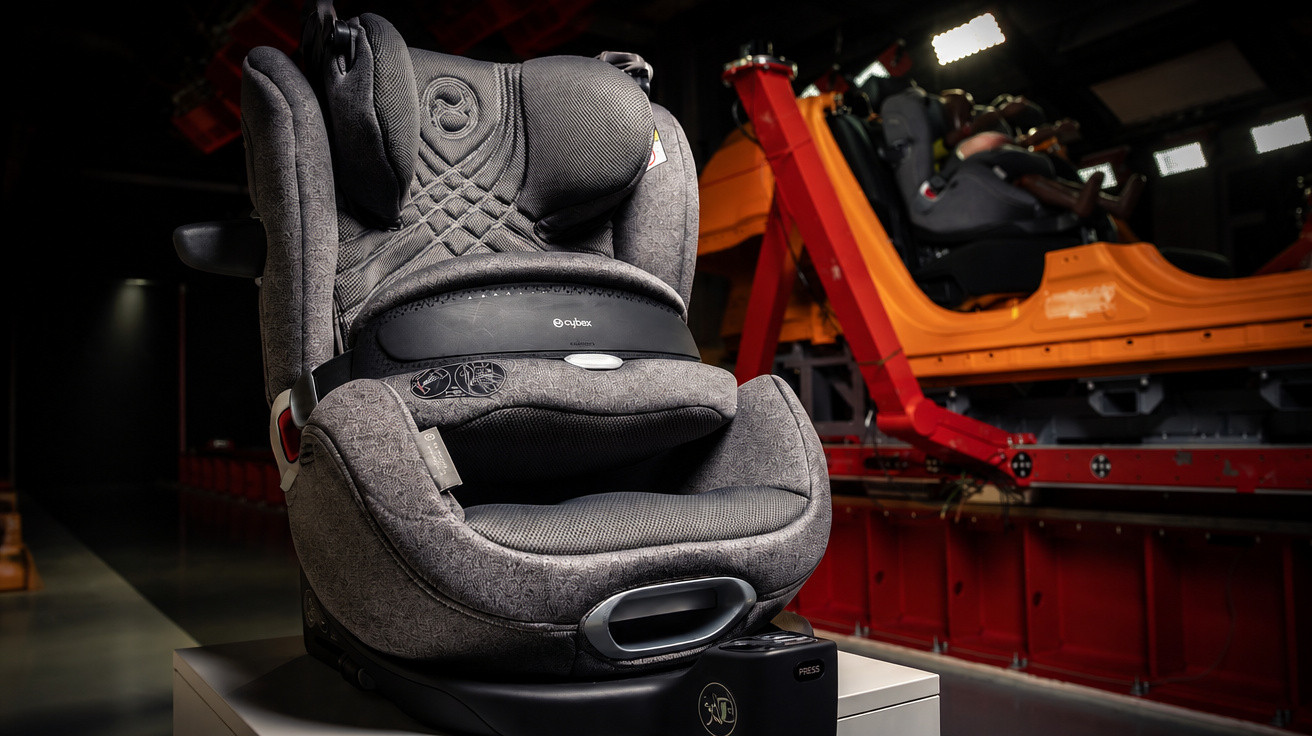
Within CYBEX’s multi-million-euro crash-test centre in Bayreuth, Germany – an unassuming building outside, yet intensely absorbing and highly confidential inside – a featureless child dummy is secured in one of CYBEX’s newest seats. Realistically ballasted and fitted with sensors and wiring, it is encircled by high-speed cameras and aimed at an event no parent would ever wish to contemplate.
Then the vivid orange sled launches.
Within seconds, the apparatus replicates the brutality of a 40g collision. The forces surge, while cameras record thousands of frames every second. At its centre is one of the most ingenious pieces of child-safety equipment we have encountered in years: the CYBEX Anoris T2, part of the first car seat range ever to incorporate a full-body airbag. That immediately makes clear that this is not simply another baby product covered in soft textiles and subdued shades. It is engineering – serious engineering.
The motor industry has spent decades refining airbags for adults, placing them in steering wheels, dashboards, side curtains and virtually every available space. So the natural question is: why should children receive anything less advanced? The answer is that achieving it is exceptionally hard. Yet CYBEX has managed it with the Anoris T2.
CYBEX Anoris T2 and its full-body airbag
Intended for children aged from 15 months to approximately seven years, the seat’s defining element is an airbag housed in the impact shield positioned in front of the child. During a frontal crash, it deploys within milliseconds, creating a C-shape around the shield. This helps safeguard the child’s head, neck and torso, while spreading collision forces over a wider area.
Put simply, it is designed to address one of child safety’s most difficult trade-offs.
Like many safety specialists, CYBEX continues to advise rear-facing travel for as long as possible – ideally until a child is four – since it provides outstanding protection for a young child’s developing neck and spine in a frontal collision. Parents, however, deal with reality rather than ideals. Children can suffer from travel sickness, cars can be cramped, families require simpler access, and some toddlers strongly dislike being unable to see what is happening around them.
This is the point at which the Anoris approach becomes compelling. CYBEX’s forward-facing design, equipped with an airbag, can provide protection comparable with – and in certain instances superior to – rear-facing seats in a frontal impact. It can also deliver up to 50 per cent better safety than a comparable forward-facing seat fitted with a traditional five-point harness.
It is a striking assertion, but this is an equally striking product. CYBEX is a company devoted to combining unique Design, unsurpassed Safety and quality, and intelligent Functionality. That three-part approach has produced not only a ground-breaking car seat, but also more than 500 awards along the way.
CYBEX has pursued the concept so firmly because many parents switch children to forward-facing seats earlier than safety experts would prefer. Research referenced by the brand suggests that a substantial number of parents turn children forward-facing before they reach two, usually for practical rather than careless reasons. Better eye contact, additional legroom, fewer complaints, less motion sickness and more room in the car are all understandable and familiar considerations.
CYBEX’s position is that, if everyday life is leading many families towards forward-facing travel earlier than anticipated, the response should not be to accept that situation with a shrug. Instead, forward-facing travel should be made dramatically safer. This is precisely the role the Anoris T2 and its airbag are intended to fulfil.
Safety features beyond the CYBEX Anoris T2 airbag
It would be tempting to focus solely on the Anoris T2’s attention-grabbing feature – its airbag – and leave it there. But doing so would overlook the wider principle. Effective safety never depends on a single solution; it is built in layers. Alongside its airbag system, the Anoris T2 includes an onboard safety assistant, side-impact protection, reclining functions, breathable materials and a design created to make everyday use simpler rather than more daunting. This is important because even the world’s most sophisticated safety technology is weakened if parents find it awkward, confusing or unpleasant to operate.
It also features Advanced Linear Side-impact Protection, which is intended to direct impact forces away from the child and into the seat’s energy-absorbing shell. Although side collisions occur less frequently than frontal crashes, they are particularly severe because there is far less distance between an occupant and the point of intrusion. Used alongside the seat shell, this side protection can lower forces by around 20 per cent.
There are practical touches, too – the details that matter at 7am in a supermarket car park rather than during a laboratory demonstration. These include a one-click shield, LED safety checks, recline positions for sleeping children and an integrated sun canopy: features that make the seat seem thoughtfully developed, not merely technically clever.
CYBEX crash testing and independent assessments
For all the discussion of innovation and branding, arguably the most reassuring aspect of the CYBEX story is its least glamorous one: testing. The family of faceless dummies and large orange sleds are based at CYBEX’s first crash-test facility in Europe, alongside established sites in China and the US. This provides CYBEX with greater development control, enabling its engineers to put seats through repeated collision scenarios around the clock and crash thousands upon thousands of seats as they refine performance, long before an independent organisation becomes involved.
Independent assessments are important, too. CYBEX car seats are routinely examined by bodies including ADAC, TCS, ÖAMTC and Stiftung Warentest. Their work involves far more than striking products against barriers. They assess frontal and side impacts, certainly, but also the likelihood of misuse, ergonomics, ease of handling, cleaning, build quality and harmful substances. In other words, they evaluate seats for everyday life as well as controlled laboratory conditions.
ADAC’s frontal-impact procedure, for example, recreates a collision at 50 km/h with a rigid barrier using a heavier vehicle, while its side-impact assessment takes place at 60 km/h. Different dummies represent a range of ages and body sizes, because a product made for children cannot depend on a one-size-fits-all view of injury risk.
This is when the images from the crash laboratory begin to carry real weight. The multi-head high-speed camera systems, dummies packed with sensors and repeated simulations – up to hundreds, even thousands, of tests annually – are not for show. They are necessary because child safety allows no margin for complacency. A seat cannot simply meet regulations and consider the job complete. It must perform in a manner that wins the confidence of engineers, safety organisations and, ultimately, parents.
The Anoris T2 is not merely another premium child seat making the usual premium child seat claims. It is CYBEX examining one of motoring’s most established safety technologies – the airbag – and questioning why children have been excluded from that discussion for so long.
Comments
No comments yet. Be the first to comment!
Leave a Comment