
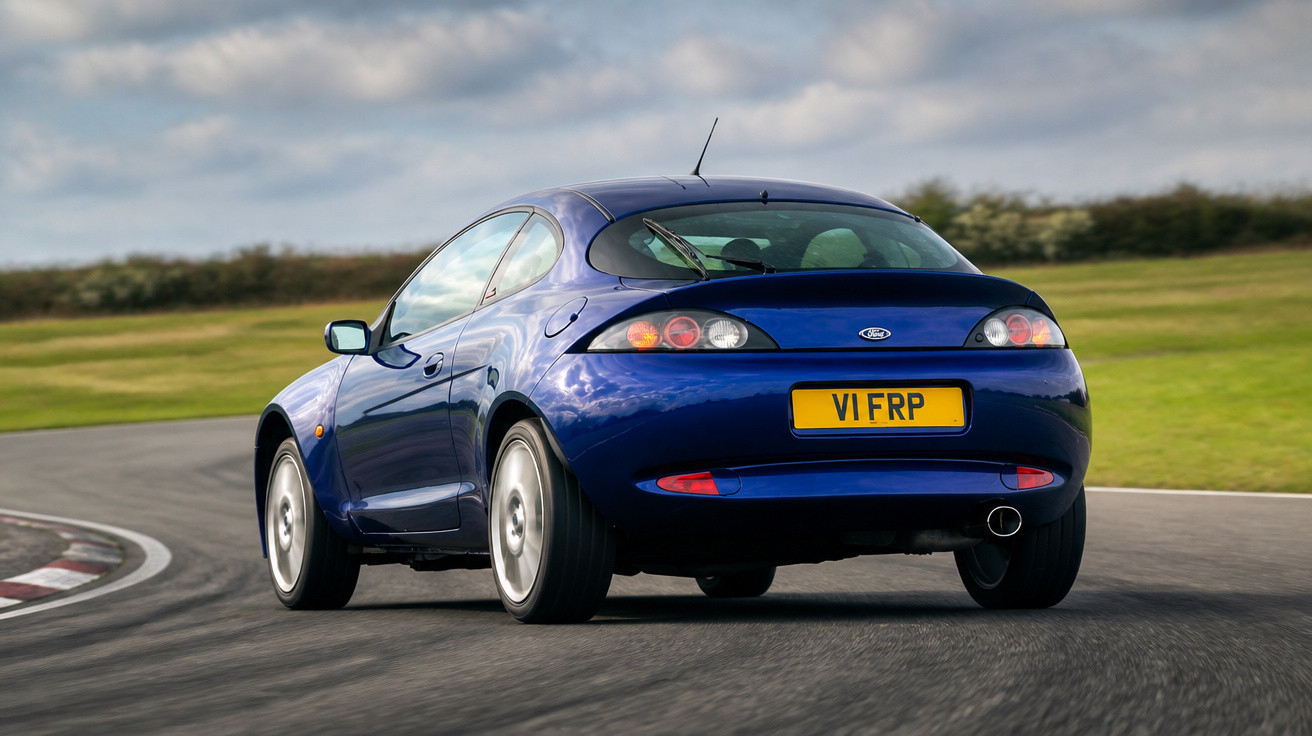
Time is not always kind to heroes. The great become old, the powerful lose their force and the mighty eventually tumble. Yet there is the Ford Racing Puma. It was a hero to me 25 years ago, and revisiting it now... this is the most effervescent car I have driven for years.
Ford Racing Puma: fizz in every corner
That sense of fizz is what defines the FRP. Think of it as a hard-roofed, elevated Caterham. It performs like Mentos dropped into Coke: so bubbly that it struggles to keep itself contained. Were it a dog, it would be a Jack Russell.
Naturally, then, it was close to being a failure. The standard Puma – essentially a Fiesta coupé with a 1.7-litre engine – had been selling strongly since 1997. Expectations were therefore high when Ford unveiled the Puma ST160 concept at the 1999 Geneva Motor Show. But, just months later, the production Racing Puma seemed to have been diluted: it did not even deliver the concept’s promised 160bhp.
Its 153bhp represented only 30bhp more than the regular Puma’s output, but the price had risen from £13,000 to £23,000. There were clear reasons for that, however. To avoid triggering homologation regulations, Ford marketed it as an aftermarket conversion: a standard Puma was assembled before being sent to Tickford in Daventry for its alterations. And although an extra 30bhp did not sound much when every properly hot hatch had 200bhp, the high-lift cams, airbox and exhaust revisions transformed the character of the 1.7-litre engine.
That was only part of the story. Apparently taking its cue from Ford’s Puma F2 rally car, track widths grew by 80mm, requiring those distinctive blistered body panels. Naturally, this brought new wishbones plus longer, sturdier driveshafts, while the rally influence continued with firmer Eibach springs and dampers, shot-peened lower gears, 295mm Alcon four-piston brakes, Sparco seats, Alcantara trim and an options list featuring a limited-slip differential.
Ford had intended to build 1,000 examples for the UK and German markets. Germany ultimately received none, though, and fewer than 490 were bought by UK customers before production ended. That came despite exceptionally favourable press coverage.
An eager, high-revving Ford Racing Puma
I contributed to some of that coverage. Although I missed the original San Francisco launch, once the car was back in the UK I would find any reason to get behind the wheel, simply because it was so thrilling. The FRP behaved as though it had 500bhp. That quality has not faded with time. Throttle response is utterly electric: graze the pedal and it launches forward, surging with a constant urge to go. Let it run and it becomes all fizz and enthusiasm, delivering everything at the top end between 5,000 and 7,000rpm as the gearchanges snap home. There is no brawn involved; this is entirely about nerve.
I found any excuse to drive one, because it was so exciting
The chassis is wound tighter than a bowstring, too. This example is not even as firm as Ford legend Richard Parry-Jones, the project’s leading figure, had wanted. A set of RPJ dampers appeared on the options list. Reportedly, only 15 or 20 cars received them, while around 80 were fitted with the differential. This car – car 1/500, no less – has neither. Around Dunsfold, it skips and bobs with a slightly stilted eagerness, seemingly desperate to be aimed at the next bend.
The steering overflows with feedback, and I cannot recall another car offering this much adjustment through the throttle. Enthusiasts often talk about the lift-off oversteer of an original Peugeot 205 GTi, but this operates in another league. Turn in, establish an angle on the steering wheel, then manage everything else with the accelerator. Roundabouts must be mesmerising in one. Lift too far off the throttle and the rear axle says, ‘wahey! Let’s have some fun!’
Why the FRP remains such a bargain
And it certainly does. Two things strike me as remarkable. First, that Ford has seemed prepared in recent years to relinquish its hard-earned reputation for ride and handling. Second, that values of older fast Fords have rocketed into the stratosphere while a smart FRP still costs city-car money. Its prices ought to soar. I cannot think of another car that turns modest power into such an exhilarating experience.
Photography: Jonny Fleetwood
Comments
No comments yet. Be the first to comment!
Leave a Comment