
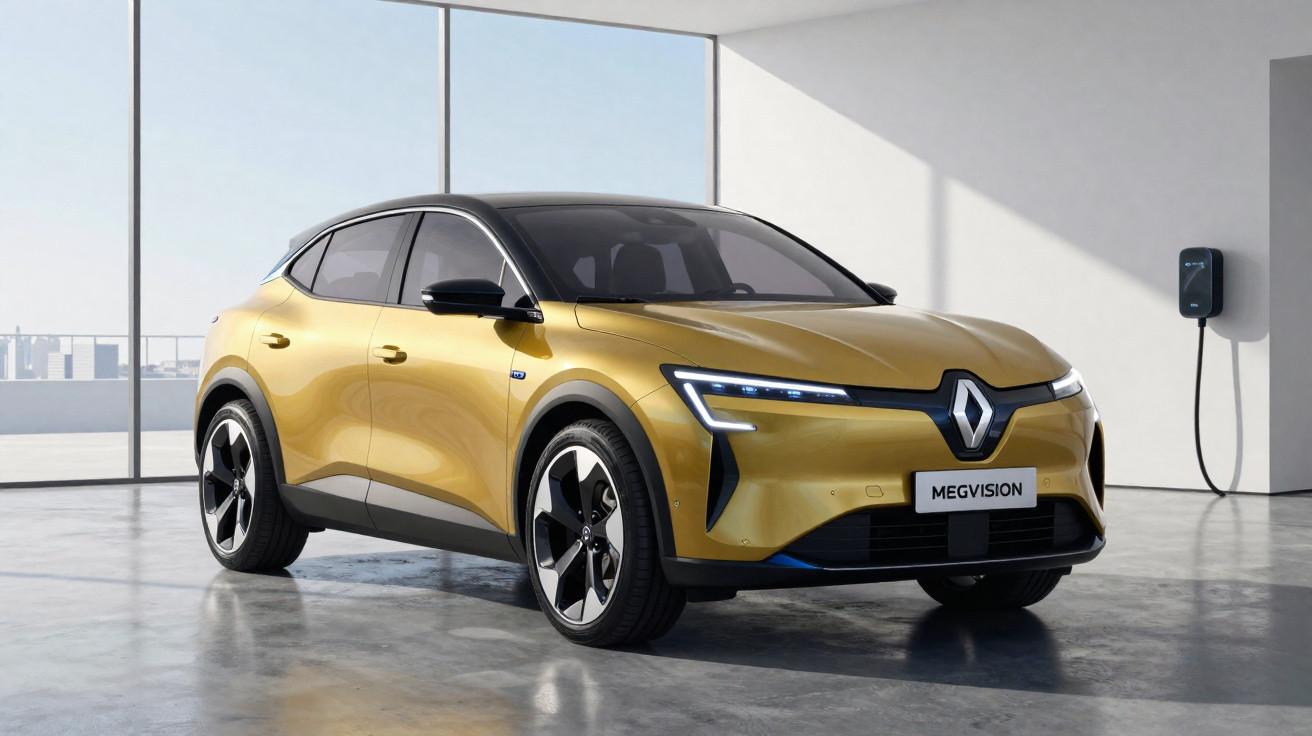
Inspired by the Morphoz concept, the Renault Mégane eVision is also a concept car, yet it is far closer to the production model we will eventually see. But just how close is it?
Renault says the Mégane eVision already represents 95% of the finished model, which is due to enter production in France at the end of 2021.
For now, however, it remains a prototype. Within its compact body - measuring just 4.21 m long, 14 cm shorter than the Mégane currently on sale - the Mégane eVision introduces several new features and previews what to expect from the Mégane’s successor.
The first conclusion is that the next Renault Mégane will, in all likelihood, be a crossover. A rumour circulating for several months, which the Mégane eVision all but confirms. In Renault’s words:
“The Mégane eVision symbolises the reinvention of a crucial segment for Renault. It represents the future of the ‘compact’ category, firmly rooted in its interior dimensions and spaciousness. The Mégane eVision continues the story of the Mégane, the flagship model in Renault’s compact range for 25 years, and positions it firmly in the modern world.”
It remains a typical compact family car, with a five-door, two-box hatchback body, but it has been “reinvented”, as Luca de Meo, the current chief executive of the French marque, put it: “the Mégane eVision reinvents the Mégane (…)”.
Will the Mégane successor be exclusively electric?
The CMF-EV platform underpinning this concept is designed specifically for electric vehicles. Developed jointly with Nissan, Renault’s Alliance partner, it will also form the basis of the Ariya, the Japanese brand’s new electric SUV. Renault has, in fact, promised an entire family of electric vehicles using the CMF-EV architecture, for which it already holds more than 300 registered patents.
Whether it will be electric-only remains unknown. What is clear is that its proportions are only achievable because it uses a dedicated electric-vehicle platform.
As can be seen, the Mégane eVision has a shorter front end than usual, while its 2.70 m wheelbase - 4 cm longer than that of the current Mégane - is especially generous for a vehicle only 4.21 m long, 5 cm shorter than the Volkswagen ID.3. This allows the 20-inch wheels (245/40 ZR 20) to sit close to the body’s corners, hinting at generous passenger space.
Its stated width of 1.80 m is typical of today’s compact family hatchbacks, while its 1.55 m height places it somewhere between conventional cars and SUVs.
Despite its crossover genes, including increased ground clearance, Renault is keen to highlight the low height of its new electric model. This is the result of its ultra-thin battery - only 11 cm high, reportedly the lowest on the market, according to de Meo - which has helped to optimise both the proportions and aerodynamics.
Renault Mégane eVision: 450 km of range, with scope for more
The battery has a 60 kWh capacity, providing a 450 km WLTP range. Luca de Meo also says there is potential for versions with even greater range.
The electric motor is mounted at the front, giving the car front-wheel drive, and produces 160 kW, equivalent to 218 hp, along with 300 Nm of torque. Renault also claims a 0-100 km/h time of under 8.0 seconds and a mass of 1650 kg.
No interior images have yet been released, but Renault promises not only generous cabin space, but also a slim, flowing dashboard design and a modular interior with integrated storage areas.
Comments
No comments yet. Be the first to comment!
Leave a Comment