
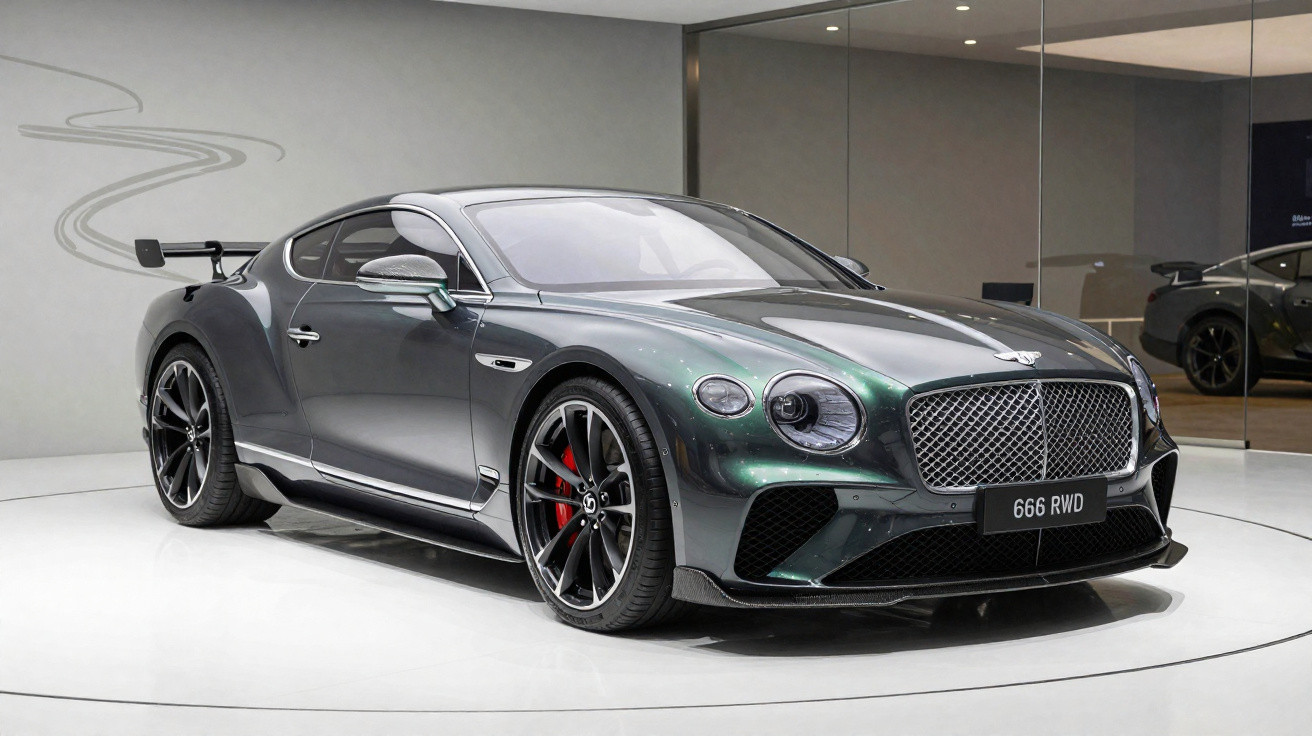
Rear-wheel drive, 666 PS and almost half a tonne less weight. We went to Laguna Seca to find out just how radically this Bentley Supersports has changed its character.
Making a car more sporting generally comes down to a handful of fundamental rules: give it more power, improve its ability to deploy those extra horses through its chassis, tyres and aerodynamics, and cut mass.
That is precisely the route Bentley has taken under the guidance of its new chief executive, Frank-Steffen Walliser. Recruited from Porsche in 2024, he arrived with the right credentials to oversee the first Bentley developed during his leadership of the British marque.
And it shows.
The lightest Bentley in 85 years
Starting with weight, this is Bentley’s lightest car in 85 years. It is almost half a tonne lighter than the Continental GT Speed, and it is also the first road-going Continental GT to weigh less than 2,000 kg.
The powertrain accounts for the largest part of this substantial weight loss. There is no plug-in hybrid system here, nor any of the hardware required for four-wheel drive. The aluminium roof fitted to ‘standard’ Continental GT models has also made way for a lighter carbon-fibre item, which additionally lowers the centre of gravity.
Carbon fibre and aerodynamic focus
The link between weight saving and aerodynamics is clear in the bodywork: almost every newly introduced exterior component is made from carbon fibre, all serving the same ultimate purpose. Bentley says none of them has been added merely for visual effect.
Together, these additions produce more than 300 kg of extra downforce at 250 km/h compared with a Continental GT Speed. They also help refine a weight distribution that starts at 54:46, front to rear.
The lower front bumper is new and incorporates a front splitter lip, the largest ever fitted to a Bentley road car. It also features fresh cooling ducts intended to reduce brake and engine temperatures. The new aluminium-mesh grille is laser-cut and uses a Supersports-specific pattern.
There are also aero blades behind the front wheels, redesigned side skirts, a rear diffuser and a fixed spoiler on the boot lid. Each has been designed to improve the airflow around the Bentley Supersports.
A helmet is compulsory when driving quickly on track, and it inevitably makes the experience feel more enclosed while limiting direct visual contact with the cabin. Even so, the interior will be familiar to anyone acquainted with the wider Continental family.
Material quality is excellent, while the upper dashboard and door trims are finished to the standard expected of the marque. The more basic-looking plastic on the centre console is less convincing, particularly as almost all the physical controls are grouped there.
That includes the rotary drive-mode selector. In a car likely to visit racing circuits regularly, and one that encourages more committed road driving when conditions allow, it would be better positioned on the steering wheel.
666 PS sent only to the rear wheels
As mentioned, the powertrain delivers the biggest reduction in mass, since this car does without both a plug-in hybrid system and four-wheel drive. It is the first road-homologated Continental GT without all-wheel drive.
Its 4.0-litre twin-turbo V8 gains a strengthened crankshaft, upgraded cylinder heads and turbochargers engineered to run at higher pressure. The result is the Bentley engine with the highest specific output ever: 166.5 PS/l, producing 666 PS and 800 Nm of torque in total.
It is paired with the familiar eight-speed dual-clutch automatic gearbox, which now has reinforced clutches and a revised shift strategy. Changes are quicker, while particular attention has been paid to downshifts under braking, helping to maintain Supersports stability.
The engine breathes through a titanium exhaust system developed with Akrapovič, delivering a soundtrack far more forceful than that of any other Bentley.
The figures that follow are 0–100 km/h in 3.6 seconds and a top speed of 320 km/h.
A chassis worthy of 666 PS
Torque reaches the rear wheels alone through an electronic limited-slip differential (eLSD), while the rear track is 16 mm wider than that of a Continental GT. Brake-based torque vectoring supports the eLSD, with both systems working together to improve turn-in and traction.
Rear-wheel steering remains, maximising both agility and stability, while the steering, suspension, traction management and stability control have all been recalibrated. The air suspension also receives new twin-chamber dampers with independently controlled compression and rebound, while retaining Bentley Dynamic Ride, the 48 V active anti-roll system.
There are three driving modes, plus Custom, which allows different settings to be combined. Touring broadly corresponds to the Continental GT Speed’s Sport mode, but adds greater ride height, softer damping and a more restrained exhaust note. Bentley mode is more dynamic, altering the gearbox strategy, throttle pedal response and chassis settings.
Then there is Sport, the most extreme setting of all. In this mode, the exhaust valves open, launch control becomes available and the body drops by 10 mm, bringing the chassis and powertrain responses to their sharpest point.
Braking is handled by what Bentley describes as the largest braking system ever fitted to a production car: 440 mm carbon-silicon-carbide discs at the front with 10-piston calipers, and 410 mm rear discs with four-piston calipers.
The new 22-inch forged and machined aluminium wheels were developed jointly with Manthey Racing. With the optional Pirelli Trofeo RS tyres, Bentley claims up to 1.3 g of lateral acceleration and says the Supersports can corner around 30% faster than a Continental GT Speed.
Lapping Laguna Seca
That was how I found myself heading out onto the Laguna Seca circuit, near Monterey Bay, where Monterey Car Week had finished the previous day. The track measures 3.6 km and has 11 corners, several of them highly demanding, most notably the famous Corkscrew. It is completely blind on entry, plunging steeply downhill, with a pine tree on the horizon serving as one of the turning references.
By the end of the start-finish straight, it is immediately apparent that the Supersports is as impressive shedding speed as it is gaining it, thanks to its extraordinary braking power and drastic loss of weight. That is no small achievement for a car capable of reaching 100 km/h in just 3.6 seconds.
The gearbox reacts more keenly in this Supersports, holding on to gears longer on acceleration and downshifting sooner, particularly in Sport mode. This is also where the V8 adopts a deeper, more prominent voice.
The huge stopping power of the brakes inspires increasing confidence over the handful of laps available to me. The immense grip of the Pirelli Trofeo RS tyres also played its part.
It was not possible to assess the suspension over poor road surfaces, as there was no road driving, but the ride clearly feels very firm and lateral body movements are exceptionally well contained.
Even though Bentley’s imposed limitation meant the stability control could not be switched off entirely, it was evident that the rear end has more ‘life’ than that of the four-wheel-drive Continental GT Speed. It invites more entertaining moments through bends.
There is also a sense that the front axle’s very strong grip will make it possible to play even more with this Supersports once the electronic systems are given freer rein. That assessment will have to wait for another day, as will discovering how well this more radical set-up works when Laguna Seca’s flawless tarmac is exchanged for an ordinary road.
How much does it cost?
Bentley Supersports production will be limited to 500 numbered examples - all of which have already been reserved - with first deliveries scheduled for 2027.
In Portugal, prices are expected to start at approximately €650,000. That figure is heavily inflated by ISV vehicle tax, a consequence of the high emissions produced by this non-electrified V8. By comparison, the price in Spain is more than €200,000 lower.


Comments
No comments yet. Be the first to comment!
Leave a Comment