
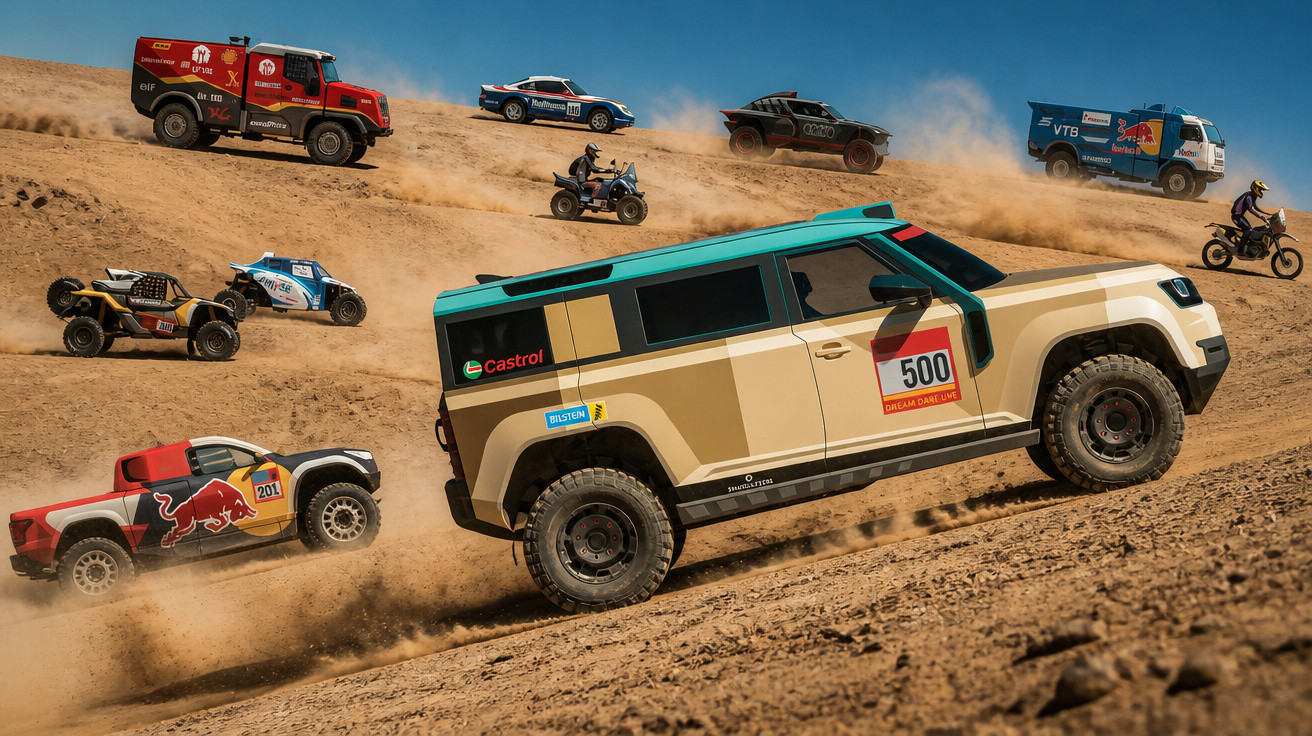
January 2026 means it is time once more for the Dakar Rally. This year, Defender is joining the sandbound circus. Motorsport’s best-known off-road race will again take on Saudi Arabia’s most punishing terrain, testing who possesses the greatest driving ability, the toughest vehicle on Earth and the navigation skills of a genetically enhanced homing pigeon. As always, Dakar is not solely about cars and bikes, either. An entire motorsport family tree will be bouncing across Saudi Arabia’s jagged landscape, from bespoke rally-raiders in the Ultimate category to near-showroom machinery in the Stock class, where Defender is aiming for glory.
As ever, this is not simply a flat-out race. Success depends on preserving your equipment while tackling unforgiving ground. The landscape is the anvil on which you must avoid breaking your machinery – or yourself.
So, what exactly features in this year’s rally? Here is our useful guide.
Dakar Rally production-based and prototype classes
Stock (previously T2)
For anyone who wants to recognise the vehicles competing, Stock is among Dakar’s most compelling categories. The new class is reserved for cars derived from production models – and genuinely stock ones at that. Competitors must retain the same engine, driveline, gearbox, bodywork and chassis as a vehicle coming off the production line.
Take the Defender Dakar D7X-R. This is Defender’s first-ever Dakar entry, based entirely on a Defender OCTA (D7X), with most alterations focused on safety equipment such as the roll cage, spare parts and medical kit. Its only substantial changes are a 500-litre fuel cell, needed for stages exceeding 800 km, and doubled-up Bilstein dampers, required both for the terrain and for carrying more than 500 kg of fuel.
Changes to the bodywork extend only to tougher bumpers, slightly broader wheel arches and larger tyres, with three spares carried on board. The reason it looks much like an ordinary Defender 100 is straightforward: it largely is one. In several respects, Stock feels like Dakar’s purest category: familiar vehicles taking on the greatest challenge.
The Defender entry is certainly one to follow. It proved exciting enough to persuade “Mr.Dakar” Stéphane Peterhansel to return to the event as a driver, which alone is worth the price of admission. He has won Dakar 14 times, on both motorcycles and in cars.
Ultimate (T1+)
Ultimate, also known as T1+, contains Dakar’s quickest competitors. These are custom tube-chassis machines created specifically for events such as Dakar. Ford returns with the Raptor T1+, driven by Carlos Sainz, Romain Dumas and Nani Roma. The Dacia SandRiders team is led by five-time Dakar winner Nasser Al-Attiyah and nine-time WRC champion Sébastien Loeb. Toyota Gazoo Racing fields the Hilux T1+, while X-Raid and Ebro Audax Motorsport are also entered, alongside several others.
Yet even these wildest of machines are not entirely unrestricted. They must have two seats for a driver and co-driver/navigator, four-wheel-drive capability, a minimum mass of 2,010 kg, a width of 2.3 metres and no more than 350 mm of suspension travel. Maximum output is controlled through EoT (Equivalence of Technology) rules and peaks at 400 bhp.
Consequently, the Raptor’s 5.0-litre V8 and the Hilux’s 3.5-litre biturbo engine operate in relatively modest states of tune. That benefits reliability, which is Point One in the “trying to finish the Dakar” guidelines.
Challenger/T3 and SSV
Challenger is home to lightweight prototype cross-country buggies, effectively a development route for future T1+ contenders. It is also where Defender’s Rokas Baciuška first made his name as a winner. These fierce little vehicles are broadly a step above SSV side-by-sides, while costing far less to run than a full T1+ programme.
They are also speed-limited compared with their larger counterparts. Challengers reach 84 mph, whereas the bigger cars can manage 105 mph flat out. That may not sound especially rapid, but nearly all of it happens off-road. They offer impressive suspension travel and just enough flimsy bodywork to make the drivers feel as though they are in a car rather than riding a motorcycle – though it is a close call.
Challenger is linked to SSV, previously known as T4. As its name indicates, SSVs, or side-by-side vehicles, are small, lightweight off-roaders based on production models. They are heavily modified but remain distinct from purpose-built Challengers; think Can-Am Mavericks or XYZ Yamahas. This is another feeder category for Challenger, allowing rising talents to gain important Dakar experience before moving into the faster classes.
Dakar Rally heritage and future technology
Classic Dakar
Classic Dakar is one of the event’s best-looking categories, set aside for retro icons from earlier eras. In 2026, both cars and trucks are split into age-based groups: Period A (before 2006), Period B (1986-1996), and Period C (1997-2005).
Classic is a regularity rally, meaning crews aim to match a prescribed or bracketed time rather than attack the route solely to set the quickest time. The closer they are to their target time or distance, the fewer penalties they collect. Fewer penalties mean a stronger score and more champagne at the finish.
If that sounds simpler, bear in mind that these are older, usually more fragile vehicles, average speeds still demand courage, and the task is even more demanding in ’26. The event has a new record total special-stage distance of 4,500 kilometres. That is just under 4,500 km of competition in a vehicle that could be more than 40 years old – rather like forcing your grandad, in car terms, to complete an ultramarathon on dodgy knees.
Mission 1000
Mission 1000 is Dakar’s mobile desert laboratory. It is where manufacturers put emerging eco-focused and cutting-edge technologies through desert punishment to discover whether they can survive. Electric cars, motorcycles and hydrogen-powered vehicles tackle distances better suited to their particular requirements.
In effect, these are rolling experiments likely to inform future rally-raids, testing, assessing and validating new technology to determine what works and what… explodes. Mission 1000 has a variety of specific regulations, including the option of hot-swapping batteries and a requirement to deploy launch control for additional points.
The 2026 event even includes a “fan boost” feature, much like Formula E. Despite all the embellishment, though, it is probably among the most brutal possible tests for a delicate prototype. Every piston-powered vehicle in Dakar is required to use low-carbon superfuels, but these entrants are looking beyond burning trees for their motorsport fix.
Dakar Rally trucks and motorcycles
Trucks
The truck category is, just as its name implies, for the heavy-duty boys and girls. Trucks began as support vehicles for Dakar’s cars and bikes in the late 1970s. Once their drivers noticed there was an …uh… “informal” contest to reach the bivouac or garage area first, matters escalated and a new class emerged.
In some respects, the trucks are even more spectacular than the cars, and some of Dakar’s most memorable scenes have involved these megatonne machines overtaking rally cars. The master was Jan de Rooy, who experimented heavily with the format before arriving at a twin-engined, 10-tonne racing DAF block of flats producing around 1,200 bhp and featuring four-wheel drive. That is what 23.2 litres of total displacement can do for you.
Russian Kamaz has historically been Dakar’s most successful truck team, with 19 victories by 2022, although its participation at the 2026 start remains unconfirmed.
Bikes
The motorcycle and quad divisions are plainly the most demanding classes at any Dakar. This year, 118 of the most sinewy, thousand-yard-stare motorcyclists are competing, and it is difficult not to salute them aboard their 450cc machinery. Exposed, quick and prone to tipping over, they face a formidable solo task.
There are obvious issues with protection in a crash, exposure even when nothing goes wrong, and the limited capacity to carry spare parts or equipment. The leading riders compete in Rally GP, with full factory support from the likes of Honda and KTM. Successful previous winners include Daniel Sanders, Luciano Benavides, Edgar Canet, Poole lad Sam Sunderland and Australian Toby Price, who are not quite as household-namey as their car counterparts. There are also classes for women, juniors and semi-old people (veterans).
Rally 2 is the main category for riders without the money for a full race team but with the toughness to complete the route. Rally3 is for competitors using modified production bikes rather than bespoke rally-raid machines. Three further classes-within-classes also distinguish the riders: Legend for elite competitors, Rookie for newcomers and Original (Malle Moto) for those contesting the entire event without assistance, in tribute to the rally’s original format.
A side note on those “original” riders: Dakar 2026 includes two two-day “marathon” stages, during which every competitor must manage for 48 hours without external assistance. One particularly lovely rule remains, however: solo motorcycle competitors are allowed to work on one another’s bikes. It was introduced to help more people actually finish the event.
- Illustrations: Peter Greenwood*
Defender OCTA | Master of Extreme Performance, Everywhere
Comments
No comments yet. Be the first to comment!
Leave a Comment