
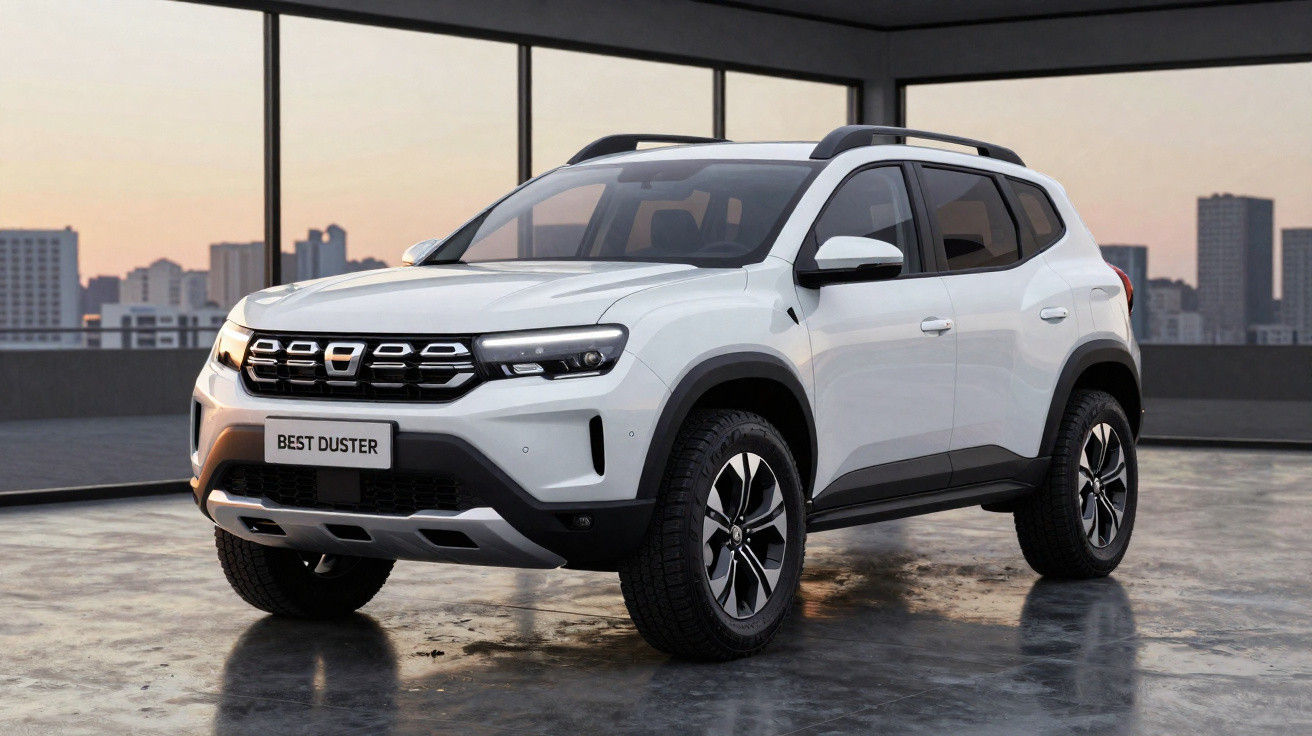
Lower running costs and a 1,500 km range are the Dacia Duster Hybrid-G 4×4’s unbeatable selling points. Do they hold up in real-world use?
Almost everything has already been said about the Dacia Duster. In this generation, it has become the best Dacia yet, swiftly continuing the success story it has built since its launch in 2010.
It has gained fresh styling, a considerably improved cabin and an entirely new platform, opening the door to new electrified powertrains. One of them is a market first, combining four systems in one: hybrid power, LPG, an automatic gearbox and four-wheel drive.
I know, it sounds complicated. But do not give up on it just yet. On paper, this could be the most versatile Dacia ever. I put it to the test to find out. Take a look:
Styling is a key selling point
With Dacias of the past, the exterior design was merely passable and the interior did just enough. Things are now very different, to the point that the Duster’s more adventurous appearance has become one of its main strengths.
The same applies inside. Harder plastics are still present, but the build feels robust and the layout is far more pleasant.
It is also impossible to overlook the new technology offering, including a fully digital 7-inch instrument display and a 10.1-inch infotainment screen with wireless smartphone integration via Android Auto and Apple CarPlay.
Hybrid + LPG
At the entry point of the Duster line-up sits the bi-fuel version, which runs on petrol and LPG. It has become an increasingly important part of Dacia’s strategy, while the technology itself has attracted a growing following in the domestic market.
Aware of LPG’s rising popularity, Dacia decided to take the concept a stage further by combining it with other technologies to create a system unlike any other on the market.
At the front is a 1.2-litre, turbocharged petrol engine producing 140 hp, while the rear axle is served by a 23 kW (31 hp) electric motor. Together, the system delivers a maximum combined output of 113 kW (154 hp).
The combustion engine develops 230 Nm of torque and is paired with a six-speed dual-clutch automatic gearbox, which can be operated using steering-wheel paddles - another first for the Romanian brand.
Meanwhile, the rear electric motor supplies 87 Nm and is connected to a two-speed gearbox. First gear provides strong torque at low speeds, which is useful off road or on surfaces with limited grip; the second ratio lowers the electric motor’s revs at higher speeds, maintaining rear-axle drive up to 140 km/h.
However, the rear electric motor’s gearbox has more tricks up its sleeve. Its Neutral mode can disconnect it entirely from the rear axle, removing potential friction losses. This is another solution not previously seen on a 48 V electric motor, supplied by a 0.84 kWh lithium-ion battery.
Record range for the Dacia Duster Hybrid-G 4×4
This is not enough to give it a genuine all-electric range, but because the battery is continually recharged while driving, the Duster Hybrid-G 150 4×4 can travel for up to 60% of urban-cycle driving time without using a single drop of fuel.
The system’s biggest advantage, though, is its LPG capability. The Duster has two 50-litre fuel tanks with this set-up - one for petrol and one for LPG. Together, they allow a range of up to 1,500 km on the combined WLTP cycle without needing to refuel.
No electric vehicle can realistically hope to compete with that figure. It makes this model even more versatile, while delivering lower running costs than the Duster Hybrid, which we have also tested:
Even better off road
On tarmac, the system is economical, pleasant to use - with the gearbox largely responsible for that - and delivers strong performance, as its 154 hp maximum output makes clear. Away from the road, this Duster remains remarkably capable.
With 21 cm of ground clearance and favourable approach and departure angles, this four-wheel-drive version lets you venture off road with greater confidence. In the featured video accompanying this article, you can see the Duster tackling mud and dirt tracks.
The experience was relatively brief, but it reinforced an opinion I already held: unless you want to tackle more demanding trails - in which case, you are looking at the wrong car - the Duster is all you need to head down a dirt or sandy track.
Interestingly, despite the system’s apparent complexity, it all works without fuss. On open roads, “Auto” is almost always the best setting, as the system automatically manages the switch between 4×2 and 4×4 modes and gives you the best possible traction in every situation.
In more difficult conditions, particularly mud like that encountered on my drive, it makes sense to select “Mud/Sand”, allowing the system to react more quickly and decisively when traction is lost.
How much does it cost?
The Dacia Duster range starts at €19,900 for the Eco-G bi-fuel version and rises to €29,300 for the Hybrid 155, which remains the flagship model.
Just below it is the new Hybrid-G 150 4×4, priced from €27,850, in Expression trim.
There is no other way to put it: a large part of the Duster’s success has always come down to its price, and in this version the value-for-money proposition is particularly compelling. It is, quite simply, the most complete and versatile Duster of them all.
You get four-wheel drive, an automatic gearbox, 154 hp of maximum power, a 1,500 km range and a system that allows up to 60% of urban driving time in electric mode. All of it comes in a single package. In addition, it can qualify for Class 1 tolls when registered with Via Verde.
Comments
No comments yet. Be the first to comment!
Leave a Comment