
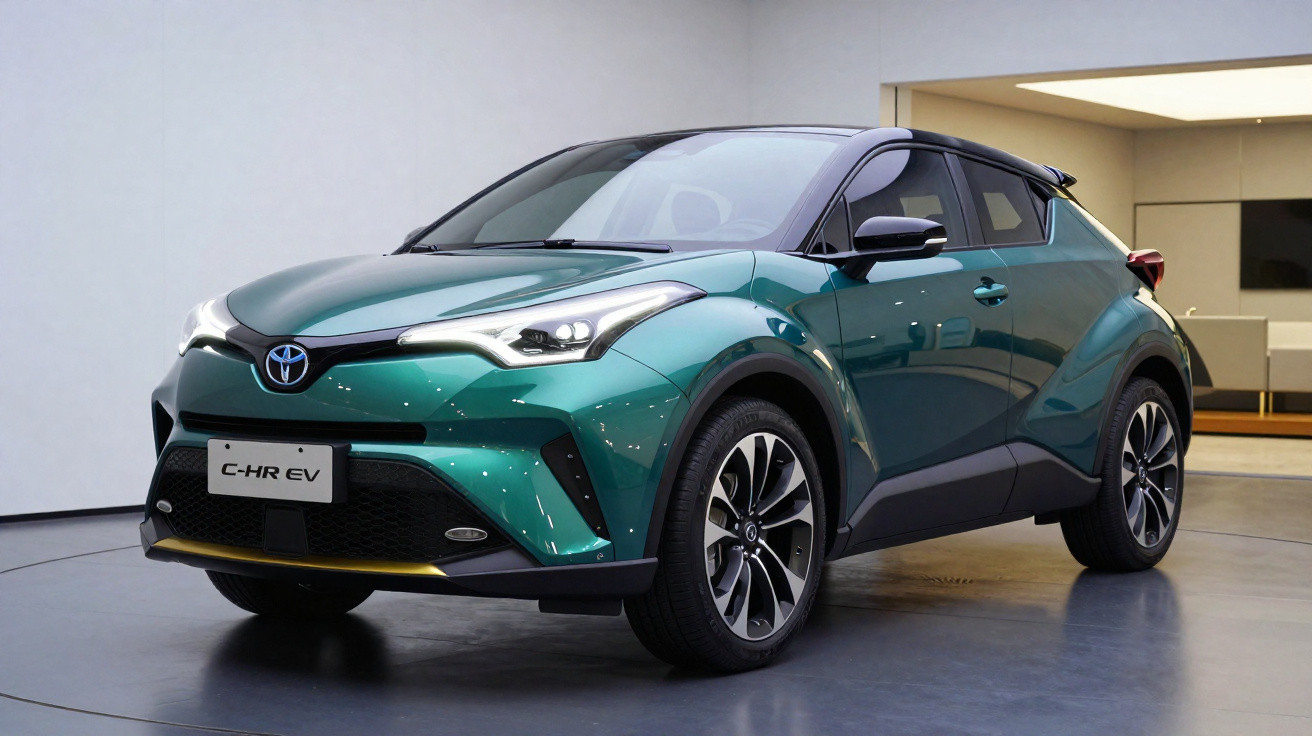
The Toyota C-HR+ is an electric-only model with far more in common with the bZ4X than the C-HR, although it sits between them in the range.
Electric cars are steadily gaining ground in Europe, as they are in Toyota’s own line-up. The Japanese manufacturer is about to introduce another battery-electric SUV, called the C-HR+. Yet the name is not especially logical: it uses the bZ4X’s platform and shares little, if anything, with the hybrid C-HR.
Giving it the name of an existing model also risks diminishing its identity, making it seem like simply another variant. This could mean one of two things: either Toyota’s marketers have been short of inspiration when naming its cars - bZ4X sounds more like a Star Wars robot than an automobile - or the company is already preparing to phase out the combustion-engined C-HR.
Given its continuing commercial success - with more than one million units sold across Europe since 2016, spanning two generations - the latter scenario seems less likely.
A family of medium-sized SUVs
The “+” in its name gives the C-HR an extra 16 cm in length, while leaving it the same distance shorter than the bZ4X. Toyota therefore has no fewer than four medium-sized SUVs - two electric and two with combustion engines - separated by 41 cm from the longest to the shortest: bZ4X (4.69 m), C-HR+ (4.52 m), C-HR (4.36 m) and Corolla Cross (4.28 m).
It is based on the same e-TNGA platform as the bZ4X, which explains how Toyota’s engineers have managed to lower its centre of gravity by 6.5 cm compared with the C-HR, while retaining a respectable 18.5 cm of ground clearance.
Aerodynamic efficiency is also significantly improved, with the drag coefficient (Cx) falling from 0.32 in the C-HR to 0.26 in the C-HR+. Another benefit of this architecture is that the C-HR+ has 30% greater torsional rigidity than the C-HR, also thanks to the battery being fixed to the SUV’s floor.
More room in the Toyota C-HR+
The new Toyota C-HR+’s larger dimensions are reflected in its interior space. Legroom is noticeably more generous than in the C-HR, helped by the 11 cm increase in wheelbase, to 2.75 m.
A rear passenger measuring 1.80 m tall has two fingers’ worth of headroom to the roof - not much for a family-focused SUV - but can fit eight fingers between their knees and the backs of the front seats.
The boot also benefits from the rear body overhang being five centimetres longer than in the C-HR. This helps explain why capacity rises from 388 litres to 416 litres. Even so, it remains one of the smallest boots among electric SUVs of around 4.5 m.
No frunk or glovebox
Toyota continues to build electric cars without a frunk, or front boot. That is difficult to understand, as it is not an expensive feature and provides a better place to store battery charging cables.
Second-row occupants will also welcome the completely flat floor in this area, with no central tunnel, as well as the fact that the rear seats are positioned higher than those in front. There are also direct air vents, although temperature and airflow intensity cannot be adjusted, except in the highest trim level.
The dashboard, which is identical to that of the bZ4X, mixes hard trim sections with areas finished in softer-feel coverings. This is a recently introduced improvement that arrived at the same time as the bZ4X facelift.
It is dominated by two high-resolution digital displays: a 7-inch instrument screen and a 14-inch central multimedia display. Although configurable, the former is largely black and white and has uninspiring graphics. The infotainment screen, by contrast, offers modern visuals and much higher graphical resolution. Wireless connectivity is available for Apple and Android devices. What is missing is a glovebox - just as in the bZ4X.
456 km to 609 km of range
Toyota’s electric drive units, comprising the inverter, motor and transmission, now incorporate silicon carbide semiconductors to improve efficiency.
There are two battery choices: 57.7 kWh for front-wheel-drive C-HR+ versions, and 77 kWh for the long-range and all-wheel-drive models. Range is 456 km for the first, 609 km for the second, with 18-inch wheels, and 546 km for the third.
Output also differs across the three versions: 123 kW (167 hp), 165 kW (224 hp) and 252 kW (343 hp). In addition to the 165 kW front motor, the most powerful version gains an 87 kW (119 hp) rear motor.
These markedly different outputs naturally result in different performance figures. The 0–100 km/h acceleration times and top speeds are, respectively, 8.4 seconds/140 km/h, 7.3 seconds/160 km/h and 5.2 seconds/180 km/h. Excluding “GR” models, the most powerful C-HR+ becomes the most powerful Toyota sold in Europe.
Weight also varies: 1810 kg for the entry-level version, 1885 kg for the tested version with the larger battery, and 2010 kg for the all-wheel-drive model.
Faster charging
One important innovation in Toyota’s new electric SUV is the ability to pre-condition battery temperature, using a water-to-water heat exchanger, before charging begins. This saves time during the process, particularly when ambient temperatures are low.
It can be activated manually through the central screen, scheduled for a set time, or started automatically by the car when the navigation system is guiding it to a charging point.
Toyota’s engineers say that, at an ambient temperature of just 10°C, pre-conditioning cuts by 20 minutes - to half an hour - the time required to raise the battery charge from 10% to 80%.
Consumption could be better
I drove the Toyota C-HR+ in its “range champion” specification - front-wheel drive with the larger battery - around Paris. The route covered small villages and national roads, without any motorway or dual-carriageway sections, which naturally favours energy consumption.
Over this 80 km route, consumption reached 15.8 kWh/100 km, well above the 13.3 kWh/100 km average Toyota intends to officially homologate. In these conditions, the claimed 609 km range can easily fall to little more than 500 km.
Competent handling, but choose the 18-inch wheels
The first dynamic impression is of excessively firm suspension when fitted with the 20-inch wheels and 235/50 tyres, an option I strongly advise against.
Although they do not make quite as much visual impact, the 18-inch wheels with 235/60 tyres are much better suited to providing even a minimum level of ride comfort. Any bumps are transmitted too directly to occupants’ bodies. Stability is certainly very good, but it does not compensate for the discomfort.
Acceleration is strong enough that the 224 hp and 269 Nm will be sufficient for the vast majority of drivers, even if the 160 km/h limited top speed may disappoint German drivers accustomed to unrestricted autobahns.
There are three regeneration levels, plus one setting that cancels it, selectable via paddles mounted on the steering wheel. The differences between them are gradual, but there is no one-pedal driving function. The brake pedal responds promptly and consistently throughout its travel.
One omission deserves mention because it shows that, quite often, less is more: there are no driving modes to choose from, the kind that alter steering or powertrain response. I did not miss them at all, as the balance of the various control settings is very good.
There is, however, an Eco mode, which reduces consumption by limiting power delivery from the electric motor, though the effect is too subtle. A Snow button is also provided to restrict torque delivery in very slippery conditions.
Just over €40,000
The new Toyota C-HR+ will reach the market in the first quarter of 2026, and this larger-battery, front-wheel-drive version is expected to be the most popular. Prices have not yet been confirmed, but a figure of around €41,500 would be a realistic estimate.
That would place it roughly €3000 below the bZ4X, which will be the first model to feel the C-HR+’s arrival and could see its European career affected.
Comments
No comments yet. Be the first to comment!
Leave a Comment