
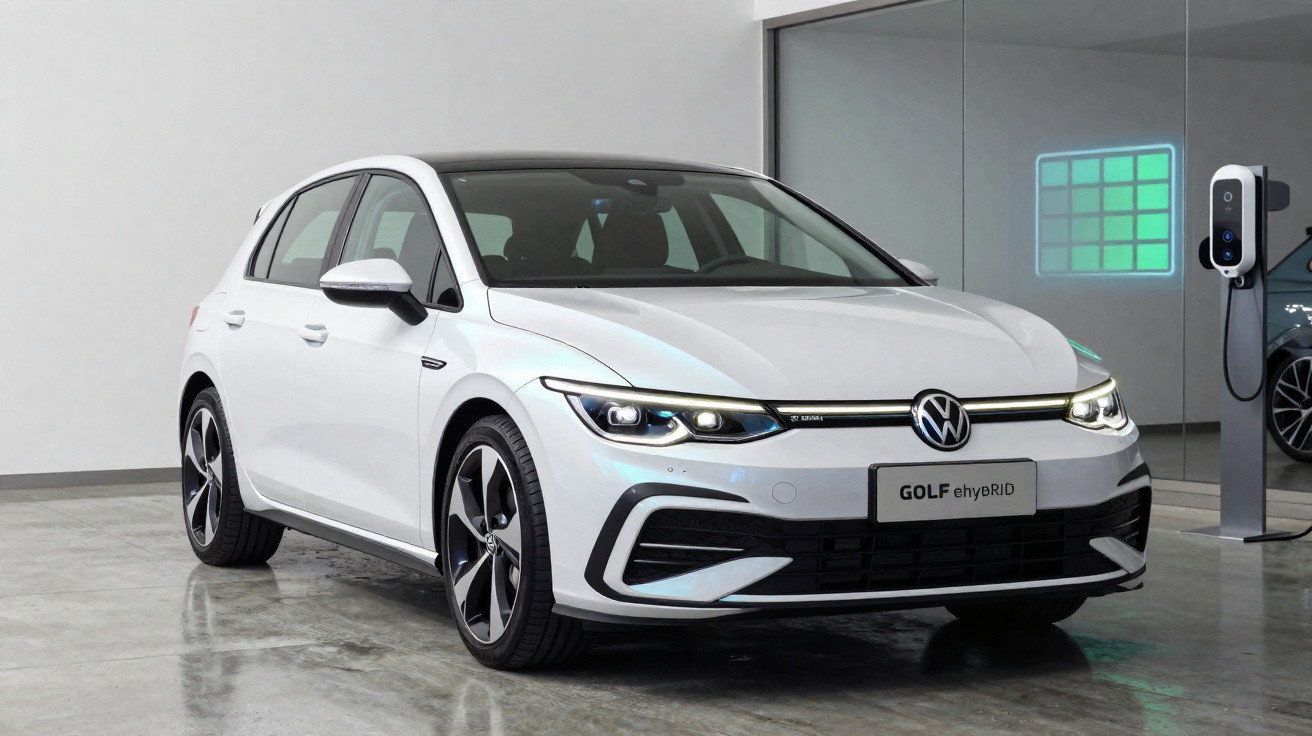
With 143 km of range, the Volkswagen Golf eHybrid makes us ask whether we really need an electric car.
The Volkswagen Golf MK8 recently received a very welcome update - a timely one, given that this generation has been with us since 2020. As expected, it brings refreshed styling, a stronger technology package and a few further changes here and there that only the most observant will spot.
Volkswagen has gone a little further than that, though - in fact, considerably further. The key developments are found beneath the bonnet of this Volkswagen Golf 1.5 eHybrid PHEV.
At the heart of them is a new pairing of the 1.5 eTSI engine and a battery pack that is almost twice the size of that in the Golf PHEV we knew previously: rising from 13 kWh to 25.7 kWh. Predictably, electric range has almost doubled too.
The familiar Golf
As you might expect, identifying this Volkswagen Golf MY2026 from the outgoing version is not easy from the outside, as the visual revisions are very slight. Golf owners will welcome that, since it helps preserve stronger residual values on the used market.
In truth, the list of changes is short. The bumper has been reshaped and the headlights are slimmer; optionally, they can be connected by an LED light strip, with an illuminated brand badge too. You simply need to spend a little more.
That was not the case, aesthetically speaking, with the car we tested.
There are newly designed alloy wheels and, on the Life version tested, they measure 17 inches. They are not especially attractive, but they strike an excellent balance between comfort and handling.
Inside, the revisions are even more understated, although they matter more. The central display has grown to 12.9 inches, while its updated graphics make it marginally easier and more intuitive to use. Meanwhile, every trim level now receives digital instruments. And physical buttons are making their way back into the Golf’s cabin.
It is a cautious return, but a noticeable one: the steering wheel no longer has the haptic controls fitted to certain versions of this Golf generation. It may not sound significant, but it makes a considerable difference, particularly while driving.
Those haptic controls responded not only to pressure but also to touch, which made them particularly awkward to operate. A stray touch was enough to activate a function unintentionally.
Otherwise, “if it isn’t broken, don’t fix it”. Material quality remains strong, the cabin is spacious and the construction feels very solid, with no unwanted rattles.
The main criticism concerns boot capacity, which is limited to 273 litres - 108 litres less than in combustion-only Golf models. That reduction is explained by the eHybrid’s battery, which has to be housed beneath the boot floor. It is the trade-off for such substantial electrification.
Volkswagen Golf eHybrid: it feels like an electric car
The Volkswagen Golf eHybrid’s “crown jewel” sits beneath the bonnet. The previous 1.4 TSI has “left the stage” to make way for the current 1.5 TSI - the same engine used in petrol-only versions, but incorporated into a plug-in hybrid system.
If you charge it regularly, you will barely notice the engine. Battery capacity has doubled to 25.7 kWh, almost doubling the electric-only range too: from a respectable 72 km to a significant 143 km. To put the battery’s size into perspective, the first-generation Nissan Leaf had a smaller battery.
With figures like these, do we really need an electric car? For businesses, the answer to that question is almost always the same, for tax reasons, but it is an even more relevant consideration for private buyers.
This Golf 1.5 eHybrid PHEV is an excellent alternative because it combines the pleasant driving experience of an electric car with the freedom to undertake long journeys without relying on public charging.
And, given that most people cover an average of 30 kilometres a day, it should be possible to charge it almost exclusively at weekends.
Typically German
It also displays the familiar traits of other German cars, including high levels of stability and predictability on the road. In the Golf’s case, it can even be entertaining when driven more briskly, helped greatly by the system’s combined output of 204 PS and 350 Nm of torque.
Those figures do not come at the expense of efficiency. I never recorded more than 3.0 l/100 km in mixed driving, covering both town and motorway use, even though the battery had already ceased to assist for much of the route. More than 350 km were covered in total.
In any case, the system prioritises electric driving whenever possible and remains consistently efficient. Naturally, once the battery is depleted, consumption will be higher and can exceed 5.8 litres on the open road - although those figures are still competitive.
Light controls also highlight the car’s agility and comfort. The steering is direct and accurate, while the suspension deals impressively with this version’s more than 1.6 tonnes without ever becoming harsh.
Competitive price, but…
The Volkswagen Golf eHybrid Life, like the example tested, is the most affordable model in the range with the plug-in hybrid powertrain, with prices starting at €41,752. That is the list price, but it is worth watching for offers.
Its standard equipment list is sufficiently comprehensive, although it does not include any luxuries. It covers 17-inch alloy wheels, three-zone climate control, adaptive cruise control, a 12.9-inch central display, front and rear parking sensors, a reversing camera and full-LED headlights.
Before reaching a final figure, consider whether you will buy your Golf privately or through a company. Alongside any available offers, that may be the calculation that makes the difference.


Comments
No comments yet. Be the first to comment!
Leave a Comment