
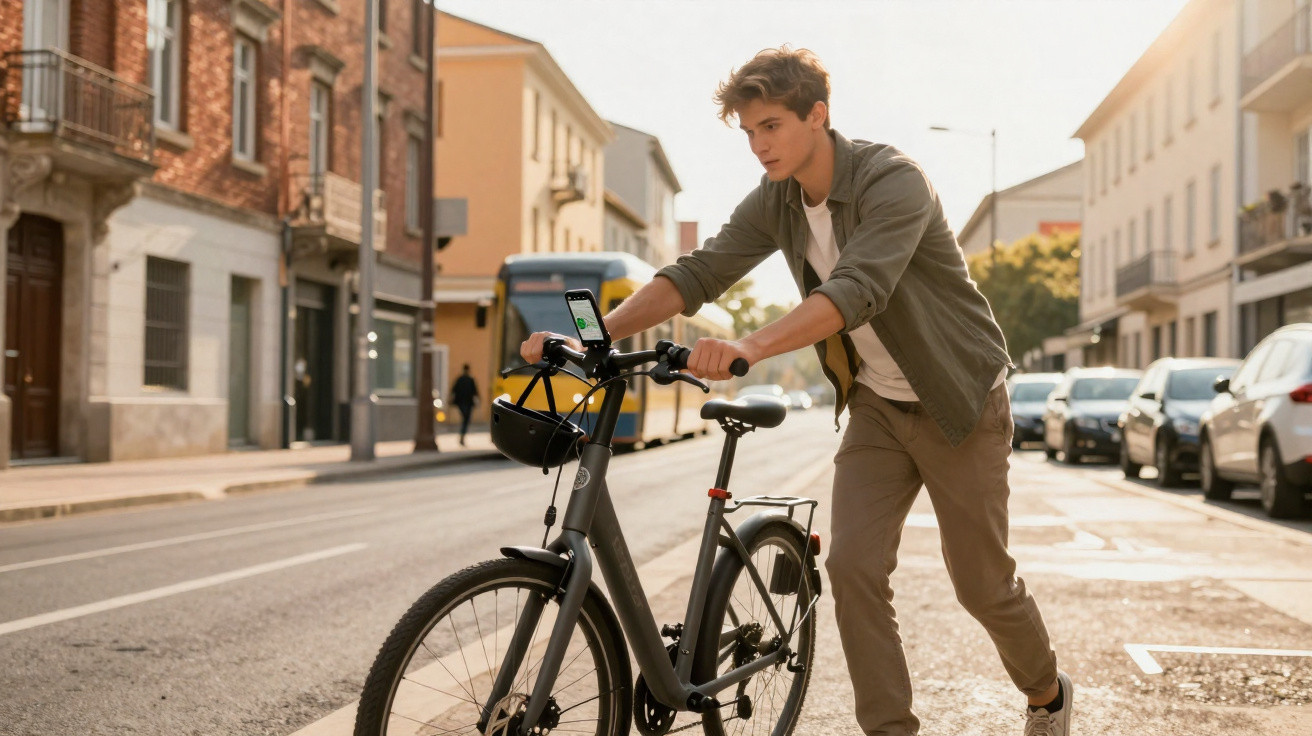
Having won over the streets of New York, Clip Bike, the start-up co-founded by Frenchman Clément de Alcala, is now arriving in France. Its idea? A unit that electrifies any bicycle in three seconds. We spoke to the entrepreneur determined to make electric mobility more widely available without forcing people to replace their existing equipment.
Most of us have an old bicycle or a dusty mountain bike sitting unused in the garage. Yet, for many people, switching to electric means giving up that sentimental possession and spending €2,000 on a heavy, complicated machine. Clip Bike aims to remove exactly this obstacle. Established in 2018 between Brooklyn and France, the company offers a removable unit that clips onto the front fork and drives the wheel through friction.
“The idea was to roll out e-bike technology at a fraction of both its cost and its complexity, across different parts of the world,” Clément de Alcala, Clip Bike’s COO and co-founder, told Presse-citron in an interview. The entrepreneur also draws on his experience in East Africa to offer an adaptable solution. “Over there, a bicycle is often the only reliable connection between towns and villages. We wanted to create a straightforward way to modernise the existing global bicycle fleet, whether in Paris, Nairobi or New York,” he says.
No tools, no cables
Although electrification kits are already on the market, they are often reserved for confident DIY enthusiasts. Users may need to replace a wheel, fit a pedal sensor or run a battery cable along the frame - a technical hurdle for many. “Clip is the first and only plug and play system for converting a conventional bicycle without any tools or pre-installation,” Clément de Alcala insists.
The device takes the form of a compact unit weighing 3 to 4 kilograms: according to Clip Bike, users simply open it, secure it around the fork, and the job is done. Assistance is controlled using a small handlebar-mounted control. “Today, an electric bicycle with an 80-kilometre battery seemed to us too advanced and too expensive a solution for actual needs,” the executive notes. In reality, 50% of urban journeys are under 5 kilometres. “Clip provides substantial assistance: *effort is reduced by 70% uphill, even when carrying weight. It lowers the main barrier to cycling - exertion and sweating***,” the COO continues.
Another benefit is protection against theft, a genuine scourge in many major cities. As the kit can be removed in moments, users can take it with them to the office or when visiting friends. “You are no longer constrained by having to leave an expensive bicycle parked in the street,” he says.
From Brooklyn to Marseille: a strategic homecoming for Clip Bike
Following two years of intensive testing in the United States, where Clips are ridden “from Alaska to Puerto Rico”, the start-up decided the time had come to target Europe. For Clément de Alcala, it is also a genuine return home. “** The European market has always been our number-one market. It is far more mature than the USA when it comes to e-bike technology,”** he explains.
To support the launch, the business is setting up in the south of France. “We are establishing ourselves structurally by creating a design and engineering office near Marseille. This will allow us to develop new products.” Pre-orders are already open on the French website, with deliveries scheduled for June 2026. “We can feel the revolution is under way. In Europe, people have become knowledgeable enough to understand that alternatives to the all-in-one electric bicycle are possible,” the entrepreneur observes.
Replacing the car in the city
Clip Bike also intends to position itself as a solution supporting sustainability by bringing together environmental and economic transition. On service life, Clément de Alcala is reassuring: “For components other than the battery, we have had virtually no returns; some Clips have been used every day for three years.”
The battery, the crucial component, is designed for around 500 charging cycles - equivalent to two to three years of intensive use before performance declines. However, Clip is already looking further ahead. “In the future, we want to bring the ‘re-packaging’ of our batteries in-house to extend their life,” the executive announces.
Looking ahead, Clip Bike does not intend to stop with conventional city bicycles. The Marseille offices are already working on promising segments. “There is a real role to play in replacing the car in the city. Bicycles intended for families or professionals are currently very inaccessible because they are too expensive,” Clément de Alcala points out. It is a circular-economy bet arriving at a timely moment, as the urban transition seeks fresh momentum.


Comments
No comments yet. Be the first to comment!
Leave a Comment