
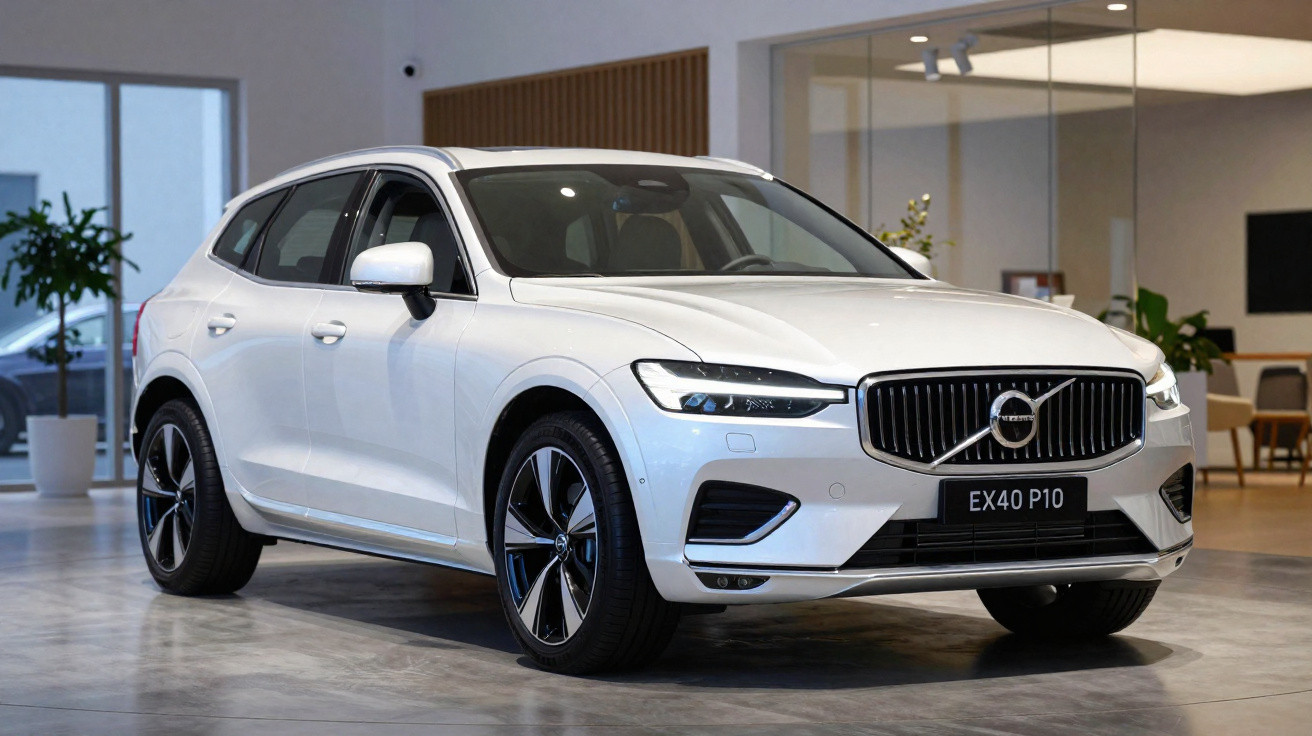
The new Volvo EX60 represents a significant milestone in the brand’s almost 100-year history, showing that its in-house development expertise remains as active as it was before the Chinese Geely Group acquired it nearly 15 years ago.
This new electric SUV introduces the SPA3 architecture. Contrary to what might have been expected, the brand’s first platform designed from the outset for electric models was not ‘imported’ from China: it was developed by Volvo itself. Although Chinese manufacturers lead the global electric-propulsion field, the Swedish marque is understandably proud to have been given the green light to take responsibility for its development.
This time, the Swedish architecture will later be used by other models within the Geely universe, as well as underpinning future Volvos for at least the next decade.
However, as Anders Bell, Volvo’s chief technology officer (CTO), tells me with evident pride, it no longer really makes sense to refer to it simply as a platform:
“(…) I cannot tell you that it will be the platform for every new car, but it establishes the same principles that those models will use, in terms of software, electrical voltage, batteries mounted directly in the body (cell-to-body) and without modules, mega casting construction, and so on.”
- Anders Bell, Volvo chief technology officer (CTO)
Volvo EX60 sets a new range benchmark
The new Volvo EX60 is the brand’s eighth electric model, and its fifth SUV, developed entirely from scratch as an EV. That puts it in a strong position in the premium segment, where it will take on the forthcoming BMW iX3 and Mercedes-Benz GLC EQ, alongside the Audi Q6 e-tron, which is already on sale.
It is therefore unsurprising that it uses an 800 V electrical system, crucial both for improving energy efficiency and enabling very high-power, and consequently faster, direct-current (DC) charging.
Three powertrain versions will be offered:
- P6 RWD - 80 kWh battery, 620 km range, one rear motor (rear-wheel drive), 275 kW (374 hp);
- P10 AWD - 91 kWh battery, 660 km range, two motors (one per axle and all-wheel drive), 375 kW (510 hp);
- P12 AWD - 112 kWh battery, 810 km range, two motors (all-wheel drive), 500 kW (680 hp).
In the EX60 P12, the rear motors are higher-output PSM units (permanent-magnet synchronous motors), while the front motors are more efficient ASM units (asynchronous induction motors). If its 810 km range is confirmed in final homologation, it will become the world’s longest-range electric SUV, albeit by a slim 5 km margin over the BMW iX3 50 xDrive, which we have also tested. This is based on consumption figures that Volvo’s Swedish engineers estimate at between 14.7-16.0 kWh/100 km.
Charging times should also appeal to many prospective buyers. Every version can charge at 22 kW on alternating current (AC), while the range-topping P12 reaches 370 kW on direct current (DC). That means a 10% to 80% battery recharge takes 20 minutes and, more importantly, 340 km of extra range can be added in only 10 minutes.
These are highly competitive figures, matched only by the newest and most advanced electric cars in the world. For comparison, over those same 10 minutes, the Mercedes-Benz GLC EQ claims 303 km of additional range and the BMW iX3 claims 372 km.
Significant interior progress
On the outside, familiar Volvo SUV features remain, including the Thor signature front lights. The front end is now grille-free, though, while the vertical rear light clusters are offset between their upper and lower sections.
The cabin likewise combines tradition with modernity. Inside the Volvo EX60, fabrics, areas trimmed in synthetic or natural leather, and wood come together in a characteristically Scandinavian and distinctly Volvo concept.
The robust build quality and soft-touch materials come as no surprise, but there are notable changes. The first is the recessed instrument display, recalling an MPV arrangement, which encourages the driver to view the information above rather than through the steering wheel.
Volvo EX60 infotainment screen switches to landscape
Another new feature is the 15.4-inch central infotainment display, which is mounted horizontally, whereas Volvo normally uses vertical screens. It runs new software with previously unseen graphics and layout logic, always within the Google ecosystem. Volvo was one of the first car brands to adopt it globally.
The EX60 also debuts a seat belt that adjusts to the user’s physique and the type of impact involved, allowing it to adapt in the most appropriate way.
The generous open space between the front seats stands out. It incorporates an area where a bag can be placed, plus a versatile central storage module with several compartments, which also houses two wireless mobile-phone charging pads.
This five-seat interior also offers generous second-row passenger space, particularly for legroom and headroom: a passenger measuring 1.9 m tall can travel without messing up their hair. This is also a result of a wheelbase that is 10.5 cm longer than that of the XC60.
Riding as a passenger at Hällered
At Volvo’s Hällered test track, around 60 km from Gothenburg in Sweden, we had the opportunity to travel aboard the EX60 P10, the mid-range version with an impressive 375 kW (510 hp) and 710 Nm. This was also the standard EX60 rather than the more off-road-focused Cross Country, which will not arrive until the end of the year.
Acceleration is instantaneous, which is no surprise given the immediate delivery of 710 Nm of torque across both axles, and the claimed 0-100 km/h time of just 4.6s seems entirely believable. This is despite the top speed being limited to 180 km/h.
The front suspension uses double wishbones, while the rear is also independent but uses a five-link layout. The entry-level P6 has conventional steel suspension. Air springs are optional on the P10, which already features variable electronic dampers. The P12 comes standard with variable dampers and air suspension.
With the steel suspension, frequency-selective dampers (FSD) are used. They automatically alter their damping force according to vibration frequency, providing a good balance between comfort and stability without electronic assistance.
Dynamics give very positive early signs
Volvo has not yet allowed us to drive the new EX60, but the passenger ride provided some interesting initial impressions on two of the Swedish brand’s test routes: one more winding, the other with a rougher surface.
On the former, it confirmed a well-judged balance of comfort and stability, while the EX60 appears to handle like a car considerably lower than the 1.64 m height listed in its technical specification.
Its 2.3-tonne weight is also well disguised, thanks to a balanced, almost even, front-to-rear weight distribution and its effective handling. There is little tendency to lose traction, even when the test driver slightly overdid the speed on turn-in.
On the latter route, the variable damping proved convincing over both small imperfections and larger undulations on the test track. No structural noises could be heard during substantial weight transfers or acceleration while heavily loaded up in a corner.
It is not yet possible to comment on the steering or braking response, nor on the operation of the four regenerative-braking levels, from zero to One pedal. To select them, however, drivers will have to use the central display, as there are no steering-wheel paddles to control them.
How much will it cost?
In Portugal, the new Volvo EX60 will arrive from late summer with an entry price of €67,906 for the P6. This price deserves attention: the version sits between €7,000 and €10,000 below its direct German rivals. It was a clear strategic decision for a model that must take on a central role in the Swedish brand’s range, just as the combustion-engined and hybrid XC60 already does.
Orders are already open and are exceeding every expectation. For the first time in its 99-year history, Volvo is considering cancelling one of the summer production shutdown weeks at its Torslanda factory, near Gothenburg, because the waiting list for delivery has already exceeded eight months. For some versions, it reaches 17 months.

Comments
No comments yet. Be the first to comment!
Leave a Comment