
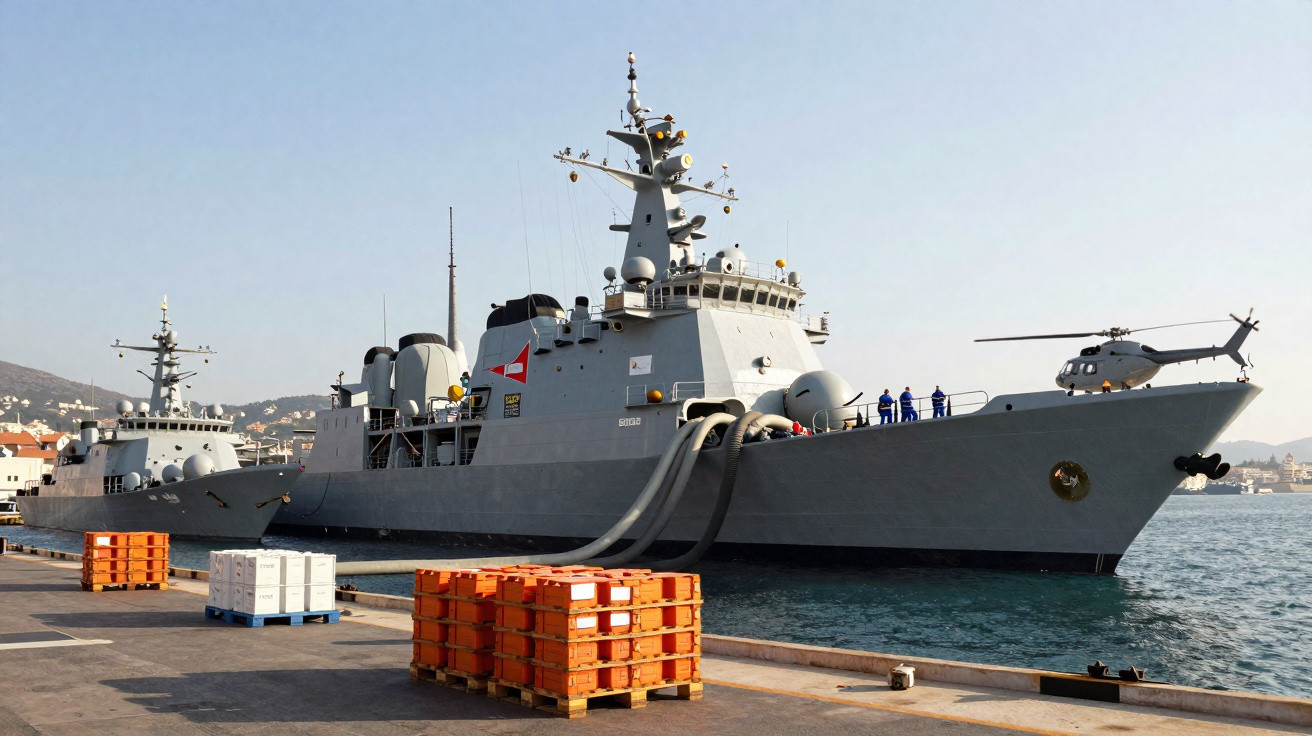
Off Toulon, a massive grey silhouette has entered service with little fanfare. It was not built to fight, but to enable others to continue fighting.
France has commissioned a new generation of support ship: a 31,000-tonne giant intended to keep carrier groups supplied with fuel, munitions and stores far from home for weeks at a time. It changes the way Paris can project naval power.
A discreet giant arrives in Toulon
On 31 July 2025, the fleet replenishment vessel BRF Jacques Stosskopf arrived and anchored in Toulon after completing sea trials, attracting almost no public attention. Measuring 194 metres and displacing 31,000 tonnes, she joins her sister ship, Jacques Chevallier, which was delivered in 2023.
Together, the two vessels represent the revival of French naval logistics, replacing the ageing Durance-class tankers that had been in service since the Cold War. While this may appear to be a technical replacement, French admirals regard it as a strategic change: even the most sophisticated warships are merely costly metal shells without fuel and ammunition at sea.
The Jacques Stosskopf gives French and allied warships the ability to stay on station for weeks, without needing a friendly port.
Toulon is the obvious home port for the first two new support vessels. It is home to the aircraft carrier Charles de Gaulle, as well as numerous French destroyers and frigates. A further two ships are due to be based in Brest, on the Atlantic coast, by 2030, giving both of France’s principal naval approaches their own logistical foundation.
A Franco-Italian bet on shared naval power
The Jacques Stosskopf was not designed from scratch. It is France’s adaptation of a vessel already constructed in Italy, derived from the Vulcano replenishment oiler. Under the joint FLOTLOG programme, Paris and Rome chose to share design work and certain components, while adapting each ship for national requirements.
OCCAR, a European defence procurement organisation, manages the project, while Italy’s Fincantieri leads the industrial design work. The programme reinforces Europe’s naval industrial base and means that neither navy must bear the full cost of developing a bespoke ship alone.
Four French ships are planned: two in Toulon and two in Brest, giving France a permanent logistics presence in both the Mediterranean and the North Atlantic.
The partnership also carries an unmistakable political message. By operating a modern class of large support vessels, France demonstrates its intention to remain among the few nations capable of deploying a carrier strike group, amphibious forces and escorts far beyond its shores without relying on others for fuel or supplies.
Inside a 31,000-tonne logistics machine
The unassuming label “replenishment vessel” conceals an exceptionally concentrated range of capabilities. In effect, the Jacques Stosskopf combines a floating fuel depot, warehouse and compact workshop within one hull.
- Up to 13,000 m³ of fuel, including naval diesel and aviation kerosene
- About 1,500 tonnes of solid cargo, including ammunition, spare parts, food and humanitarian aid
- High-capacity transfer equipment capable of moving around 1,200 m³ of fuel per hour at sea
- Diesel-electric propulsion producing 24 MW and a speed of around 20 knots
During replenishment at sea, the ship comes alongside a frigate, destroyer or the aircraft carrier. Long hoses are passed across on cables, allowing fuel to be pumped at a high rate while both vessels hold their course and speed. Cranes and pallets can transfer solid supplies, while helicopters may sometimes move loads from one deck to another.
Its hull has a double bottom and side protection, satisfying stricter environmental requirements and lowering the risk of pollution after an accident. Such protection is important when the vessel is operating in sensitive waters or near vulnerable coastlines.
More than a floating petrol station
Although its principal role is support, the Jacques Stosskopf is equipped with a modern combat system. Its Polaris system, paired with a Terma Scanter 6002 surveillance radar and Safran Paseo XLR electro-optical sensors, provides the crew with a detailed view of air and surface activity nearby.
The vessel can control its own close-in weapons, exchange tracks with allied forces and contribute to tactical situational awareness. This makes it less dependent on escorts in low-threat settings and allows it to play an active role in a naval task group’s sensor network.
Armed mainly for self-defence and surveillance, the ship is designed to survive in contested waters long enough to keep the fleet supplied.
Backbone of expeditionary forces
The new BRFs are more than French national assets. Designed to NATO and EU interoperability standards, they can refuel allied vessels. European frigates, US destroyers and even non-NATO partners could, in principle, pull alongside for fuel and supplies where political conditions permit.
Space on board is allocated for an embarked staff, allowing the ship to serve as a temporary command node in multinational operations. Its workshops and specialist personnel can repair damaged equipment and maintain helicopters and small craft.
The ship may also operate in EMCON modes, reducing its radar and radio emissions. This lowers the likelihood of detection by opponents monitoring electromagnetic signatures, an increasing concern in any high-end maritime conflict.
Key dates and ships in the French BRF programme
| Ship | Delivery | Home port | Status |
|---|---|---|---|
| Jacques Chevallier | 2023 | Toulon | Operational |
| Jacques Stosskopf | Late 2025 | Toulon | Being accepted into service |
| Émile Bertin | Early 2030 | Brest | Under construction |
| Gustave Zédé | Before 2031 | Brest | Planned |
This quartet is central to France’s latest military spending law, which specifically seeks to safeguard “maritime sovereignty” and freedom of action. The older replenishment vessels did not offer the capacity, survivability or endurance required for missions close to contested areas or in the Indo-Pacific.
By renewing its support fleet, France keeps its aircraft carrier and escorts viable tools for long-range operations well into the 2030s and 2040s.
Preparing for a new generation of carrier groups
The timing is deliberate. France is developing its next-generation aircraft carrier, which is intended to replace Charles de Gaulle during the 2030s. A larger and more capable carrier operating heavier aircraft will demand greater quantities of fuel, munitions and spare parts.
The Jacques Chevallier, Jacques Stosskopf, Émile Bertin and Gustave Zédé are being constructed with that future requirement in mind. Their design allows for greater throughput, more demanding aviation-fuel requirements and the logistical burden associated with modern networked warships.
They are also intended for so-called hybrid conflicts, in which conventional naval engagements combine with cyber attacks, GPS jamming, drone swarms and information warfare. In such a complex environment, logistics vessels that combine resilience, discretion and strong situational awareness become essential assets.
Why support ships matter more than most people think
Combat vessels make the headlines, whereas tankers and supply ships seldom do. However, naval history contains many cases in which fleets with superior firepower lost momentum because fuel, food or munitions ran out at the worst possible moment.
During a crisis in the Baltic, the eastern Mediterranean or the Indo-Pacific, a French or allied task group could need to remain at sea for weeks, far from a friendly harbour. A large replenishment vessel can travel between the group and a secure logistics hub, sustaining operations without requiring front-line units to leave the area for resupply.
There are risks, too. A support vessel is a high-value target, and disabling one can cripple a task group without directly engaging its carrier or destroyers. That is why the design places such emphasis on self-defence systems, electronic warfare, decoys and coordination with escorts.
From peacetime missions to high-end conflict
In peacetime, a vessel such as Jacques Stosskopf can support humanitarian assistance and disaster-relief operations. Its fuel, fresh-water production, cargo capacity and medical spaces can assist relief work near devastated coastal regions, particularly when port infrastructure has been damaged.
In a high-end conflict, the same capabilities would serve a markedly different purpose. Several replenishment vessels could alternate between a distant theatre and a secure base, forming a “logistics bridge” at sea. Should one ship have to withdraw, the others could maintain the chain and allow the carrier group to remain on station.
Two ideas underpin the thinking behind these vessels: “endurance” and “autonomy”. Endurance describes how long a task group can stay deployed without major resupply from land. Autonomy denotes the political and military freedom to act without depending on another nation’s ports or tankers. The Jacques Stosskopf reinforces both, not only for France but also for any coalition it chooses to support.




Comments
No comments yet. Be the first to comment!
Leave a Comment