
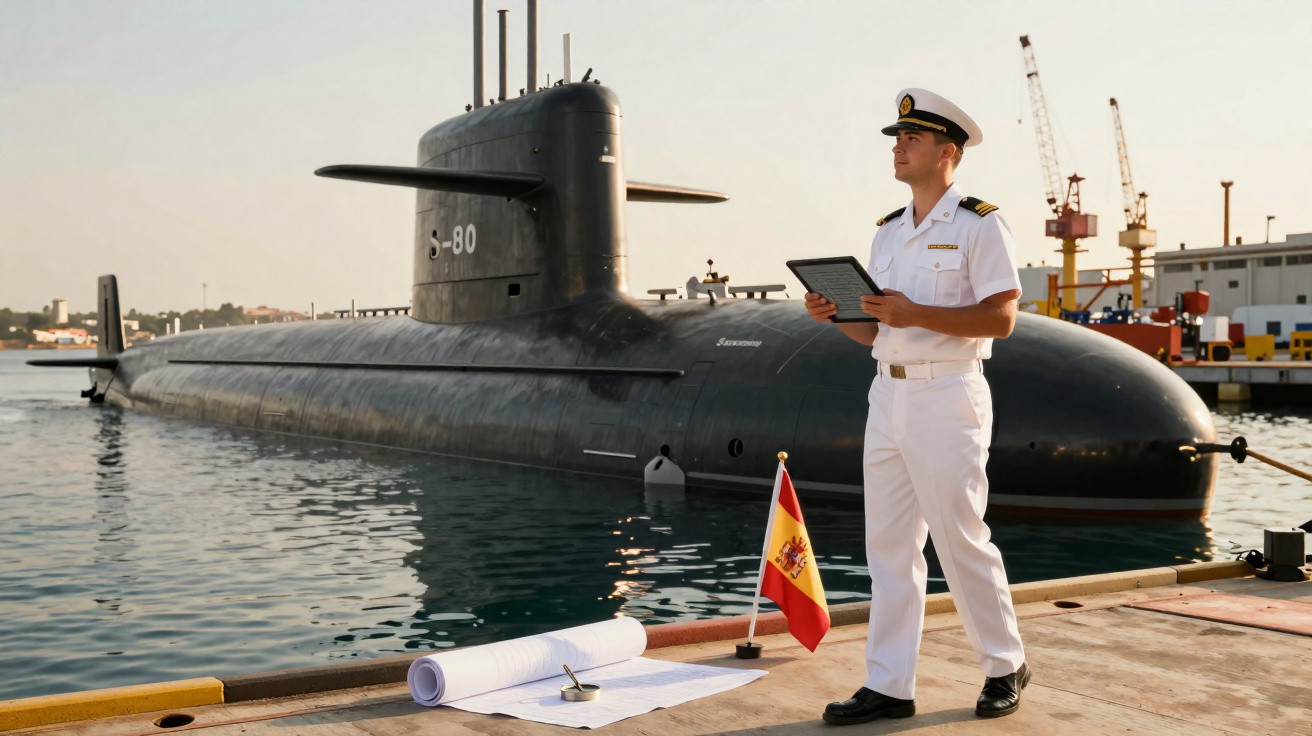
Having reached significant milestones during 2025, the Spanish Navy and Navantia’s S-80 Plus submarine programme continues to make steady progress. Alongside the multinational exercises undertaken by the class’s lead boat, the S-81 Isaac Peral, the second submarine in the class, the S-82 Narciso Monturiol, is also moving forwards and is currently undergoing harbour trials.
S-82 Narciso Monturiol harbour trials
Launched at Navantia’s Cartagena facilities in early October last year, the S-82 Narciso Monturiol has been progressing through trials and preparations since November. Their ultimate purpose is to enable delivery to the Spanish Navy, which, according to previous announcements, is expected to take place during 2026.
On 20 March, Spain’s Ministry of Defence issued its latest update on the S-82’s harbour trials through its social media channels, confirming that the submarine had started its diesel engines for the first time.
It added that this was a “...new milestone in the harbour trials that brings this submarine a little closer to its delivery to the Spanish Navy”.
Testing programme and next milestones
As was the case with the S-81, the trials being carried out on the Narciso Monturiol are part of a comprehensive and demanding schedule. Every system must be tested, including propulsion, power generation, communications, sonar and weapons systems.
Although no further details were provided, it is likely that one of the next milestones following the start-up of the submarine’s diesel engines will be its first surface voyage. This could subsequently lead to operations in open waters ahead of its first controlled dive.
AIP systems for the S-83 and S-84
Finally, the last two boats ordered for the Spanish Navy - the Cosme García (S-83) and the Mateo García de los Reyes (S-84) - will chiefly be distinguished by the installation and integration of new third-generation AIP (Air Independent Propulsion) systems, increasing the class’s endurance and broadening its capabilities.
Photographs used for illustrative purposes.

Comments
No comments yet. Be the first to comment!
Leave a Comment