
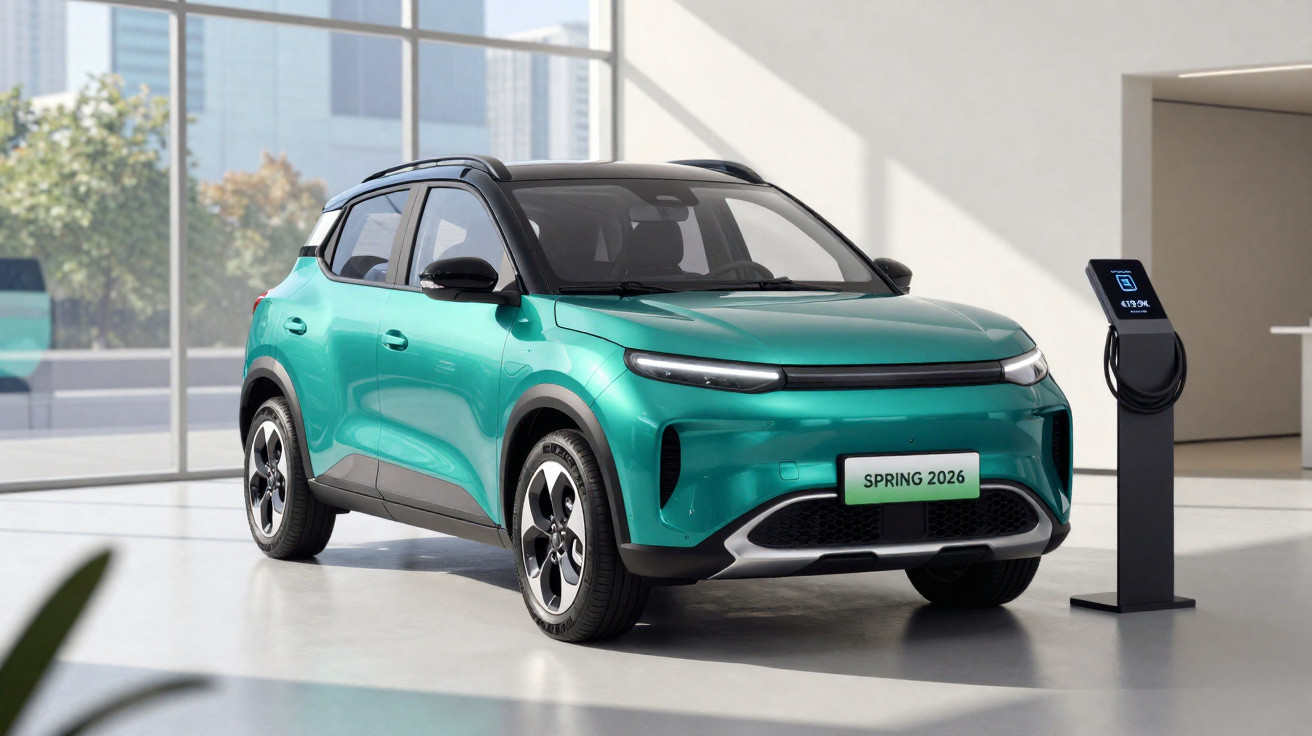
Now with 100 hp, the Dacia Spring can tackle a stretch of motorway or an overtaking manoeuvre with confidence.
Almost everything has already been said about the Dacia Spring: it is a small, affordable electric car that honestly gets the job done on the daily commute.
For many drivers, it has been their entry point into all-electric motoring, not least because it has remained the cheapest electric car on sale in Portugal year after year.
It is therefore no surprise that it has recorded almost 200 thousand sales across Europe since its 2021 launch. Whether you like the concept or not, the Spring is a genuine success story.
However, times change, as do customer expectations. In 2021, the Spring stood alone among new electric cars priced below 20 thousand euros; that is no longer the case. And that is before considering the growing and increasingly attractive used-car market.
Dacia knows this as well as we do, which is why it gave the model a major update in 2024: a new exterior look, a transformed interior, improved ride comfort and an even lower price. You can see it in detail, inside and out, in this video:
That move breathed fresh life into the model, with an immediate effect on sales. As well as leading its segment in Europe, the Spring became Portugal’s best-selling electric car among private buyers in 2025, with 715 registrations - 220% more than in 2024.
But the Romanian brand wants more. It has now unveiled what could be the Spring’s final update, before another small electric car based on the Twingo from sister brand Renault joins it shortly.
More power, a new battery, an updated platform and, for the first time, an anti-roll bar. On paper, it has everything required to become the best Spring yet. But is that really the case? We drove it to find out.
Better in (almost) every respect: the Dacia Spring
Although it is only an annual update, the 2026 Dacia Spring has made progress in several areas. And, as you will see, many of the changes are significant.
First up are two new electric motors: one with 52 kW (71 hp) and another producing 75 kW (102 hp). They deliver 20% more torque, for a total of 137 Nm, between 80 km/h and 120 km/h.
That may not sound like a great deal, but the original Spring managed no more than 33 kW (45 hp), so its output has more than doubled. That matters. I know 100 hp will not impress anyone, but the Spring weighs little more than a tin of tuna at 1069 kg, and that extra power makes a genuine difference.
It feels more responsive, safer and more versatile. This power increase finally takes the Spring beyond city limits: it is no longer intimidated by a section of motorway or a more demanding overtaking manoeuvre. It is also sharper than ever in urban traffic.
The change I welcome most, though, is the addition of an anti-roll bar, fitted as standard on every version. This is accompanied by revised spring and damper settings, along with improved brake-system assistance.
The result is a more stable and more composed car through corners, with less body roll. It makes the driving experience feel more natural, safer and easier to predict.
Range remains an issue
Another major change concerns the completely new battery. Previously, it used NMC chemistry (nickel, manganese, magnesium) and had a 26.8 kWh capacity; it is now an LFP (lithium iron phosphate) unit with “just” 24.3 kWh.
Even with the reduced capacity, the official WLTP range is virtually identical for both versions: 225 km for the new Spring, compared with 228 km for its predecessor. This is explained by the claimed consumption figure of only 12.4 kWh/100 km.
That said, if Dacia continues not to increase the battery capacity - in this case, it has actually reduced it - extracting more kilometres will be difficult. And this range is limited. While the car is now more capable and versatile, it remains an electric vehicle with a restricted operating range.
Take the Renault Twingo, for example: thanks to an LFP battery with a 27.5 kWh capacity, it can travel up to 263 km on a single charge.
What about charging?
There have been improvements here too, albeit modest ones. Direct-current (DC) charging remains optional, as it was before, but the maximum power has risen from 30 kW to 40 kW. That allows a charge from 20% to 80% in 29 minutes.
For alternating-current (AC) charging, the limit remains 7 kW, just as it was in the previous Spring. However, thanks to the management of the new LFP battery, Dacia has cut 40 minutes from the 20% to 100% charging time, which now takes 3h20 min.
Below 20 thousand euros
The Dacia Spring is better and more comprehensively equipped than ever. Of that, I have no doubt. Yet it still has the limitations typical of a segment A car, whether electric or petrol-powered.
In the Spring’s case, the biggest shortcoming is its range - probably its greatest “Achilles’ heel” - especially for anyone without another car at home.
As in so many other cases, it all comes down to expectations. If you are looking for an electric car capable of covering several hundred kilometres every week, the Spring is unlikely to be the answer.
On the other hand, if you want a fully electric car to deal with the 30–40 kilometres you travel to work, can charge at home and do not have major space requirements, this Dacia will always be worth considering.
It is true that this new 100 hp version does not yet have a confirmed price for Portugal, with orders opening only at the end of the month. However, we already know that it will cost less than 20 thousand euros.
While that might once have been a major advantage, it could now make life harder for the Spring, as one of the models attracting the most attention in this segment - its Renault Twingo “cousin” - is also priced in this area.
I have not driven it yet, but I have already seen it in person in Paris, and it has a “wow factor” that the Spring lacks. But make up your own mind:
At the end of the day, I know it will almost always come down to personal taste. However, given that many buyers end up in segment A because of their budget, I think the Twingo has the edge: it is more desirable, more fun and… cooler. Even if the Spring continues to offer an almost unbeatable price/quality/practicality balance in the new electric-car market.
Comments
No comments yet. Be the first to comment!
Leave a Comment