
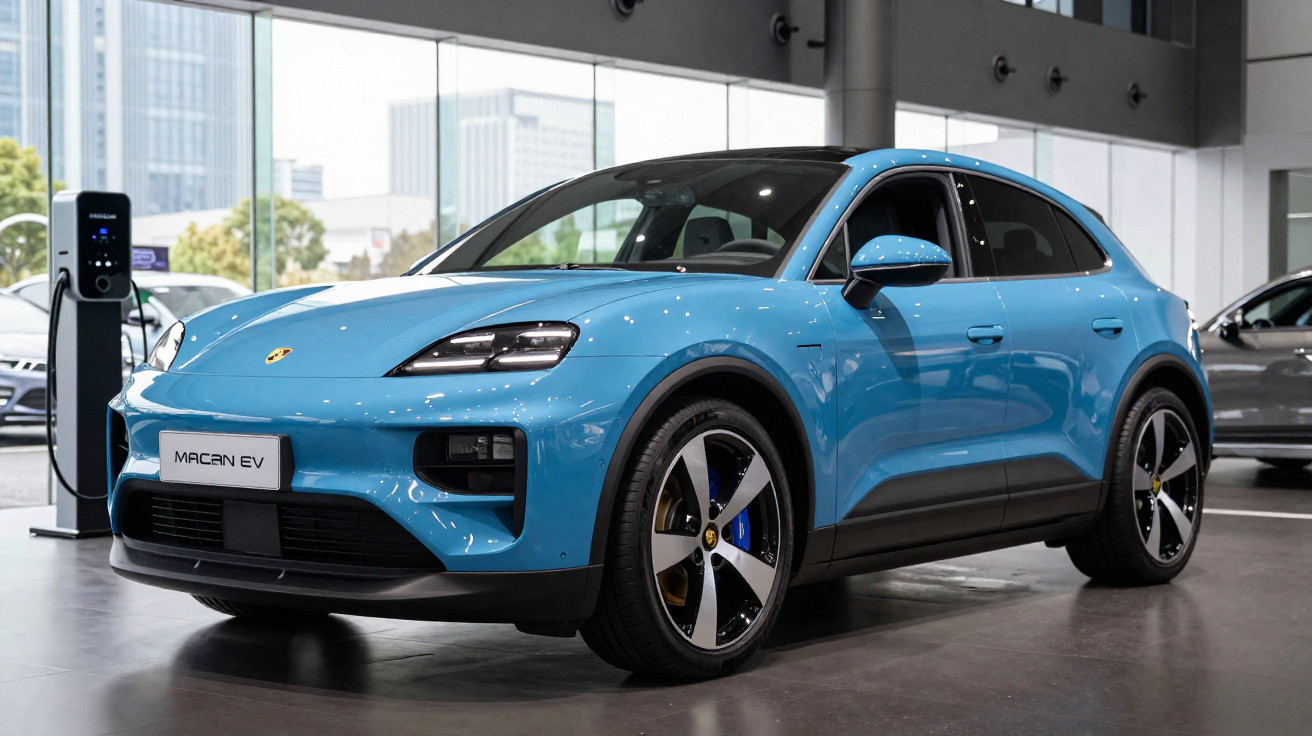
The second-generation Macan has embraced full electrification, but has that taken the sporting ‘soul’ out of this Porsche?
Do not be misled by the badge. The latest Porsche Macan could scarcely be more different from the model we once knew. It is now fully electric, uses the PPE architecture shared with its Audi Q6 e-tron sibling and, in certain versions, tips the scales at almost two and a half tonnes.
I know: that is not what we are accustomed to associating with the Macan name. Perhaps that is why Porsche has reversed course and has already confirmed it will introduce an equivalent combustion-engined SUV, albeit potentially under a different name.
Until that arrives, though, do not dismiss the electric Macan just yet. Its brief remains unchanged: to be the sportiest and most enjoyable SUV to drive in the Stuttgart brand’s line-up. The question is whether it can still deliver that now it is electric. I spent a week with it and found the answer. It may not be what many people expect.
Porsche visual DNA
Although it is marginally longer and wider than the previous generation, one glance at this Macan is enough to recognise Porsche DNA. The raised, rounded wheel arches immediately evoke the iconic 911, while the lighting signatures at both ends are closely related to those of the Taycan.
With no combustion engine beneath the front bodywork, the bonnet is substantially shorter, which also strengthens this model’s robust appearance. Its muscular shoulder line reinforces that impression still further.
A descending roofline is always open to debate in this type of vehicle, where versatility is highly valued. Yet, given Stuttgart’s dynamic ambitions for this SUV, it is easy to understand Porsche’s design team making that choice.
A larger boot
Even so, the silhouette does not appear to have compromised luggage capacity. The electric Macan offers considerably more boot space than the previous combustion-powered Macan: 540 litres compared with 458 litres, before even counting the additional front-compartment storage, which contributes another 84 litres.
That puts it in line with its principal rivals, whether the Maserati Grecale Folgore (535 litres), Audi Q6 e-tron (526 litres) or BMW iX (500 litres). Put simply, the Macan has enough room for a small family’s holiday luggage.
An interior with no major surprises
Existing Porsche customers will find little unexpected inside the new Macan. Build quality is excellent. It does not feature materials as flamboyant as those in the more expensive Maserati Grecale Folgore, but its assembly precision is superior and everything seems to be positioned exactly where it should be, particularly the pair of displays.
I am especially fond of the curved 12.6-inch instrument cluster, which sits perfectly within the driver’s line of sight and can be tailored to individual preferences.
The steering wheel also leaves no room for criticism. It is the same item used across today’s Porsche range and, frankly, it is among the best on the market: an excellent grip, a sensible number of physical controls for the most frequently used functions and a rotary controller for switching driving modes. Everything feels right.
One option I would happily do without
A third 10.9-inch display can also be fitted in front of the passenger. The car I tested did not have this option and, I must admit, I struggle to see its purpose, whatever the model.
Conversely, if I were buying this electric Porsche Macan, the BOSE sound system (costing 1217 euros) would be an essential option. Its sound is rich, clear and exceptionally well distributed throughout the cabin.
On the subject of sound, it is worth noting that the Android Automotive-based operating system provides native access to apps including YouTube, Spotify and Amazon Music, alongside the now-essential wireless smartphone connectivity through Android Auto and Apple CarPlay.
What about passenger room?
We have already considered the luggage space offered by the new Macan, and the verdict was positive. But what is it like for rear-seat passengers? It performs well there too.
Watch, or revisit, the video Diogo Teixeira recorded when this model was unveiled, which shows this in greater detail:
It is a Porsche…
And that says almost everything. Zuffenhausen’s engineers have a particular talent for giving every one of their cars a very distinctive feel.
Whether powered by an internal-combustion engine or one or more electric motors, there is a series of calibrations and sensations that I would describe as common to every model. I mean the accurate steering, brilliantly judged brake pedal and, above all, the finesse with which the car moves. This Macan is no exception.
It has the brute force expected of an electric vehicle with more than 400 bhp, but combines it with precise controls and steering that feels clean and natural, adding an unexpected layer of enjoyment. In this respect, however, I must say it does not quite match, for instance, a combustion-engined Porsche Macan GTS. Still, there is no denying that it is an enjoyable SUV to drive.
Curiously, its 2400 kg actually helps - I never thought I would write that… The very heavy battery is mounted in the floor of the platform, lowering the centre of gravity and helping to disguise this SUV’s less athletic body.
As a result, the Macan is considerably more agile than I anticipated, while retaining the composure and progressive responses that were already qualities of the previous generation.
The chassis is highly capable and, together with the adaptive air suspension (an essential option), gives the Macan a versatility that ultimately makes all the difference.
On a mountain road, the Macan turns eagerly into bends and lets you press the accelerator relatively early to exit with real intent. Its movements are always very well controlled, with no unnecessary drama. On the motorway, at steady speeds, it becomes a refined long-distance car: quiet and comfortable.
It therefore does exactly what Porsche has always wanted the Macan to do. It remains the German brand’s sportiest and most engaging SUV, while the Cayenne - which will also receive a fully electric variant - offers a roomier, more refined and more comfortable proposition.
What is its real-world range?
The test car was a Macan 4, combining two electric motors, one on each axle, for a total output of 300 kW (408 bhp) and 650 Nm of maximum torque. It accelerates from 0 to 100 km/h in 5.2s and reaches a top speed of 220 km/h. Forgive me for being so blunt, but if that is not enough, an electric SUV is probably not for you.
Equally, if not more, interesting is its 95 kWh usable battery, with Porsche claiming a range of up to 613 km on the combined WLTP cycle.
In the real world, however, the 21 kWh/100 km average I recorded during this test would theoretically allow only a little more than 450 km from a full charge. My daily route does include some motorway driving, but I was nevertheless expecting better efficiency.
Naturally, I did better - much better, in fact - on shorter journeys, at lower speeds and in urban areas. It is relatively easy to achieve around 17 kWh/100 km. Range will therefore depend heavily on the type of journeys you make during a day or week.
Would I choose the Porsche Macan 4?
I probably would not choose this version. Unless this level of power and performance is a priority, I think the most appealing Macan may actually be the entry-level model, with 360 bhp and rear-wheel drive. It also provides a little extra range.
That said, as the next step up, the Macan 4 remains what I consider the range’s sweet spot. I find it difficult to justify choosing a Macan Turbo. That is true of the Macan, but I could say exactly the same about the Taycan.
It may wear a Porsche badge, but price is an important advantage for this electric vehicle: the Macan 4 starts at 86 793 euros, while the base version starts at 83 671 euros.
For comparison, an Audi Q6 e-tron quattro in a similar specification costs 82 870 euros. The BMW iX, in xDrive45 form, starts at 87 000 euros, while the Mercedes-Benz EQE SUV 350+ starts at 87 250 euros. And that is before mentioning the Maserati Grecale Folgore, whose range begins at 116 794 euros.
A misstep?
As for the Macan itself, there is no doubt that it is an excellent product. Indeed, taken as a whole, it may even be the best Macan ever. But that alone is not enough to state outright that Porsche has made the right call.
After all, this is a sales and revenue champion within the Stuttgart brand. While sales are going well in Portugal, the same cannot be said in other markets.
Full electrification is not for everyone and, honestly, I do not know whether it ever will be. In today’s market, making a model exclusively electric means limiting it to only a small section of buyers.
We know that and, naturally, Porsche does too. That is why it has scaled back its broader electric ambitions and its plans for this model, confirming an equivalent combustion-engined SUV for 2028.
Is that an admission of error? Probably. But even if it is, the market is to blame rather than the electric Macan, which is an excellent car.
Comments
No comments yet. Be the first to comment!
Leave a Comment