
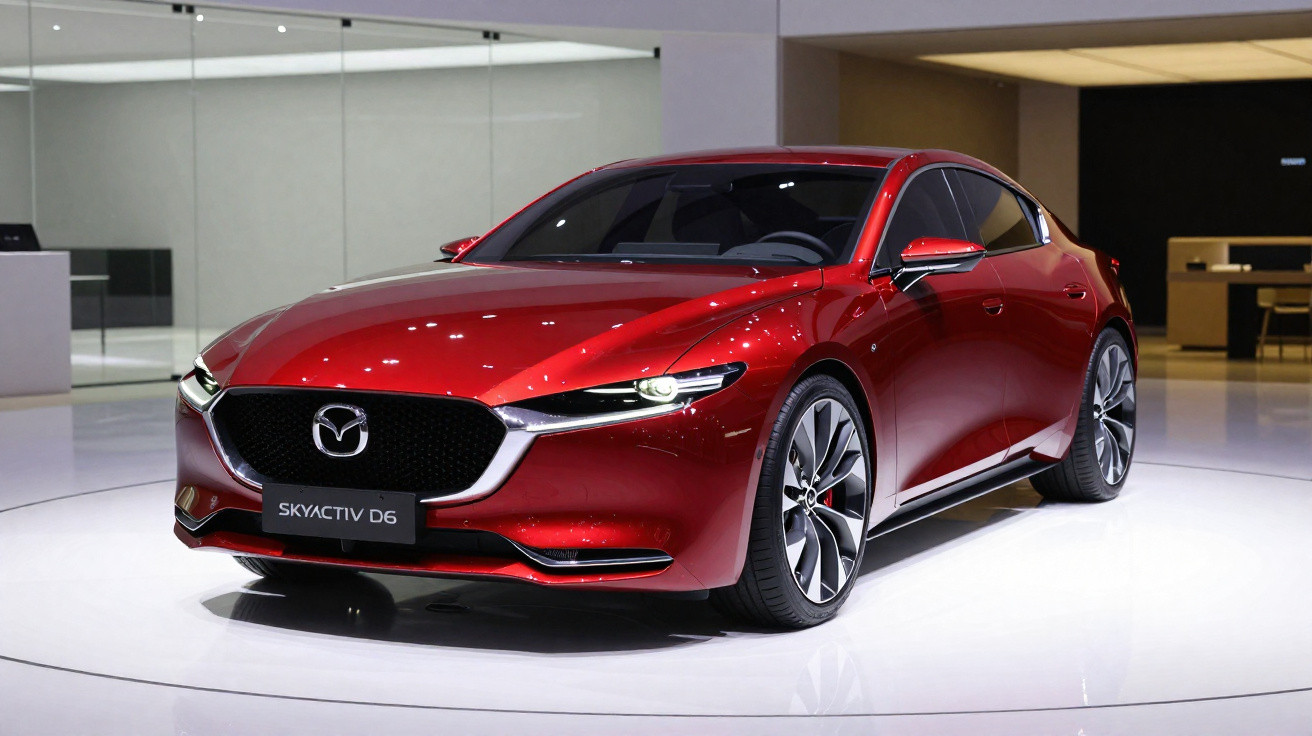
Over the years, Mazda have accustomed us to taking bold decisions. Need some examples?
When every other manufacturer had abandoned Wankel engines, Mazda continued to invest in this engine type - and a new model using this technology will be launched shortly.
More recently, while every manufacturer was reducing engine capacity - the well-known downsizing approach - the Japanese brand chose a different route, increasing the capacity of its engines instead. The reasoning behind that decision can be revisited in this article.
Back in the present, and with little surprise, the story is repeating itself. At a time when virtually the entire motor industry is announcing the end of combustion engines, Mazda is smiling and, cheerfully, once again going against the prevailing trend.
Investment in combustion engines continues
In 2023, Mazda will introduce a new family of high-capacity straight-six engines.
You read that correctly: six cylinders and large engine capacities. One of these new engines will use the Diesel cycle - a technology that has now become unpopular, particularly in Europe.
This bold commitment by the Hiroshima manufacturer was among the subjects covered by Razão Automóvel during the presentation of the new Mazda CX-60, the first model to use this new engine family.
At the event, we spoke to Joachim Kunz, Mazda's Senior Manager Technical Development Co-Creation. He explained why the Japanese manufacturer had decided - yet again - to challenge the dominant direction of the motor industry.
Combustion engines: a kamikaze strategy?
Kamikaze - meaning “divine wind” in Japanese - was the nickname given by the Japanese to aircraft pilots during the Second World War whose mission involved carrying out suicide attacks on Allied ships.
Since then, the term kamikaze has been adopted in several languages, including Portuguese, as a metaphor for people, actions or practices that may have devastating consequences.
Mazda is known for applying Japanese words to the strategies behind its models. Nowadays, almost everyone has heard of the Japanese brand's Kodo design or its Jinba Ittai philosophy.
You can see where this is going…
We asked Joachim Kunz whether the strategy Mazda are pursuing, in the face of the announced restrictions on combustion engines, was not somewhat… kamikaze. Kunz smiled at our provocation, but answered with conviction:
The question prompted a response from another Mazda executive in the room, who had been listening closely to the interview, albeit from a little further away. In just a few words, he summed up the Japanese brand's state of mind:
The tone used by these executives made their conviction clear: on one hand, they believe there is still scope to develop combustion engines and improve their efficiency; on the other, they believe the full electrification of the vehicle fleet - under the terms and timetable set by European authorities - could create constraints for future mobility.
Why six-cylinder Mazda engines?
Having addressed the manufacturer's strategy - and only time will tell whether it is the right one - we turned to the more technical matters. First of all, why six-cylinder engines?
Mazda have always championed engines with larger capacities. There is a rationale behind this choice - already explained in this article - which allows larger engines to be more thermodynamically efficient and, consequently, more environmentally friendly.
That is why Mazda's new Skyactiv-X engine will have six cylinders and, therefore, a 3000 cm³ capacity - the aforementioned 500 cm³ for each cylinder.
It is an entirely new engine and the second to use SPCCI technology, which has already been the subject of several articles here at Razão Automóvel.
Technical specifications have not yet been disclosed, but Mazda promise this engine will deliver fuel consumption equivalent to the four-cylinder Skyactiv-X used in the Mazda3 and CX-30.
The “Super Diesel” is the big surprise
Discussing new engine families is increasingly rare. Discussing new Diesel engines is rarer still, especially six-cylinder units.
Mazda still believe in Diesel technology, not only for the reasons already outlined, but also for one very specific reason: in its home market of Japan, Mazda have topped the sales charts with this technology.
With the Mazda CX-5's 2.2 Skyactiv-D engine, the manufacturer was able to meet that country's emissions standards while offering a viable option for motorists seeking lower running costs.
It will now raise the stakes with an evolution of this engine: a six-cylinder, 3.3-litre “super Diesel”.
We asked Joachim Kunz about the decision to give this Diesel engine an additional 300 cm³ compared with the petrol Skyactiv-X unit using the Miller cycle. Once again, thermodynamic behaviour was the factor behind the choice:
Although the requirements of the future Euro 7 standard - the set of rules determining the levels of emissions permitted from combustion engines in the EU - are still unknown, Joachim Kunz has no doubt that this new engine will meet them in full.
For our part, we can only wait to discover whether Mazda's strategy will prove Shōsha (a winner) or Kamikaze (suicidal).
Experience tells us Mazda usually know what they are doing. Will history repeat itself once again?
Comments
No comments yet. Be the first to comment!
Leave a Comment